




- Pochampally Ikat: Where threads become geometry
- Indrakeeladri decked up for Dasara festivities
- Green Card crackdown major setback for Indian IT giants
- ED seeks day-to-day trial of Jagan in quid pro quo case
- Donald Trump continues to harp on Nobel
- “Haven’t you taken pesticide yet”, tehsildar mocks farmer
- 'Urgent relief': Maha CM Fadnavis directs immediate foodgrain supply to 265 drought-hit talukas
- BJP won bypolls, rejects Opposition's claim that govt is afraid: Assam CM Sarma
A transcendental quest into the unknown
In Short
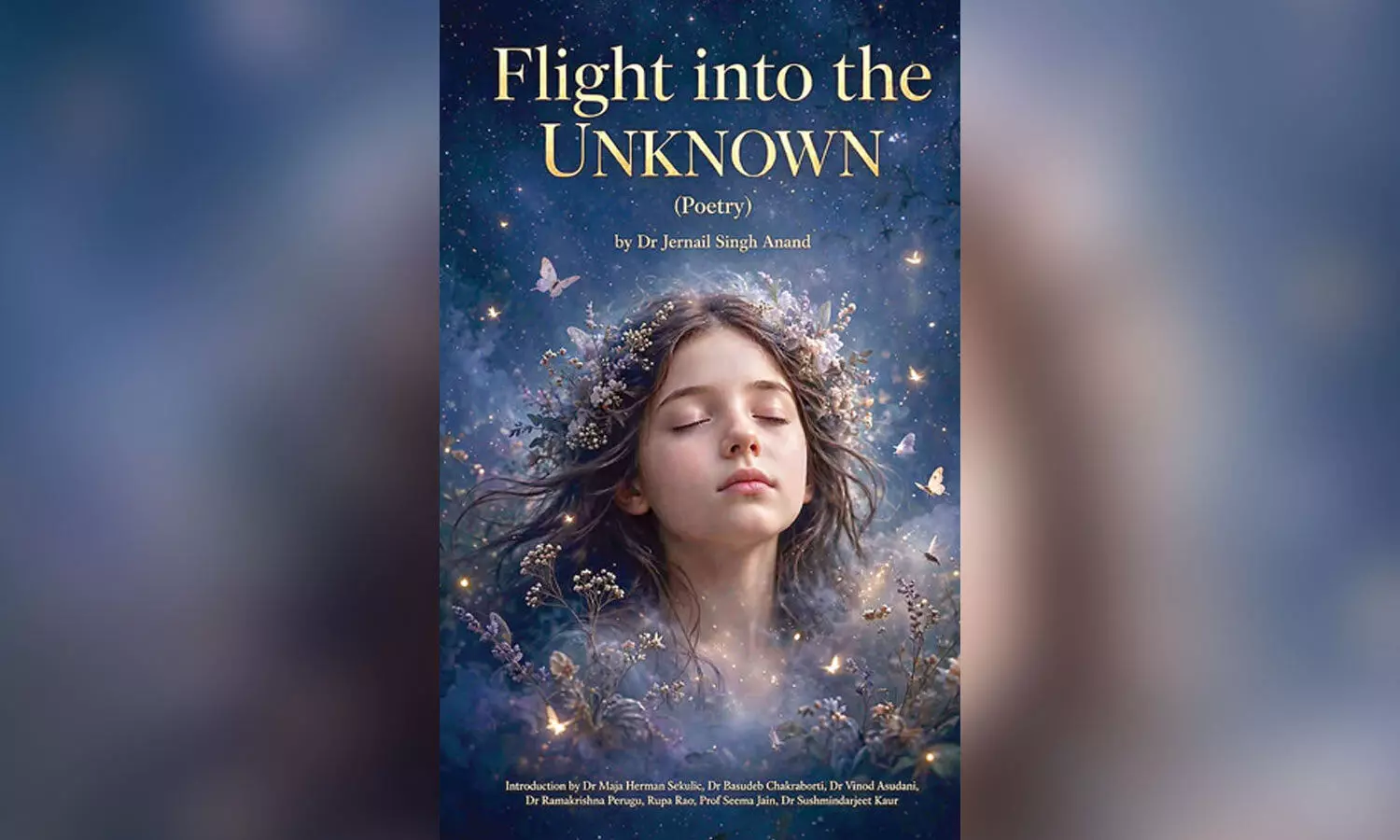
Dr Jernail Singh Anand’s ‘Flight into the Unknown’ explores the connection between philosophy, spirituality, poetry and human conscience. Through simple yet thought-provoking verses, the collection invites readers to reflect on life, morality, compassion and the mysteries of human existence

Share :
A transcendental quest into the unknown
Dr Jernail Singh Anand’s ‘Flight into the Unknown’ is a metaphysical expedition where verse becomes the vehicle for philosophy, spirituality, and conscience. The book, introduced by luminaries like Dr Maja Herman Sekulić, positions itself at the intersection of “philosophy of life and poetry of life.” Anand, who has authored more than 210 books [20 epics], is framed by Dr. Sekulić as “the best philosopher among today’s poets, and best poet among today’s philosophers,” placing him in a lineage with Lao Tzu, Dante, Goethe, and Khalil Gibran. This is the book’s central achievement. His poems are “engaging and easy to grasp philosophical poetry” that bridges thought and feeling without heavy theoretical jargon. Take ‘Cosmic Rhythm’: “Those who are alive / And those who die / Each by living or dying / Helps preserve / The cosmic rhythm.” The poem’s simplicity is deceptive. In a few lines, Anand dismantles anthropocentric ego: “No one is indispensable”. “The great Master / Keeps the scales up / Weighs the good and evil.” This is Vedantic equanimity rendered in plain, rhythmic English.
Dr Ramakrishna Perugu calls Anand “a living epic of ethical imagination” whose poetry “does not merely offer answers; it awakens conscience”. Anand confronts civilization’s contradictions: “The western civilization / Believed in the individual, / While the eastern philosophies / Believed / In the collective conscious.” His solution is synthesis: “We can have a complete view of man / When both are connected / In a harmonious blend.” This is not academic comparative philosophy. It is lived wisdom, insisting that Religions, philosophies and ideologies… “Prove only one thing, / The inadequacy of human thought.” Pointing to Anand’s self-scrutiny, and unsparing honesty, Dr. Sushmindarjeet Kaur avers that Anand’s poems transform private pain into universal conscience, turning silence into questions and humour into truth. Anand’s diction is deliberately unadorned. His free verse breathes. Line breaks do philosophical work, creating pauses for reflection: “Goodness is the essence / Of divinity / And beauty / And of humanity too.”
The collection moves like an inner dialogue. ‘Of Pain Unsaid’ opens with unacknowledged suffering. ‘Alienation to Alienation’ deepens it into spiritual estrangement. ‘Poet Opens a Clinic’ offers words as balm, but ‘The Undoing Wordster’ interrogates that claim. Finally, ‘2030—A Fantasy’ looks forward, giving “imaginative lift” after sustained introspection. The “flight” of the title, then, is not escape but transcendence. In ‘Manifesto for Future’, Anand writes: “You and me are also forms of God / Love is the worship meant for us.”
‘Flight into the Unknown’ succeeds because it never severs thought from emotion. Anand makes “philosophical thought poetic without losing emotional immediacy” [Perugu] and his poems form a reflective journey that encourages readers to cultivate a more mindful aware, compassionate and ethical existence [Rupa Rao]. Anand does not claim to have answers. He admits: “All my knowledge fails to tell me / What I am.” Yet in that admission lies the book’s power. It invites us to sit with mystery, to weigh our own scales, and to recognize that “Words can be balm for injuries / And weapons for war.” For a world drowning in noise, ‘Flight into the Unknown’ is a quiet, necessary altitude. It reminds us that the deepest flights are inward, and the most unknown territory is the human conscience.
(The writer is an Internationally Acclaimed Literary Critic, an eminent Columnist and the Founder of Authors Paradise Literary Group.)
Saudi authorities say attack on Riyadh airport killed 12 people and wounded over 300
Rajiv panel recommendations approved…Cabinet clears BC quota across eight categories
CM Naidu sets Nov 15 deadline for local polls
GO on BC quota in local bodies caps total reservations at 50%
Two die, two missing at Pakala beach
El Nino century’s biggest natural crisis: CM Revanth Reddy


