Crisis In Moral Leadership?


The two events, kumbh-mela and Shivaratri, coming together, showed that devotion is an integral component of the Indian mind. Millions of people immersed in the Ganga during the Kumbh, and thousands of people thronged the temples on Shivaratri, throughout the day and night.
The two events, kumbh-mela and Shivaratri, coming together, showed that devotion is an integral component of the Indian mind. Millions of people immersed in the Ganga during the Kumbh, and thousands of people thronged the temples on Shivaratri, throughout the day and night. It is not only the lay people who took the dip in Ganga but several celebrities. We do not know the type of devotion or the message the celebrities wished to send to their followers. Lay people, anyway, are the simple devotees who visit these places as a matter of religious duty. It looks as though bhakti is in the Indian airspace itself. The Bhakti economy is booming, but do we see corresponding social good and strengthening of social morality?
It seems that the counter forces are stronger, though they are silent and imperceptible. We do not know whether there is a conscious plan to corrupt social morality, but we do notice it in the form of moral decline in several spheres in society. The decline has seeped into schools and colleges, and finally in the institution of marriage. The honourable courts don the role of moral purveyors and declare that two young unwed people can live together, and that extra-marital relations are no offence. The age of consent for sex is sought to be lowered and the age of marriage to be raised. Such steps are accepted with glee by several educated members of society. No wonder, we see the emergence of co-living hostels, some of which are said to be facilities for our young, most skilled, educated men and women, fresh from universities working in global tech companies. Tech companies are happy with them as their employees like the facilities and the attrition rate is low. At some late age, when such adults have a destination wedding, pity the priests who recite mantras describing the bride as a kanya-ratnam, a gem of a virgin, comparable to Lakshmi, and the groom as virtuous as the great Vishnu.
Is morality worth preserving? Societies which take pride as being advanced, have seen the gradual collapse of the institution of marriage, and attendant problems. Living together is common, but the stress is on the children of such parents. The birth rate has fallen much below the replacement level of population. This led to the threat of people of other cultures dominating the social and moral field. Several intellectuals started raising alarm bells about the possible disappearance of native civilization. Woke ideology further perverted the educational institutions of the USA for the last ten years but President Trump started with a right step in dismantling wokeism. He called it restoration of sanity. Elsewhere in Europe too, we see the rise of the right wing, opposing the decline in moral values.
The same agencies which are corrupting the western society seem to be active in India too. Global institutions have influenced our educational field and woke ideology seems permeated in the utterances of the higher judiciary.
There are many stakeholders of social morality, but the role of religious leaders and intelligentsia is great. For instance, several temples perform the kalyanam of Shiva and Parvati on Shivaratri. Shiva Puranam gives a glorious account of the way Parvati, born as a human, performs penance and elevates herself to a divine level to marry Shiva. The pundits who perform marriage are mostly unaware or incapable of explaining the spiritual import of marriage. Marriage is equal to a yagna in Indian tradition. Sex is not the only objective but joint performance of dharma, raising children in virtuous way, continuance of the family line, responsibility to other family members, etc., are all part of an Indian marriage.
All kalyanams of deities are meant to teach us the right values regarding marriage. They are designed to be comprehensive education for the parents as well as the children. Not only marriages but several activities in temples are opportunities for imparting values which strengthen the family structure. It is for the religious leaders to become aware of the corrupting forces and train the priestly class to channelize bhakti into a morally stabilising force. This is the main field in which the corrupting forces should not enter.
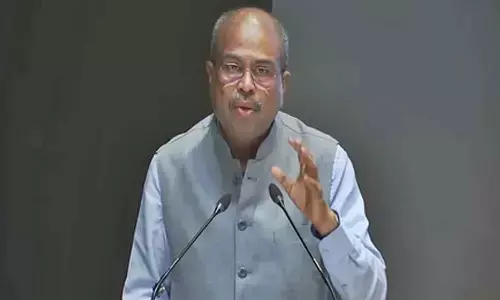
(The writer is a former DGP, Andhra Pradesh)