Solvathon 2026 – Smart Med-Tech Ideas to Heal the Future

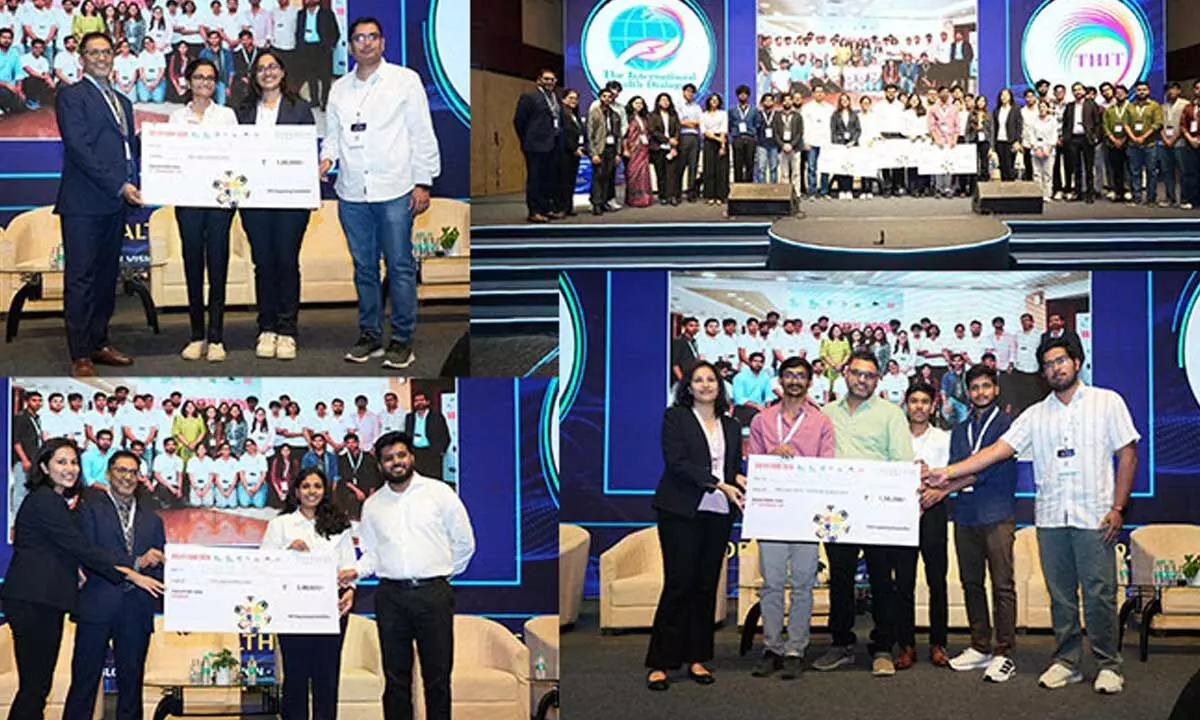
A slew of innovative tech-based smart solutions emerged from Solvathon 2026, India’s premier HealthTech Innovation Challenge. With IIIT-H’s Center for Innovation and Entrepreneurship collaborating as innovation partner with Apollo Research and Innovations (ARI) and Transforming Healthcare with IT (THIT), the 3-day hackathon saw medical and tech-centric experts grapple with real-world healthcare challenges.
Healthcare and specifically eldercare has raced to the top of the householder’s budgeting portfolio along with your child’s orthodontic treatment and university education, making it an issue that affects everyone, from cradle to grave. Thus, when stakeholders in medico-tech (students, researchers, startups, clinicians, and technologists) came together at Solvathon 2026 between January 30 – February 1 at HICC to dig deep and unravel real-world healthcare challenges, it was a timely response to an unfolding emergency.
Defining the problem statement
From framing tougher problem statements, exploring opportunities for deeper clinical integration, to building scalable, impactful tech-based futuristic solutions, Avanija Ramanan’s team from IIIT-H’s CIE steered the immersive three-day hackathon, that featured tech industry leaders, the research stack and mentors from GCCs, with medical experts from Apollo Research and Innovations (ARI) and Transforming Healthcare with IT (THIT) giving a glimpse of how the hospital ecosystem works.
Of the 134 registrations received, 41 complete applications were submitted across problem statements. 12 shortlisted teams were taken through a structured mentorship program, guided by medical industry and technology experts, on clinical relevance, technical strength, scalability, and overall impact.
Nirupa Vijaykumar, Portfolio and Partnerships lead at CIE elaborates, “The problem statements that we received from the hospital were given by doctors, for the challenge specifically. The one thing that we as a team took away was how interested doctors actually are, in finding solutions for real problems.”
Eight weighty solutions
What emerged from the three-day hackathon was a prescription for eight important pain points.
Three teams emerged winners. MedSafe, (Mahesh Bontha and Naveen Krishna from Peacewise Consulting), proposed an AI-powered Medication Safety Platform that will leverage ML models and CYP450 pathways to enable proactive risk detection and significantly reduce preventable adverse drug reactions across healthcare facilities.
CrossMediSafe (Niraj Deshmukh, Kirthikha Sunder, Varun Apte- IISER Tirupati) looked at an AI-based open-source platform for a holistic understanding and integration of different medication methodologies available in India, like Allopathy, Ayurveda and Unani. It integrates structured pharmacological databases with traditional medicine formularies and uses NLP-driven intelligence to detect herb–drug and drug–drug interactions in real time, enhancing medication safety in India’s pluralistic healthcare ecosystem.
For reimagining patient movement through dynamic workflow optimization, Omni Flow (Janyavula Vinay, Madhavaram Midhun, Pitta Sandeep Kumar, Dinnu Sai Krishna from Apollo University) looked at integrating low-cost IoT edge devices, hybrid smart-paper tracking, and predictive dashboards to reduce turnaround time and eliminate overcrowding in shared-resource environments.
Whether it was building an intelligent system that interprets health-related conversations and recommends locally available medical products (Rx, OTC, supplements, FMCG) or an affordable real-Time Voice AI Assistant in regional languages that costs less than ₹2 per minute for large-scale deployment, the focus was on glocal for local.
For enhanced patient care and workplace effectiveness, one project suggested evaluating strategies and developing tools to strengthen emotional Intelligence (EI) of frontline nurses. They explored the possibility of empowering elder care nurses with AI-driven tools that integrate real-time insights and emotional context to deliver personalized care and better patient outcomes.
Nirupa summarizes, ”Traditionally, doctors were not very invested in looking at technology for solutions but they are now adapting to tech differently and consider it as an enabler to do their job better, whether it is diagnostics, screening, early detection or patient monitoring. We have been seeing that value for a long time but having doctors and hospitals recognize it was a good validation for us, that the enabling work that we have been doing has actually been quite useful.”
Solvathon 2026 demonstrated how inter-disciplinary collaborations between academia, startups, clinicians, and tech experts has immense potential to improve patient safety, hospital efficiency, and overall access to quality healthcare across India.