




- Uttam fixes Rs 66 per kg price cap on rice to curb inflation
- Supreme Court verdict clears way for Miyapur land takeover
- Apologise to TG people ahead of Hyd visit: Ponnam to Amit Shah
- CEO warns of legal action over bogus graduate voter entries
- Rain fury throws Hyd out of gear
- IT raids Omega Hospitals over suspected tax evasion
- Will electoral responsibility be prioritised over leisure plans during this poll
- Paid holiday declared on Nov 1 for GVMC elections
Much ado about one MLC seat: Million memes, noise and political theatre
In Short
MLC Verdict: Is it really time for Modi’s farewell?

Share :
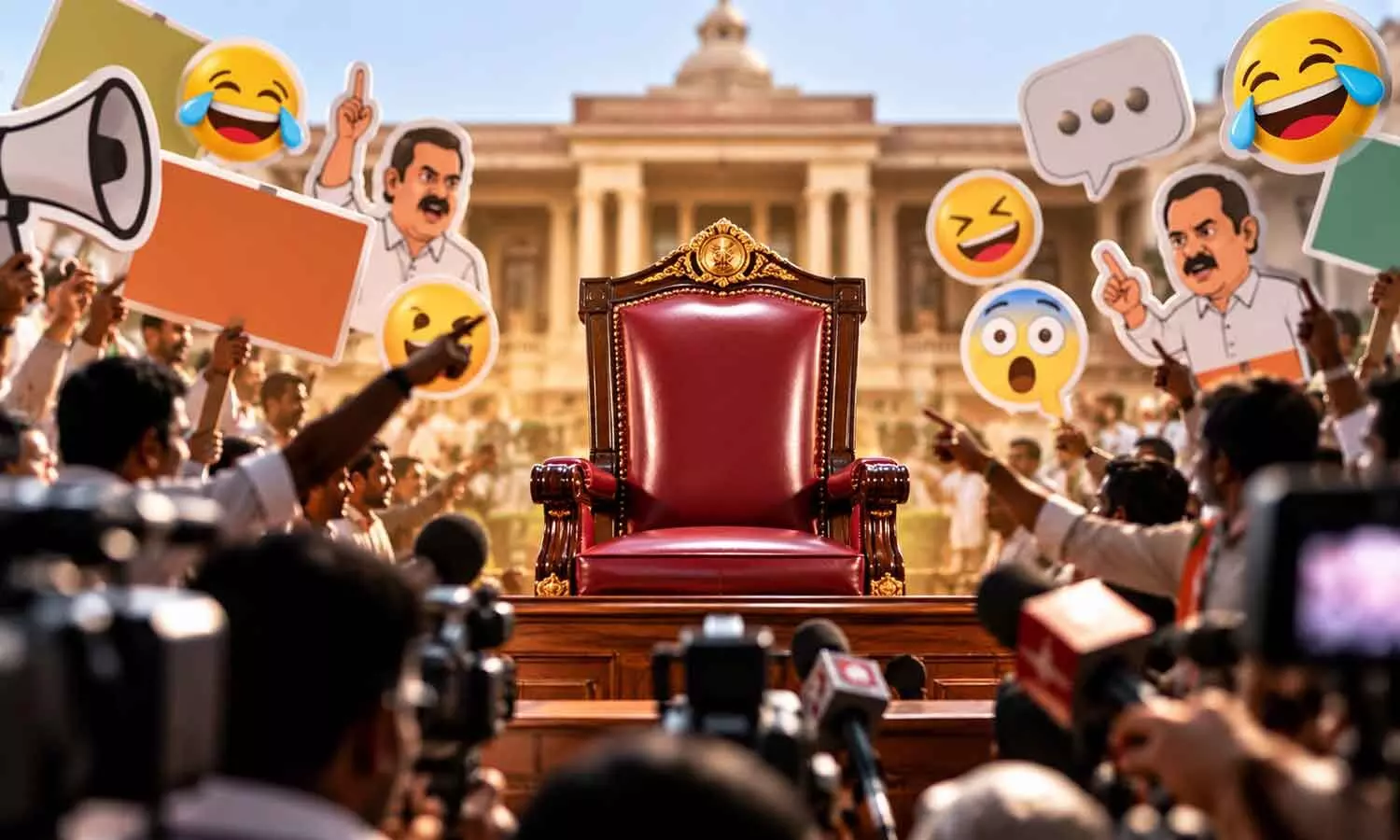
Much ado about one MLC seat: Million memes, noise and political theatre
Can it be said that the just-concluded MLC elections mean that “Janta Ne Kar Liya BJP ki Vidai Ki Tayari,” as an overenthusiastic Shiv Sena (UBT) leader claimed on Thursday? Can elections to the Legislative Council really be taken as a reflection of the mood of the people?
Well, if that is the argument, the Congress should be more worried than any other party. The party, which has been celebrating its victory in one seat and claiming that the time for Modi’s farewell has arrived, is conveniently hiding the fact that it did not wrest the Nagpur seat from the BJP but merely managed to retain it. Yes, the BJP certainly needs to introspect on why it failed to wrest the seat from the Congress. Nagpur is, after all, the bastion of the RSS and Union Minister Nitin Gadkari.
Congress candidate Abhijit Wanjari, who was the sitting MLC, had the advantage of an established network among graduate voters. His candidature was endorsed by 48 organisations. Wanjari credited the leaders and workers of these organisations, along with Congress and Maha Vikas Aghadi (MVA) cadres, for his victory.
The BJP, on the other hand, appears to have faced some internal discontent over the choice of candidate. Former MLA Anil Sole was among those initially considered for the seat, and reports suggested that his candidature had triggered differences within sections of the party. The entry of an independent candidate further complicated the BJP’s electoral calculations, particularly in a contest where the transfer of preferential votes played a decisive role. Ultimately, the Congress victory was because of his support base and crucial transfer of second-preference votes.
Elections or no elections, one thing is clear: there is anti-incumbency against the Modi-led NDA government. That is an undeniable fact. But the situation is certainly not such that people are completely disillusioned with Modi, as the Congress would like to believe. The unfortunate part is that the Congress leadership, including Leader of the Opposition Rahul Gandhi, refuses to acknowledge this reality. They seem to believe that just “Ek aur dhakka” will bring down the government. This only shows how disconnected they are from ground realities.
The difference between the BJP and the Opposition, particularly the Congress, is that the latter appears reluctant to introspect, whereas the BJP treats every election as an acid test. Even when it loses, the party examines the reasons behind the setback and attempts to identify where things went wrong.
The MLC results show that the BJP has improved its overall tally, though it needs to examine why it failed to wrest the Nagpur seat from the Congress and lost ground to the Samajwadi Party in Varanasi.
The Samajwadi Party in Uttar Pradesh certainly has reasons to celebrate as its performance has been encouraging. It made significant gains, increasing its tally from three to five seats. The BJP won six, retaining its overall tally. But what about the Congress? Did it contribute in any meaningful way to the SP’s victories? If the Congress believes that Modi’s “time is up”, how does it explain its own failure to retain three of the four seats it had won in the previous MLC elections? Did the SP increase its tally because of ‘vote chori’?
These are questions that could have an adverse impact on the Congress when it eventually negotiates seat-sharing arrangements with its alliance partner, the SP, ahead of the Uttar Pradesh Assembly elections.
One of the biggest mistakes political parties make is to interpret an electoral victory as an endorsement of everything they stand for and a defeat as merely a temporary setback. Such an approach prevents them from understanding the underlying message. The MLC results deserve much more serious examination.
For the Congress, the warning is particularly significant. The party needs to understand that voters are increasingly looking beyond political rhetoric and assessing government performance, the credibility of promises and the accessibility of elected representatives.
Being in power may help a ruling party to some extent, but it does not automatically translate into electoral support. Nor does the presence of a Chief Minister, ministers and senior leaders on the campaign trail guarantee victory.
The Congress has repeatedly sought to build its political strategy around the argument that the BJP can be challenged through Opposition unity and a common platform. However, while Opposition leaders may come together for the sake of optics, they are far from united in their political objectives. What people want is a credible political programme, effective leadership and a committed grassroots organisation. The Congress appears to be lacking in all these areas.
Even the party cadre seems to understand that the Congress is not following the right approach to challenge Modi. Yet, the top leadership continues to believe that the Gandhi family, now represented by Rahul and Priyanka, can lead the party to victory. It needs to understand that what matters is not merely Opposition unity but the ability to convince voters that Modi should go. Unless voters themselves arrive at that conclusion, no amount of political posturing can dislodge him.
This was precisely what a party worker in Patna was apparently trying to convey when the AICC president, instead of patiently listening to him, shouted back, “Modi ka baap bhi jayega.” Such responses only underline the disconnect between the party’s grassroots workers and its top leadership.
The Congress’s problem is that it often appears more comfortable mobilising people against the BJP than communicating a positive alternative. Criticism of the Prime Minister and the ruling party may energise its committed supporters, but it does not necessarily persuade voters. People want to know how the Opposition proposes to do differently, how it intends to fulfil its promises and whether it has the leadership and organisational capacity to deliver.
There is also a serious disconnect between the Congress leadership at the national level and the party organisation on the ground. In several states, factionalism, leadership rivalries and the absence of sustained cadre-building have weakened the party. Electoral campaigns cannot be built overnight, nor can leaders expect voters to respond merely because they project themselves as the principal alternative to the BJP.
Other Opposition parties, too, have lessons to learn. The Samajwadi Party, the Trinamool Congress, the DMK and others have their own regional strengths, but these cannot automatically translate into a cohesive national Opposition movement. Regional calculations, competing ambitions and leadership disagreements continue to undermine the larger objective of presenting a credible alternative.
The BJP, however, should not interpret the results as a reason to sit back and celebrate. Its organisational strengths need constant reinforcement. The party, too, faces challenges, including local anti-incumbency, candidate selection, factional differences and the need to nurture second-rung leadership.
Another important lesson is that electoral politics cannot be reduced to social media campaigns, public meetings and high-decibel accusations. Political parties need functioning district units, active booth-level workers, credible candidates and continuous interaction with people. The gap between political messaging and public experience can prove costly.
The Opposition should also stop undermining constitutional institutions, whether Parliament or independent bodies such as the Election Commission and the judiciary. We have seen how leaders such as Shiv Sena (UBT) MP Sanjay Raut made comments about the judiciary and subsequently apologised to the court.
Ultimately, elections are not won merely by claiming that the opponent is unpopular; they are won by convincing people that one’s own party deserves their confidence. The Congress and its allies must move beyond the politics of protest and develop a constructive agenda addressing employment, education, inflation, governance and social security.
The BJP, meanwhile, must remember that no electoral advantage is permanent. Every verdict, whether favourable or unfavourable, carries a message. The real test of political maturity lies in understanding that message rather than celebrating selectively or dismissing an unfavourable verdict.
The MLC results, therefore, should serve as a lesson for both the BJP and the Opposition. But for the Congress, the message is particularly clear: political space does not automatically become vacant just because the ruling party faces criticism. It must be earned through credibility, organisation, leadership and a convincing alternative. Merely announcing Modi’s farewell will not make it happen
(The author is former Chief Editor of The Hans India)
KCR tried to grab Rs 50k-cr Miyapur land, alleges CM Revanth
Bhatti’s call at NAREDCO TG property show: Realty must become partner in TG’s growth
Shah to join Nov 2 Hyd ‘Maha Padayatra’
Kids' edu videos attract attention, not learning: ISB study
Much ado about one MLC seat: Million memes, noise and political theatre
Institutional autonomy must be respected by everyone in the country


