




- EPFO services on WhatsApp
- Bhumana alleges mass rigging in Tirupati civic elections
- Election dry days bring business boom to rural liquor outlets
- Women voters turned up more in most zones
- Police extend support to elderly and disabled voters
- Tribals stage protest for restoration of cell tower, streetlights
- ‘BRICS Sustainable Lifestyle Week–2026’ encourages adoption of healthy living
- Your turn to become PM won't come
Modern western revolutions hold universal lessons
In Short
The Bolshevik Revolution in Russia at the commencement of the 20th century and the Chinese Revolution later, underscored the efficacy of Socialist ideology in bridging the gulf between the haves and have-nots. Communism that rose after those revolutions, impacted the entire world with its new and egalitarian socialist ideology of economic equality

Share :
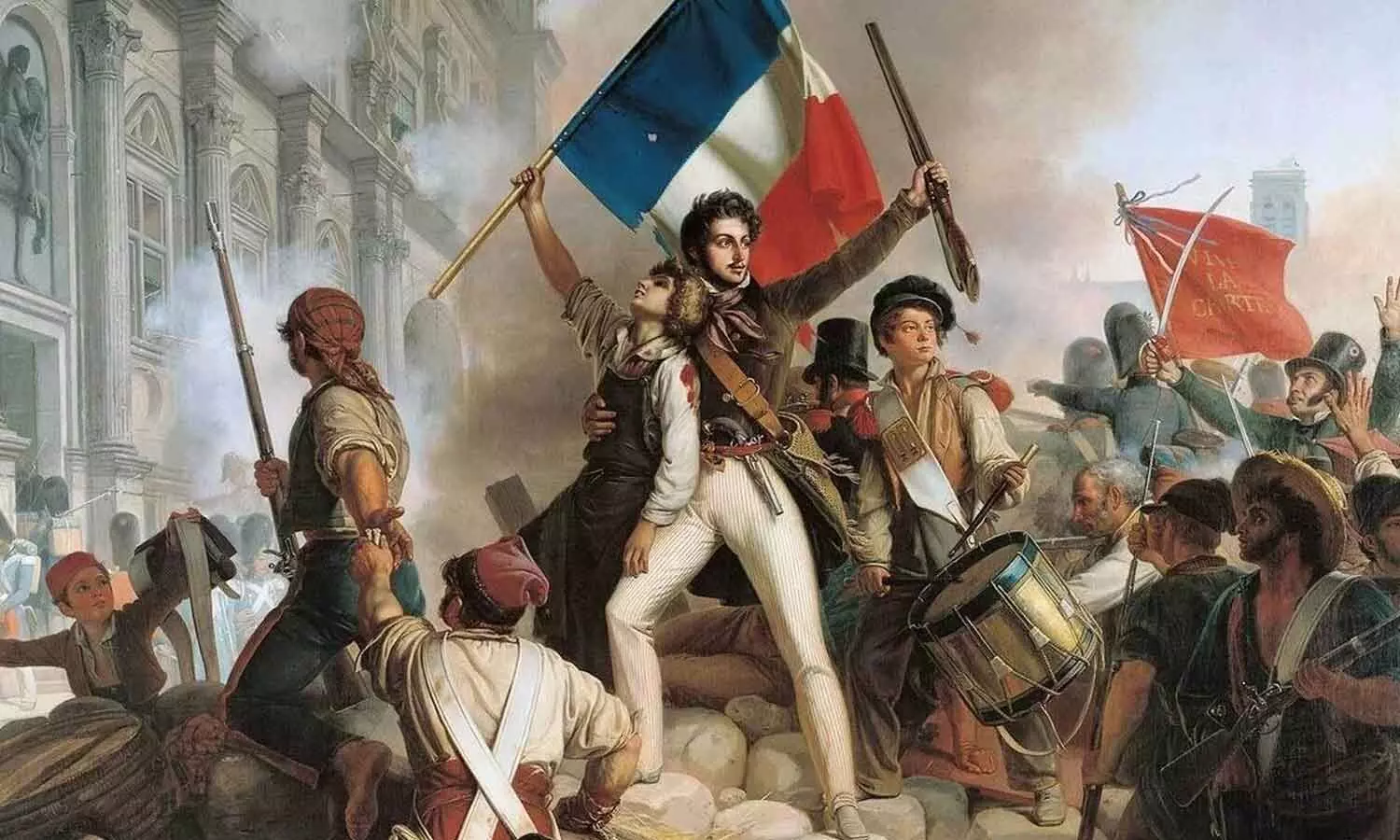
Modern western revolutions hold universal lessons
It is widely reported with great disapproval in the media that the National Council for Educational Research and Training (NCERT), made several omissions in the history section of the IX Class Social Studies textbook this year. However, the unilateral decision to delete the lesson on Modern Western Revolutions in the said textbook has disturbed teachers, parents, educational administrators as well as the right-thinking general public as it is well-known that numerous revolts and revolutions in several countries in Europe and America from the middle of the 16th century have metamorphosed political institutions.
New concepts in politics discourse evolved and the very fabric of governance has undergone a change due to such major revolutions. From a feudal mindset of medievalism, when monarchs considered themselves as the ‘shadows of God on earth’ invoking the most obnoxious divine right theory and asserting that common people were created only to serve kings, pay taxes and do their duties. The revolutions and independence movements in countries like the Netherlands, England, France and in the new continent America, besides Russia and China, have taken our societies to high pedestals of political maturity.
The modern European revolutions also laid strong foundations for the emergence of parliamentary democracy, constitutional monarchy, rule of law, social equality, human rights, liberty, equality and fraternity besides the idea to resist economic exploitation and to have universal franchise, gender equality and many more. Though such revolutions witnessed largescale violence, death and destruction, the legacy they left behind did not keep the societies, where they were. There was a change for the better in every field of activity.
The change was such that it was rightly called, Modern Period. Medieval institutions, practices and values were buried during such revolutions, while new and progressive ideas and political institutions, human-centric administration with freedom and dignity to life had their genesis in successive revolutions. In a way, the revolutions in Europe marked an epilogue to the old dying order and a prologue to the new democratic and progressive modern era.
The first anti-colonial movement:
The first and foremost of all modern revolutions was the Dutch war of independence in the middle of the 16th century. The Netherlands was a colony for the Habsburg rulers of Spain. Netherlands, with throbbing trading centres like Amsterdam, Antwerp, Ghent and Bruges, were very rich and provided a lot of revenue to the mother country. With the wealth coming from the Dutch, Spain became a predominant power in Europe.
During the reign of Charles V, Spain was so powerful that it was often said that “If Spain moves, the entire Europe moves”. But after Philip II succeeded Charles V in 1558 the relations between Spain and the Dutch were strained due to the shortsighted policies of the young and inexperienced king. He strained relations with the people of Netherlands on religious, political and every possible front.
The Dutch people formed a national army by 1564 and fought against the oppressive rule of the Spanish king. After a protracted war, the Dutch under William of Orange defeated the Spanish armies and declared their independence from Spanish rule. This in fact is the first ever instance of a successful war against colonial power. William of Orange was declared their king.
The idea of democracy did not occur at that time. To the Dutch, opposition to monarchy and the idea of democracy as an alternative form of government were to come after a few more revolts and revolutions. However, the way the Dutch successfully fought a foreign political rule and the “The Dutch declaration of the rights of man” with an avowed object that “No power on earth should have the right to control the destinies of the people living in another country”, became an example for many European countries to emulate.
The Bill of Rights:
The passing of the Bill of Rights in England in 1688 is another milestone on the road to democratic institutions that sounded a death-knell to the absolute monarchies. This Bill of Rights heralded the dawn of limited and constitutional monarchy. The much hated “divine right theory of monarchy” was buried in the debris of the popular revolution in England. The entire 17th century England was marked by a conflict in the country over the question as to where does sovereignty lay? Was it with the king or with the parliament? During this period, England witnessed a tumultuous Civil War (1642- 49) at the end of which King Charles I was defeated and executed by the Parliament, a Republic was set up (1649- 1660), at the end of which monarchy was restored in the person of Charles II, before another revolution, popularly known as the Glorious Revolution or the Bloodless Revolution occurred when King James II had to abdicate the throne giving way to the joint rule of his daughter Queen Mary and her husband William IV, who finally gave the much acclaimed Bill of Rights.
With the passing of the Bill of Rights, the king in Britain became the constitutional head and continues to be so ever since. It should be remembered that though the British constitution is an unwritten one, the Bill of Rights along with Magna Carta (1215) forms part of the written elements in their unwritten constitution.
Dawn of democracies:
After the rise of constitutional monarchies and eclipse of the absolute monarchies in several countries all over Europe, and Bill of Rights in Britain, there was the triumph of democracy with the outbreak of the American war of Independence by the latter part of the 18th. Century. All the 13 colonies on the Atlantic sea board of America rose against the colonial regime of Britain on the principle that they cannot pay the taxes as there were no American representatives in the British Parliament, which passed the legislation.
They therefore raised the slogan, “No Taxation without representation”. American nationalists raised an army and under the leadership of George Washington defeated the British armies and won their freedom by 1776. American Revolution made the world realize that colonialism is an obstacle in the exercise of rights, dignity to life and happiness of the individuals.
Close on the heels of the American Revolution there was the French Revolution (1789 -1799), the mother of all revolutions. During this revolution, the much-discredited Bourbon absolutist despotism in France was violently put down, King Louis XVI and Queen Mary Antoinette were publicly guillotined, a republic was set up, unjust social order was discarded, unfair methods of taxation were abolished, and the common people were freed from the clutches of the Nobles and clergy.
The watch words of the French Revolution-liberty, equality and fraternity- resonated not only in every part of France, but throughout the civilised world. The French Revolution and its legacy changed the political fabric of almost all countries.
The Bolshevik Revolution in Russia at the commencement of the 20th century and the Chinese Revolution later, underscored the efficacy of Socialist ideology in bridging the gulf between the haves and have-nots. Communism that rose after those revolutions, impacted the entire world with its new and egalitarian socialist ideology of economic equality.
The legacy:
The Modern Revolutions thus had far-reaching consequences in the very political, economic, social and cultural spheres in the entire world. The political philosophy of Cicero, Horace, Paine and the celebrated works of Voltaire, Rousseau, Montesquieu, and others which made the revolutions possible were also read in translations by people all over the world. The revolutionaries who fought for freedom, liberty and human dignity with utmost conviction had sacrificed their lives for the values they cherished.
They gave up their ‘Today” for our “Tomorrow”. If humanity enjoys a life of dignity with liberty and freedom, if we consider that the parliamentary form of democracy as the best form of governance ever achieved by the human mind, it was because of the numerous struggles and sacrifices that leaders made during those modern revolutions in the West.
There is therefore every need today to remember and remind the present and future generations of the need to protect, preserve and nurture all human rights, political systems, values, and institutions the past revolutions have gifted us. NCERT will do good if schoolchildren, through the books they read, are not denied the lessons and knowledge of such revolutions in the modern world.
(The writer is a retired professor of History, University of Hyderabad)
Pressing need for restoring normalcy in trouble-torn Manipur
Modern western revolutions hold universal lessons
“If you see something, say something” ethos can safeguard schools
Cyclone Murasu: Heavy rain alert for Telangana
Modi conspiring to retain power with vote chori: CM Revanth
Andhra Pradesh CM reviews likely impact of cyclone ‘Murasu’, calls off Delhi visit


