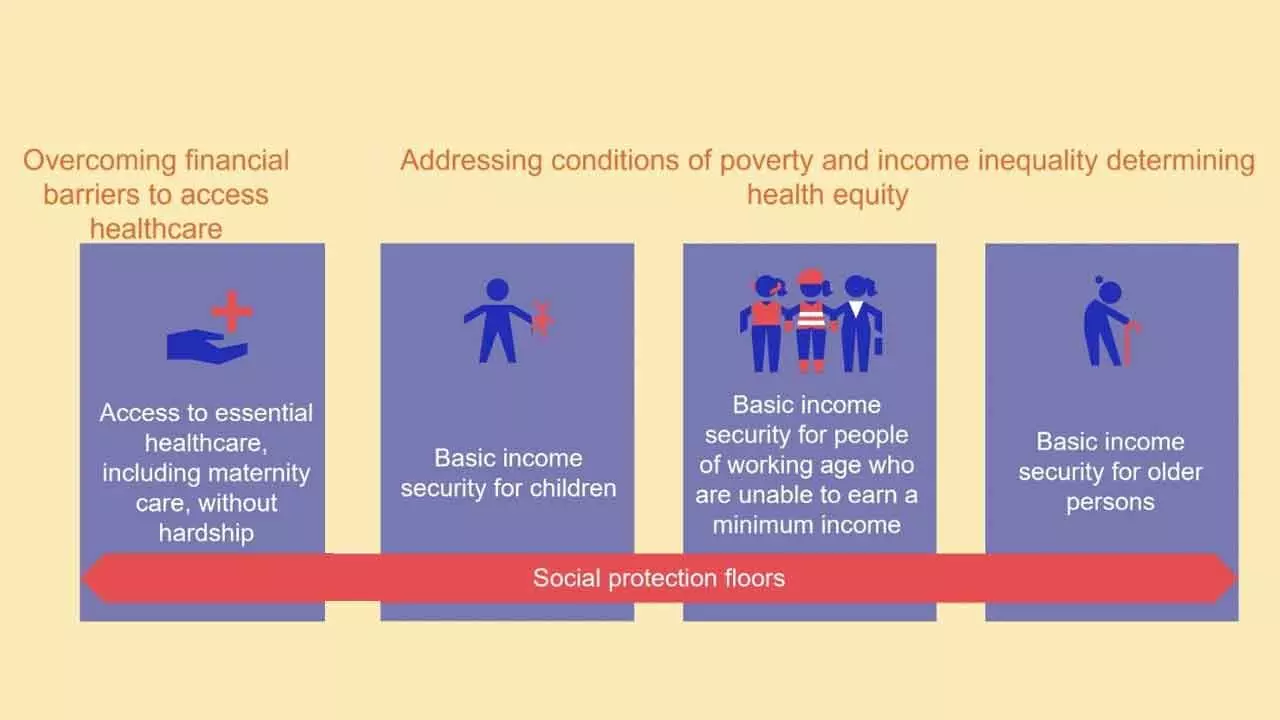
Social protection floors can ensure health care and basic income security

Investing in quality education, healthcare, and social protection is essential for reducing inequality and promoting economic security. Effective social spending is a necessary investment that fosters productivity, resilience, and social cohesion.
The World Social Report 2025 addresses global social challenges and advocates for a new policy consensus to promote equity, security, and solidarity in response to rising inequalities and insecurity. The world is facing significant social challenges, including rising inequality, insecurity, and distrust, which threaten global cooperation and social progress. The report emphasizes the urgent need for a new policy consensus centered on equity, economic security, and solidarity to address these issues effectively.
Rising tensions and polariation are undermining global cooperation. Inequality, insecurity, and distrust are prevalent, with many struggling economically. The Sustainable Development Goals (SDGs) are off track, necessitating urgent action. A new policy consensus is proposed, focusing on equity, economic security, and solidarity.
Despite improvements in material well-being, many people globally feel economically insecure, with a significant portion living on the edge of poverty. The report highlights the need for resilience against economic shocks, climate change, and conflicts that exacerbate poverty.
Persistent inequality and exclusion
Income inequality has increased in many high-income and some middle-income countries, while some regions have seen declines. Social cohesion is weakening globally, with declining trust in institutions and increasing polarization among communities. This erosion of trust hampers cooperation and collective action, exacerbating social divides.
The report calls for a comprehensive policy framework that integrates social, economic, and environmental dimensions to address current social challenges.
Current social challenges and inequalities
Despite significant progress in reducing extreme poverty, many people experience growing insecurity and persistent inequalities. This situation threatens social cohesion and the achievement of sustainable development goals (SDGs).
Around 60 per cent of respondents in a Gallup World Poll reported feeling “struggling,” while 12 per cent felt “suffering.”
Economic and social inequalities remain high, with many individuals facing precarious job conditions and financial vulnerability.
Need for a new policy consensus
The report advocates for a new policy consensus based on equity, economic security, and solidarity to address the current social crisis. The prevailing policy approach has favored free markets and economic efficiency, benefiting only a few.
A new consensus must recognise that addressing social challenges requires structural transformations in policies and institutions.
Future summits
The 2023 SDG Summit and the Summit of the Future emphasized the need to strengthen trust and social cohesion.
The Second World Summit for Social Development in 2025 is a chance for governments to make concrete commitments to accelerate progress.
Challenges in eradicating poverty
Despite progress in reducing extreme poverty before 2019, the Covid-19 pandemic has reversed many gains, leading to an increase in global poverty levels. The most significant challenges remain in low-income countries, particularly in sub-Saharan Africa. Extreme poverty rose to 692 million by 2024, close to pre-pandemic levels.
Complex dynamics of poverty movement
Households frequently move in and out of poverty, with many experiencing temporary escapes rather than permanent solutions. Longitudinal data reveals that poverty dynamics are more volatile than previously understood.
Many households experience fluctuations in income and consumption levels. Sustained escapes from poverty are infrequent; many fall back into poverty.
Chronic poverty affects a significant portion of the population in certain regions.
The composition of those in poverty changes constantly, complicating eradication efforts.
Health shocks and informal employment are significant contributors to this precarious situation.
Recent crises, including climate change and conflict, have exacerbated vulnerabilities and hindered poverty reduction efforts. The impacts of these crises are felt most acutely in low-income countries, where recovery is slow.
Nearly 20 per cent of people are at high risk from climate-related hazards. Conflict-affected countries have seen an increase in extreme poverty, rising from 20 per cent in 2000 to 48 per cent in 2019. The current trends suggest that two-thirds of people in poverty may live in fragile countries by 2030.
Income inequality
Income and wealth inequality remains a significant global issue, with varying trends across different countries and regions. While 52 out of 128 countries have seen rising income inequality, 66 have experienced declines.
Investing in people
Investing in quality education, healthcare, and social protection is essential for reducing inequality and promoting economic security. Effective social spending is a necessary investment that fosters productivity, resilience, and social cohesion.
The ILO calls for a universal labor guarantee to ensure fundamental workers’ rights and decent working conditions.
Over 90 per cent of countries have minimum wage laws, but many pay below living costs.
Active labour market policies are needed to support job transitions, especially in informal sectors.
Boosting social protection systems
Social protection is essential for managing risks and reducing poverty and inequality. Comprehensive systems must be inclusive and adaptable to the changing world of work.
Social protection helps manage everyday risks and provides support during unexpected events. Almost 48 per cent of the global population lacks access to social protection, with significant gaps in low-income countries.
Countries must build social protection floors to ensure access to essential health care and basic income security.
Building a new policy consensus
The upcoming global forums in 2025 are crucial for advancing a new policy consensus focused on equity, security, and solidarity. This long-term effort requires sustained cooperation and commitment from the international community beyond 2025.
The pursuit of a new policy consensus is an ongoing process, not a one-time negotiation. The focus must be extended beyond efficiency and growth to include universal moral foundations. The task is fundamentally about people, emphasizing the need for inclusive dialogue and representation in decision-making processes.