




- Farmers’ land problems: Political masters continue to call the shots
- Indiramma house construction must be expedited: MLA
- Farmers’ land problems: Political masters continue to call the shots
- Hare Krishna Movement partners TG in student breakfast drive
- Swarna congratulates Mahesh on completion of 2 years in office
- Engineers’ Day celebrated in Karimnagar
- Grand welcome for Dr Periyala Ravinder Rao in Dallas
- Maoist Committee member Nakka Suseela surrenders in Nizamabad
Farmers’ land problems: Political masters continue to call the shots
In Short
Telangana’s land records system has undergone several changes over the years

Share :
Farmers’ land problems: Political masters continue to call the shots
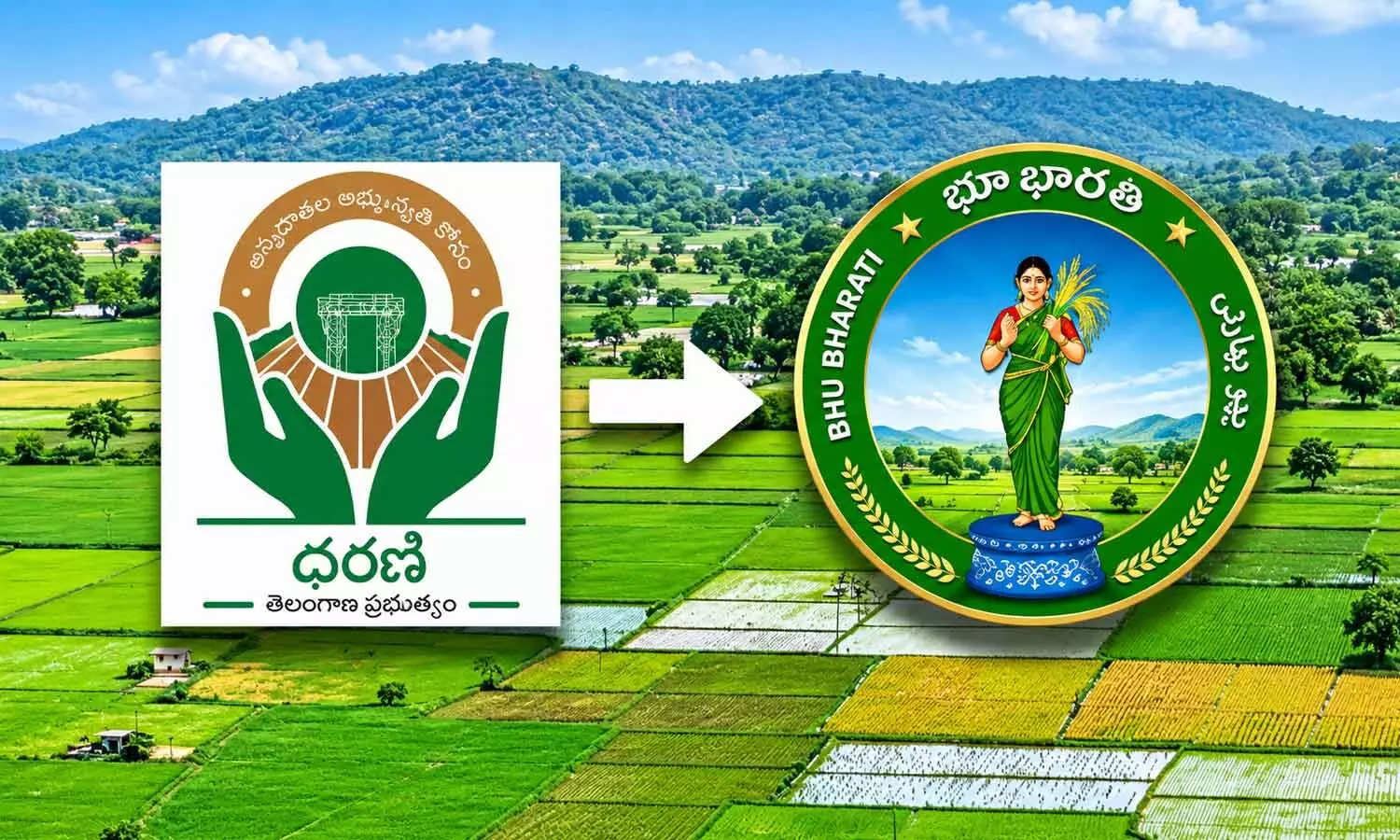
Hyderabad: The Congress party came to power in Telangana after making replacement of Dharani a key item of its poll plank in the 2023 elections. As promised, it replaced the Dharani landrecords system with Bhu Bharati, introducing the Telangana Bhu Bharati (Record of Rights in Land) Act, 2025, while repealing the Telangana Rights in Land and Pattadar Pass Books Act, 2020.
The new system was intended to address several issues related to land records, registration, mutation, inheritance, appeals, and correction of errors. The Record of Rights (RoR) is the key document identifying persons holding rights over land and the nature of those rights. It forms the basis for issuing Pattadar Passbooks, registering transactions, and extending several government benefits to farmers.
However, according to revenue expert and Supreme Court advocate A Padmachari, both Dharani and Bhu Bharati are the same and that neither has solved the problems faced by farmers. He said there were not so many land-related disputes before the formation of Telangana State.
“Why have so many problems arisen for farmers after the creation of a separate Telangana State? Why did the Bharat Rashtra Samithi and the Congress governments not involve seniorrevenue officials before introducing the Dharani and Bhu Bharati laws? Why did Section 22(A) problems arise after the formation of Telangana State? All these problems have arisen due to political intervention. Earlier, revenue officials used to resolve land-related problems in the Telangana region of the erstwhile Andhra Pradesh. However, the situation has now reached a stage where farmers have to approach political leaders. Sadly, the resolution of land problems has become dependent on the mercy of political leaders,” he observed.
Telangana's landrecords system has undergone several changes over the years. The KhasraPahani was declared the Record of Rights under the Hyderabad State RoR Act of 1948. The 1-B Register subsequently became the RoR under the 1971 Act.
The 1-B records were updated through the Land Records Updation Programme (LRUP) in 2017 and incorporated into the Dharani system. Under the 2020 RoR legislation, Dharani was declared the Record of Rights.
The Bhu Bharati Act, 2025, provides for a new Record of Rights. However, the existing Dharani records continue to serve as the RoR under Bhu Bharati, while the government can undertake special programmes to amend the records or create a new RoR following a re-survey.
According to experts, the government is not implementing these special programmes as swiftly as it had announced.
One of the major differences between the two systems is the provision for correction of errors. Under Bhu Bharati, applications can be submitted for correction of errors in the RoR or for inclusion of names of persons who have land rights but are not reflected in the records.
The Revenue Divisional Officer (RDO) and the District Collector have powers to examine such applications. Aggrieved parties can also approach the appellate authorities.
Under the Dharani Act, there was no specific statutory mechanism for correction of errors in the RoR, requiring affected persons to approach civil courts.
Bhu Bharati also introduces changes in the mutation process. When land rights are acquired through purchase, gift, mortgage, transfer or partition, registration and mutation are undertaken by the tahsildar.
In the case of inherited land, the tahsildar is required to conduct an inquiry before updating the RoR. A decision has to be taken within the prescribed period, failing which the mutation is to be carried out automatically as provided under the law.
The earlier Dharani system did not provide for an inquiry before mutation of inherited properties, which allegedly contributed to disputes among legal heirs.
Bhu Bharati also provides a mechanism for recording rights acquired through various other means, including court or Lok Adalat decrees, assignment pattas, Section 38-E certificates, Occupancy Rights Certificates, and sale certificates.
Another significant provision concerns Sada Bainamas, or simple unregistered sale agreements. Bhu Bharati provides a mechanism to process pending applications relating to eligible agricultural lands purchased through such agreements.
The RDOs are empowered to conduct inquiries, verify possession, and ensure that transactions do not violate laws relating to assigned lands, land ceilings, or land transfers. Eligible applicants can subsequently receive certificates, with the details incorporated into the RoR and Pattadar Passbooks issued.
The Dharani Act did not contain provisions for regularising such transactions.
Bhu Bharati establishes a two-tier appellate mechanism for land-related grievances. Appeals against orders of the tahsildar can be filed before the RDO, followed by an appeal to the District Collector.
In matters involving orders passed by the RDO, appeals can be filed before the District Collector and subsequently before the Land Tribunal, as provided under the Act.
The Dharani Act did not provide a similar appellate mechanism, forcing affected persons to approach courts for several categories of disputes. Bhu Bharati also places greater emphasis on land surveys and maps. Land maps are to be incorporated into Pattadar Passbooks, following survey and verification.
The Act provides for Bhudhar, a unique identification number for every land parcel, in line with the broader objective of modernising land records. Temporary and permanent Bhudhar numbers are envisaged depending on the stage of the survey.
The Bhu Bharati Act applies to agricultural lands, non-agricultural lands and Abadi areas, or village settlement areas. It does not apply to government lands, Jagir lands or Inam lands, as specified under the Act.In contrast, the Dharani framework was primarily applicable to agricultural lands.
The Act also provides for creation of Records of Rights for house sites and Abadi areas in rural regions. This is linked to the broader objective of providing property records for residential plots.
Under Bhu Bharati, Records of Rights are intended to be accessible to the public through the portal. Certified copies can also be obtained by applying through the prescribed procedure.The system further provides for maintenance of village revenue records, including Village Pahani, Government Lands Register, Register of Changes, and Water Resources Register. These records are to be updated whenever mutations take place.
From the provisions outlined in the new law, Bhu Bharati offers farmers a broader statutory framework than Dharani, particularly in correction of land records, inheritance mutations, appeals, survey maps, recording rights acquired through different means and regularisation of eligible Sada Bainama applications.It also limits the need to approach civil courts for routine record-related corrections, while reserving civilcourt intervention primarily for determining ownership rights. The practical benefit to farmers, however, will depend on effective implementation, timely disposal of applications, accurate surveys, and the functioning of the appellate system.
In essence, while Dharani focused heavily on digitising and maintaining land records, Bhu Bharati seeks to combine digital land records with survey, correction, inquiry, appeals and broader recognition of land rights. The new framework is therefore intended to provide farmers with greater avenues to correct records and resolve land-related grievances within the revenue administration itself.
Govt opens doors to fee on large UPI payments
22-A controversy: CM Revanth to expose Dharani loopholes in Assembly
Local BRS leaders stalling re-entry of turncoat MLAs!
Vice-President to be chief guest at Hyd Liberation Day fete
Reading for pleasure is akin to unlocking a hidden treasure
Learn security lessons from Bolarum arms theft shocker


