World Quantum Day: Acharya Nagarjuna, Feynman: Pioneers in quantum concept

Acharya Nagarjuna contemplated concepts resonating with ideas like ‘quantum consciousness’ in our interdependent world (pratityasamutpada)
Hyderabad: Richard Feynman, a renowned American physicist, is well-known for his contributions to the field of quantum computing. In his 1981 talk titled “Simulating Physics with Computers,” Feynman proposed that quantum systems could be used to simulate other quantum systems, which are difficult to replicate using classical computers. His talk, published in 1982, laid the conceptual groundwork for quantum computing. Feynman suggested that quantum computers could leverage the principles of quantum mechanics to solve problems intractable for classical computers. His fundamental idea was that by building machines that utilise quantum mechanics, it becomes possible to simulate any quantum mechanical system, including the physical world itself. He argued that classical computers are not efficient enough to simulate quantum phenomena because they require resources that scale poorly with the size of the system.
Following his insights, researchers began exploring Feynman’s ideas, which led to the development of quantum algorithms and efforts to build practical quantum computers. Feynman famously remarked, “Nature isn’t classical, dammit, and if you want to make a simulation of nature, you’d better make it quantum mechanical.”
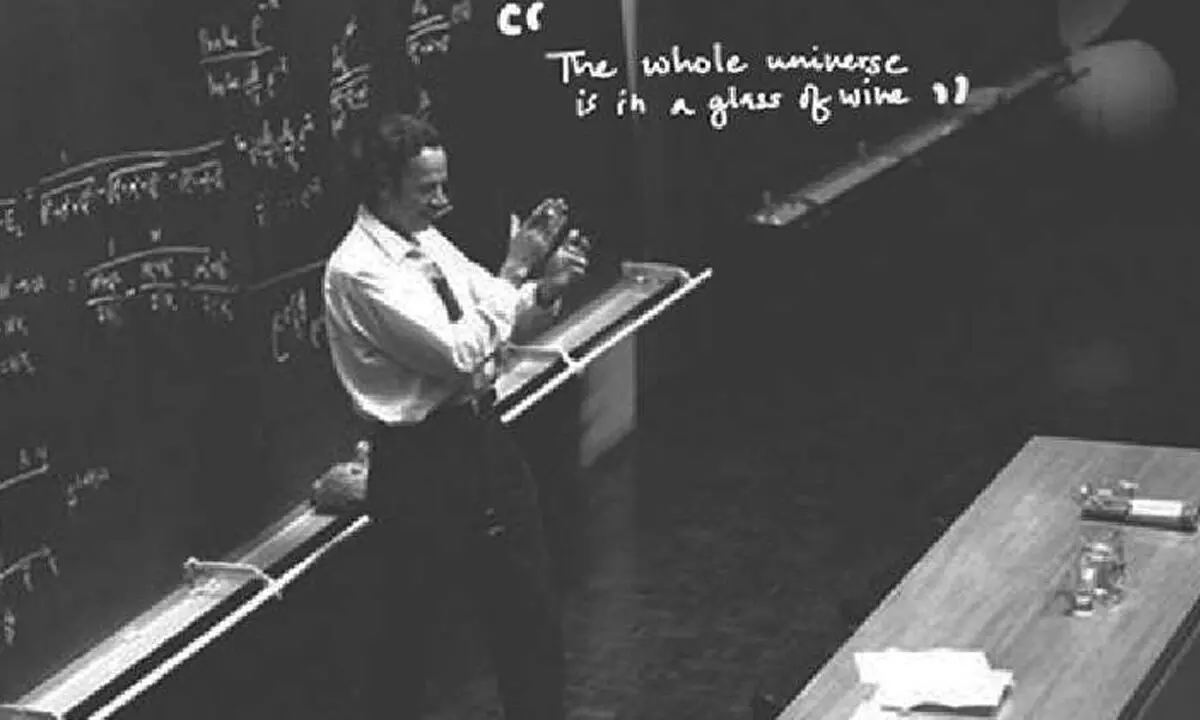
His path integral formulation of quantum mechanics is considered fundamental for understanding the subject, which plays a significant role in quantum algorithms’ development that is poised to shape the emerging landscape of artificial intelligence and quantum computing. Moreover, Feynman’s views on nature’s intricacies surpass human imagination, inviting us to appreciate life, the universe, and everything within it as an interdependent whole, unfolding at an immeasurably grand scale. This perspective parallels how thinkers from other fields, including Acharya Nagarjuna, have contemplated concepts resonating with ideas like “quantum consciousness” in our interdependent world (pratityasamutpada). At the same time, these ideas resonated with classical Indian thought in the concept of Acharya Nagarjuna’s “Sunyata,” which is often translated into English as “emptiness.” However, his ideas of a ‘relational view’ and ‘dependency of objects or entities’ and bonds between them resonate with the quantum entanglement and relational view approaches.