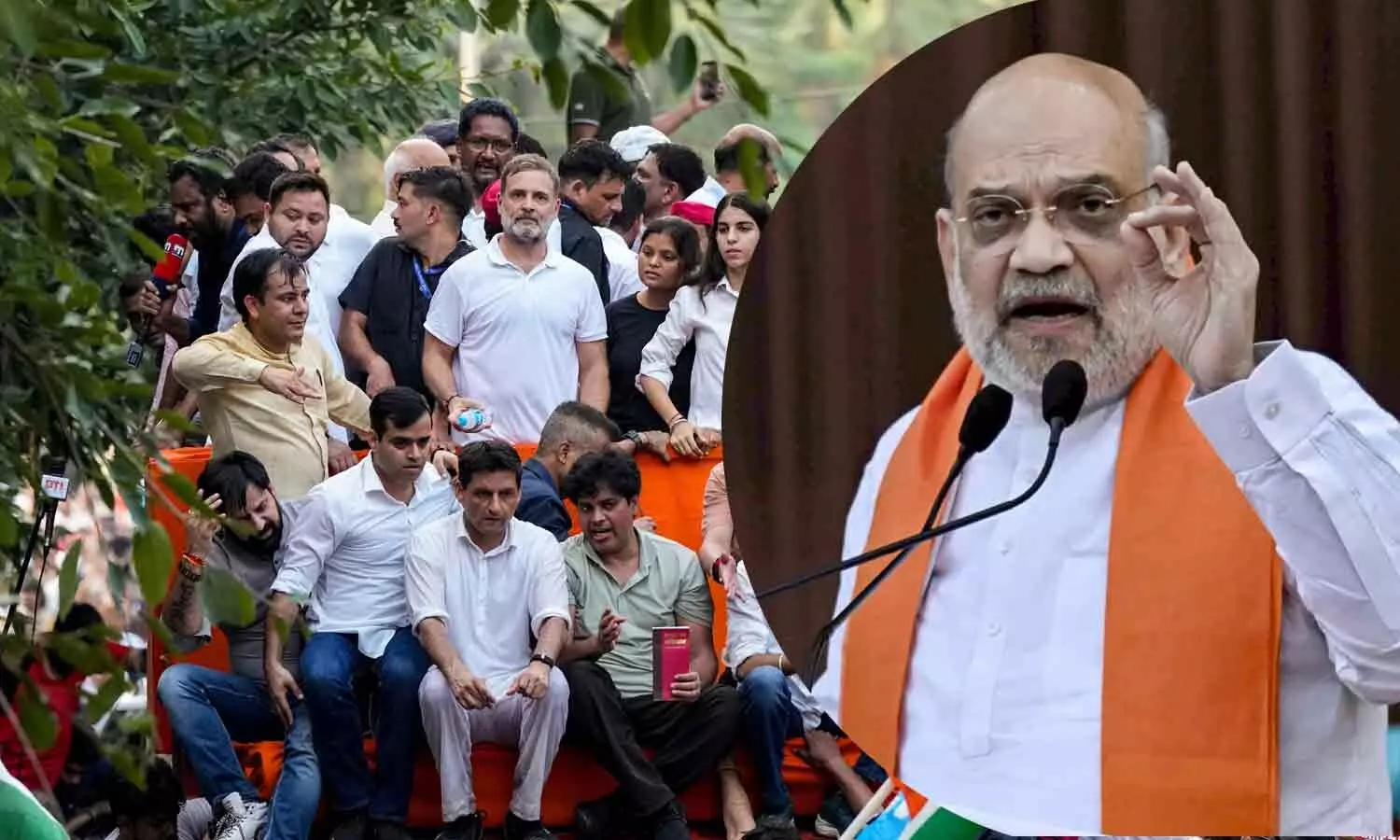
Cong’s November 1 Rally in Delhi to Remind People of the 1984 Anti-Sikh Riots: BJP

In Short

BJP leaders criticise Congress over its planned November 1 rally at Delhi’s Ramlila Maidan, linking the date to the 1984 anti-Sikh riots and escalating the political exchange over Rahul Gandhi and the party’s leadership.

Cong’s November 1 Rally in Delhi to Remind People of the 1984 Anti-Sikh Riots: BJP
X

Cong’s November 1 Rally in Delhi to Remind People of the 1984 Anti-Sikh Riots: BJP

Font size
FOLLOW ON Google News

Why did the Congress party choose November 1 for its rally at Ramlila Maidan? This has become an issue of war of words between the opposition, particularly the Congress and the BJP.

The BJP says that the Congress chose this day as it wants to remind the people of the anarchy of 1984, when the national capital witnessed the anti-Sikh riots following the assassination of the then prime minister Indira Gandhi.

built his political power by denying Sardar Vallabhbhai Patel his due and became Prime Minister despite receiving zero votes. During his tenure, the country witnessed Partition, one of the bloodiest chapters in human history," he said.

Trivedi pointed out that Nehru became Prime Minister of the Interim Government on September 2, 1946 and that the partition of the country took place during this period rather than in 1947.

The BJP leader also targeted former Prime Minister Indira Gandhi, alleging that she consolidated her political position after splitting the Congress. She asked her MPs to vote against the Congress party's official position during the presidential election involving Neelam Sanjiva Reddy, leading to the party's division. After the tragic assassination of Indira Gandhi, Rajiv Gandhi came to power amid the massacre of Sikhs in Delhi in 1984,” he said.

Now it was creating an anarchy-like situation and has been unsuccessfully trying to launch and re-launch Rahul Gandhi as its PM face despite his continuous failure to revive Congress and his near 100 defeats in various elections.

It may be recalled here that even the Prime Minister Narendra Modi, at a trade summit organised by an English news channel, said that even ISRO would not have launched as many satellites as the Congress party’s attempts to re-launch their leader.

On Thursday, the Union Home Minister Amit Shah also took a jibe at Rahul Gandhi, saying that Rahul connects more with people abroad while he always remains connected with the grassroots-level people, and that is why the BJP has been winning election after election. Rahul, he said, believes in street politics, while the BJP believes in its voters. He said the frustration of Congress of not winning elections was manifesting in the form of disrespect for constitutional bodies, and hence they were trying to undermine them by taking to street politics.

A Journey of Three Decades Time passes faster than we realise. What feels like a journey that began only yesterday has today grown into more than three decades of a meaningful and fulfilling life devoted to education, journalism, and the empowerment of young minds. My professional journey began with journalism training in New Delhi in 1979. I went on to work as an independent journalist, drawing on my fluency in both English and Telugu. Over the years, I have edited and worked on Telugu articles in both languages, an experience that strengthened my command of language and sharpened my understanding of society, people, and contemporary issues. Yet, my principal profession and enduring passion have always been teaching. My decision to become a teacher was not merely a career choice—it was a calling. Teaching offered me the rare privilege of inspiring young minds, guiding them through their formative years, and making a lasting difference in their lives. I found immense satisfaction in simplifying complex concepts, nurturing curiosity, encouraging independent thought, and building confidence among students. Every moment in the classroom—every question, every moment of discovery, and every spark of understanding—reminded me why I had chosen this path: to empower young people through knowledge, values, and essential life skills. My teaching career began at the grassroots level as a Montessori teacher and gradually progressed to the position of Vice Principal. I had the opportunity to work in reputed educational institutions, including Dilsukhnagar Public School in Hyderabad, where I shouldered both teaching and administrative responsibilities. Although I have always considered myself, at heart, a teacher, my administrative experience enabled me to understand and contribute to the education system from a much broader perspective. For my students, I have always tried to be an approachable and dependable presence—someone they could turn to not only for academic support, but also for guidance and emotional encouragement. At the same time, I developed a reputation as a firm disciplinarian who believed that integrity, fairness, responsibility, and discipline were fundamental to education. I was also consistently appreciated for maintaining clear communication with parents and staff and for ensuring that examinations and other academic processes were conducted with transparency, fairness, and efficiency. As my career progressed, however, I began to feel that academic education alone was not enough. This realization led me to work more closely with students following the SSC and CBSE curricula, while consciously bringing life-skills education into my teaching. I came to understand that education becomes truly meaningful when it prepares children not merely to pass examinations, but to face life. Teaching emotional resilience, self-reliance, social awareness, communication, decision-making, and other practical life skills often had a deeper and more lasting impact than academic achievement alone. I saw how these skills could help students navigate challenges with greater confidence, maturity, and responsibility. My academic background provided a strong foundation for this approach. My degree in Psychology from the University of Madras helped me develop a deeper understanding of young people's minds, their emotional needs, and the influence of their family and social environments. My M.A. in Telugu with First Class from Osmania University.

Next Story
Share it