




- Starlink vs Jio: Why Elon Musk May Be Racing Against Ambani in India
- Ahmedabad Gen Z Spends Up To Rs 15,000 On IV Drips Ahead Of Navratri
- BJP Leads in Bengal, TVK in Tamil Nadu Bypolls
- Take Immediate Action Against Offensive Social Media Content About Protests Govt
- Apple Teases October 13 Event: HomePad and New Smart Home Devices Expected
- Dussehra holidays for schools in Telangana to begin from tomorrow
- TG-TET 2026 for in-service application begins, deadline ends on 16 Oct
- Manchu Manoj Drops A Heartfelt Birthday Wish For His Dear Sister
Delhi Turns into a Fortress Amid Hectic Political Activity Against CEC
In Short
Delhi deploys over 26,000 police and paramilitary personnel amid INDIA bloc protests against Chief Election Commissioner Gyaneshwar Kumar, with traffic restrictions and heightened security across central Delhi.

Share :
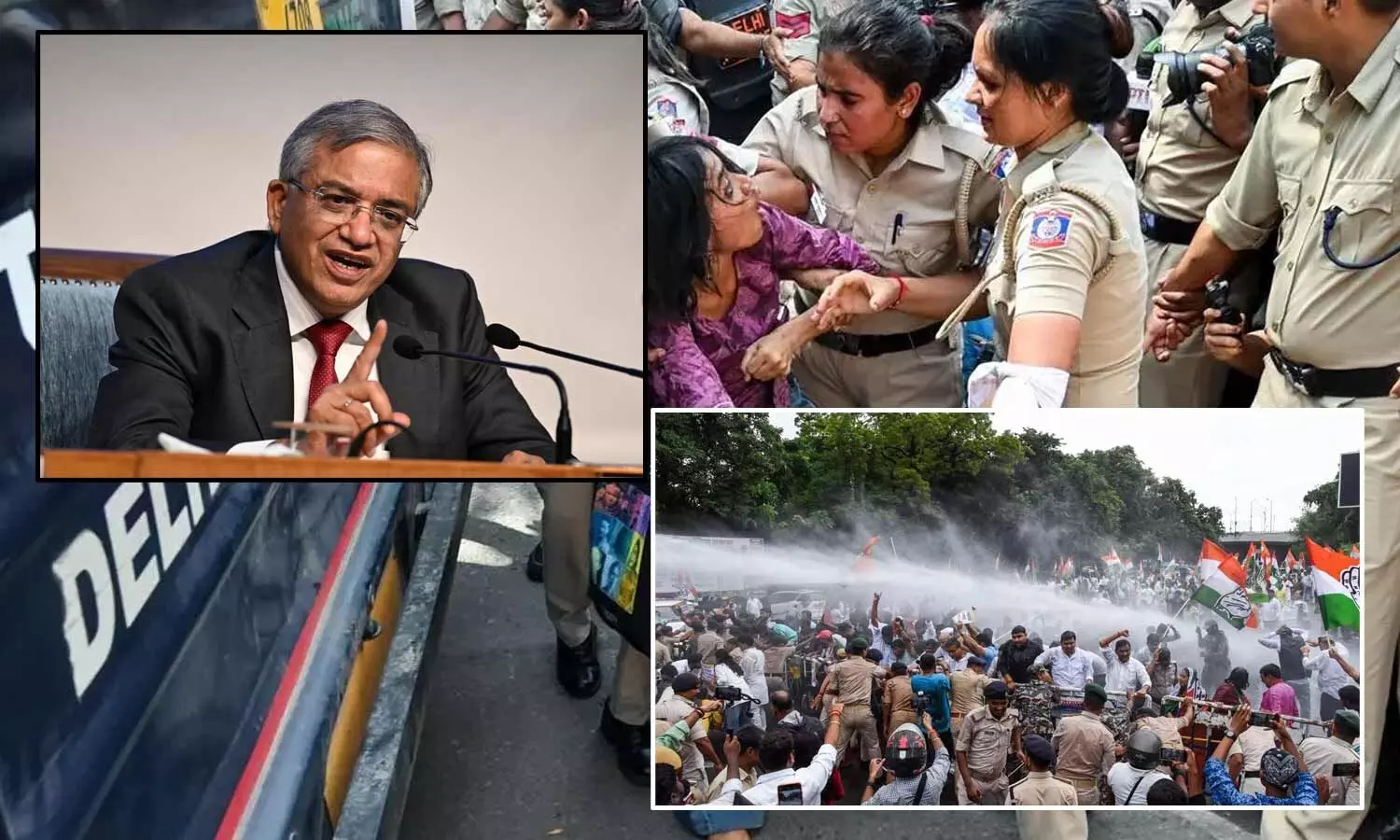
Delhi Turns into a Fortress Amid Hectic Political Activity Against CEC
Delhi has turned into a fortress, with heavy police deployment in view of the hectic political activities lined up to protest against Chief Election Commissioner Gyaneshwar Kumar.
On the one hand, a delegation of the INDIA bloc, led by Rahul Gandhi, will meet President Droupadi Murmu on Friday to submit a memorandum demanding the removal of the CEC and the cancellation of the Special Intensive Revision (SIR) process. The MPs will assemble at the old Parliament House and take out a rally towards Rashtrapati Bhavan.
On the other hand, the Delhi Police face the major task of maintaining public order, as the CJP has called for a protest rally at Jantar Mantar on Saturday. The police had a bitter experience in July when the CJP staged a protest.
The Delhi Police had a bad experience in July when the Cockroach Janata Party demanded the resignation of Education Minister Dharmendra Pradhan over the NEET paper leak issue. The police failed to prevent anti-social elements from infiltrating the protest, leading to clashes between the police and protesters, in which more than 100 police and CRPF personnel were injured.
A senior police officer said permission for the CJP to hold the protest had been denied. According to the police, the rules require an application seeking permission to be submitted at least 10 days before the proposed protest, a requirement the CJP had not met. Moreover, the police said that during the July protest, when permission had been granted, the organisers had violated the rules and breached the undertakings they had given.
The police also alleged that several criminal elements had joined the protest. In view of these circumstances, the police decided to deny permission to the CJP. They have also imposed restrictions under Section 163 of the Bharatiya Nagarik Suraksha Sanhita (BNSS).
Earlier, CJP leader Sourav Das alleged that the police would arrest party members ahead of Saturday's rally.
Unwilling to take any chances, the Railways decided to cancel several major trains operating from two railway stations to prevent activists from reaching Delhi. Around 57 metro stations are also expected to be closed on Saturday.
The police have urged commuters to plan their journeys and follow traffic advisories, as restrictions and diversions may affect movement in central Delhi.
More than 26,000 police and paramilitary personnel have been deployed across central Delhi. Security has been tightened around Parliament, Connaught Place, Jantar Mantar and other sensitive locations.
Police teams are keeping a close watch on potential gathering points and routes leading towards Rashtrapati Bhavan. Additional contingents of Central Armed Police Forces have been mobilised to secure key roads.
The police are unwilling to take any chances, given the alleged attacks by some Congress activists on police personnel on Thursday and Friday. Several policemen and women reportedly fell to the ground, sustained injuries and were manhandled. The Congress, however, dismissed the allegations as blatant lies.
Amid the standoff, the police erected pickets and barricades at strategic points. They also appealed for peace near Shahi Masjid in Chandni Chowk, urging people not to be swayed by provocations or believe rumours, particularly as Friday prayers were scheduled to take place.
Supreme Court gives nod for local body elections in AP
Delhi Turns into a Fortress Amid Hectic Political Activity Against CEC
Supreme Court dismisses AP’s Petition on 34 % BC reservations
Bypoll Results 2026: BJP Leads In Bengal And Assam, Vijay’s TVK Faces Test In Tamil Nadu
Dasara holidays for schools to begin from tomorrow in AP
'For saving democracy': Congress leader on INDIA bloc protests against CEC


