India’s electronics exports cross $40 billion: Vaishnaw

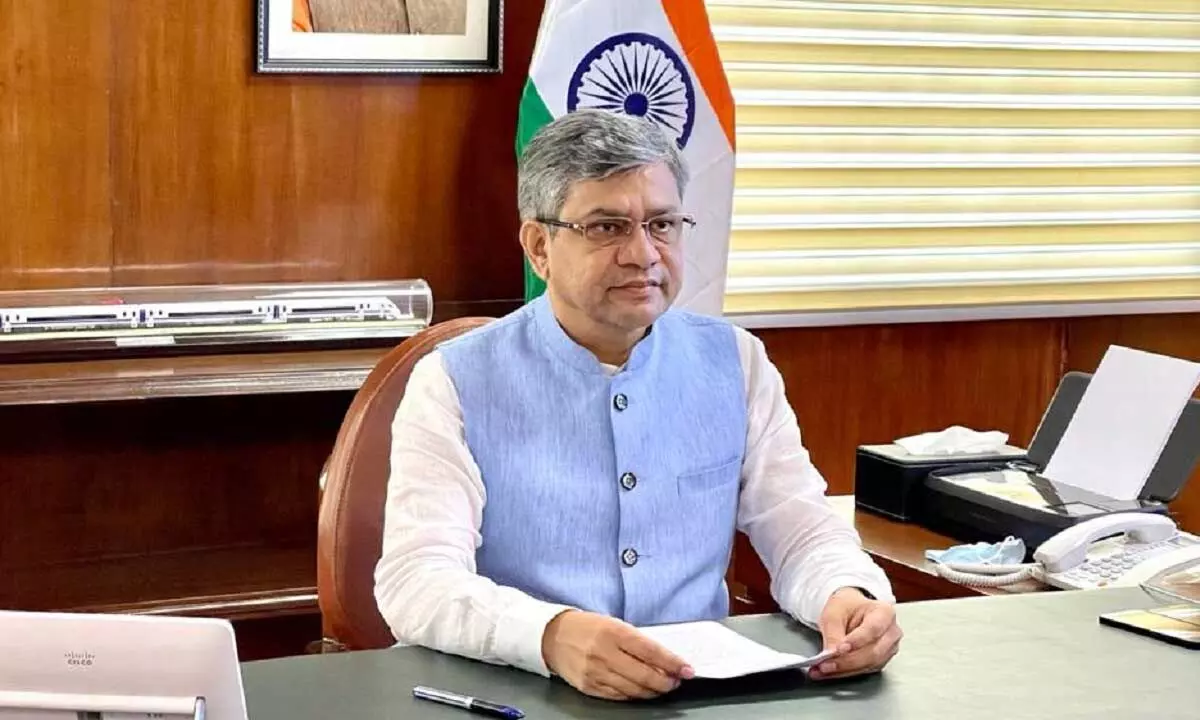
Railway Minister Ashwini Vaishnaw(File Photo)
Hyderabad: Union Minister Ashwini Vaishnaw on Saturday announced a major leap in India’s electronics manufacturing sector, stating that exports have crossed the $40 billion mark — an eight-fold growth over the past 11 years. Domestic electronics production has also increased by 6 times, reflecting a strong upward trajectory in India’s digital economy.
Speaking at the 14th Convocation of IIT Hyderabad, Vaishnaw attributed this exponential rise to Prime Minister Narendra Modi’s strategic vision. “In just 11 years, we’ve multiplied electronics production six times and exports eight times. This kind of double-digit CAGR is rare globally,” said Vaishnaw.
Highlighting India’s advancements in telecommunications, Vaishnaw revealed that the country had successfully developed a complete 4G telecom stack within three and a half years. The stack is now deployed across nearly 90,000 telecom towers, surpassing the network coverage of many developed nations. To enhance innovation, the government has established 100 dedicated 5G labs, providing students with hands-on experience in real-world applications of next-generation wireless technologies.
Turning to the semiconductor sector, the minister stated that India is poised to manufacture its first commercial-scale Made-in-India chip within this year. He expressed optimism that India would soon rank among the top five semiconductor-producing nations, highlighting the country’s increasing focus on capital equipment and materials crucial for chip manufacturing. Vaishnaw also announced a large-scale talent development initiative aimed at skilling the semiconductor workforce. The Centre has distributed the latest Electronic Design Automation (EDA) tools from global leaders — Cadence, Synopsys, and Siemens — to 270 colleges and institutions. Including startups, the reach extends to 340 institutions. “No other country has launched a semiconductor talent program of this magnitude,” Vaishnaw remarked. In the transport sector, India’s first bullet train is making steady progress, and it is expected to be operational by August or September 2027. Meanwhile, the Indian Railways has already advanced to manufacturing version three of the Vande Bharat train at the Integral Coach Factory in Chennai, showcasing significant strides in indigenous railway engineering.
Vaishnaw cited five foundational pillars for India’s technological rise — electronics manufacturing, artificial intelligence, semiconductors, the telecom sector, and railways — positioning them as key drivers for the country’s next-generation growth and global competitiveness. Let me know if you’d like this adapted into a press release format or designed as a digital feature. Medak MP M Raghunandan Rao and senior officials of the university were present. Later, the minister visited the TiHAN: India’s first autonomous navigation testbed for aerial and terrestrial systems of IIT Hyderabad, driving research and innovation in self-driving vehicles and drones.