Telangana’s AI school curriculum faces cognitive crossroads?

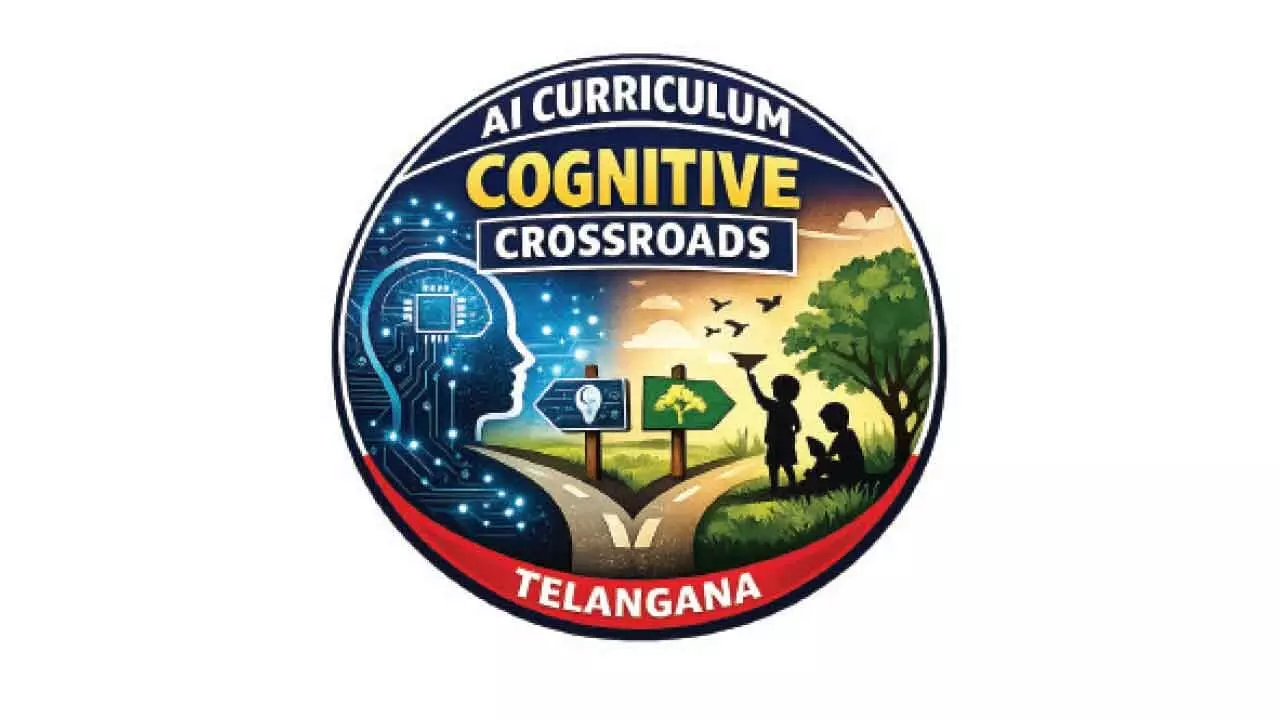
Policy Driven by Tech Voices-Telangana’s School Education Department is drafting AI modules with inputs largely from IT professionals and industry leaders
Hyderabad: Is the State School Education Department blindly embracing the push of the Telangana government to embed Artificial Intelligence into school education without due diligence? If current developments are any indication, while policymakers and technology experts hail the initiative as a forward-looking step to prepare children for a digital future, cognitive researchers warn that the move disregards decades of scientific understanding about how human cognition evolved and how children naturally learn.
The School Education Department, working closely with IT professionals and industry leaders, is drafting AI modules for classrooms across the state. Citing the policy thrust and priorities of the government, officials argue that early exposure to AI will equip students with computational skills, algorithmic thinking, and digital literacy. However, critics point out that the policy framework is being shaped almost entirely by voices from technological fields, effectively sidelining fundamental sciences such as physics, life sciences, and cognitive psychology.
These disciplines emphasise that cognition is not merely computational but deeply rooted in embodied, ecological, and social processes shaped by evolution. This development is pegged as evolutionarily empowered by millions of years of non-computational processes of the human mind.
Speaking to The Hans India, a Professor of Physics from a Telangana State University pointed out that research in cognitive science highlights that the minds of children evolved to learn through movement, play, and sensory interaction with their environment.
They perceive opportunities for action directly from their surroundings and develop intelligence through imitation, empathy, and collective play. These evolutionary modes of cognition ensure adaptability, creativity, and resilience without reliance on abstract computation. The implications are that, in contrast, AI-driven education risks disrupting these natural pathways. Screen-based platforms reduce tactile and sensorimotor engagement, weakening embodied learning. Algorithmic tools encourage rule-based thinking, overshadowing intuitive problem-solving. AI tutors and chatbots may displace peer-to-peer learning, limiting empathy and collective intelligence.
Gamified systems fragment attention, impairing deep focus and sustained inquiry. Early exposure to algorithmic bias and surveillance cultures risks shaping cognition around external validation rather than intrinsic curiosity. Despite these concerns, the AI education policy of Telangana is moving ahead rapidly.
According to sources in the State Education Department, policy inputs are mostly from IT professionals, either from academics or industry. However, when asked, they pointed out that there is little consultation with cognitive scientists. All this is turning into policy-making to make children be treated as miniature engineers rather than explorers shaped by evolutionary learning.
The focus of the State Education Department and a bunch of experts called to serve was to design curricula as if computation alone defines intelligence. While research shows evolution has given humans embodied, ecological, and social cognition that cannot be replaced by algorithms, there remains an absence of interdisciplinary dialogue before finalising the curriculum for children as part of school education policies.
It raises questions about long-term impacts. While AI literacy is undeniably important, experts insist it must be balanced with embodied play, ecological exploration, and social learning. Otherwise, children may grow adept at symbolic manipulation but lose resilience in real-world adaptive problem-solving. The initiative reflects a tension regarding whether education should prioritise computational skills for future jobs or preserve evolutionary modes of cognition that underpin creativity and adaptability.
The answer, researchers argue, lies in balance by integrating AI as a complement, not a replacement, for natural learning processes. As the state moves forward, the challenge will be to ensure that AI in schools enhances curiosity and innovation without eroding the evolutionary foundations of human intelligence. The debate is not about rejecting technology, but about designing education that respects the natural trajectory of cognition while preparing children for the digital age, say the experts.