Delimitation buzz reshapes political equations in erstwhile Chittoor district

- Rise in Assembly and Lok Sabha seats keeps leaders guessing over reservations
- Speculation rife over constituencies that may be reserved for women
Chittoor: Political activity in the erstwhile Chittoor district has gathered momentum following the Centre’s decision to increase the number of Lok Sabha and Assembly constituencies and undertake delimitation ahead of 2029 elections, a move expected to significantly redraw the region’s electoral landscape.
The proposed implementation of women’s reservation in State Assemblies and Parliament from 2029 has further intensified political discussions, with leaders closely tracking constituencies that may be earmarked for reservation.
The Centre is learnt to have decided on increasing the number of Lok Sabha and Assembly constituencies by nearly 50 per cent and is expected to introduce the relevant legislation during the ongoing session of Parliament.
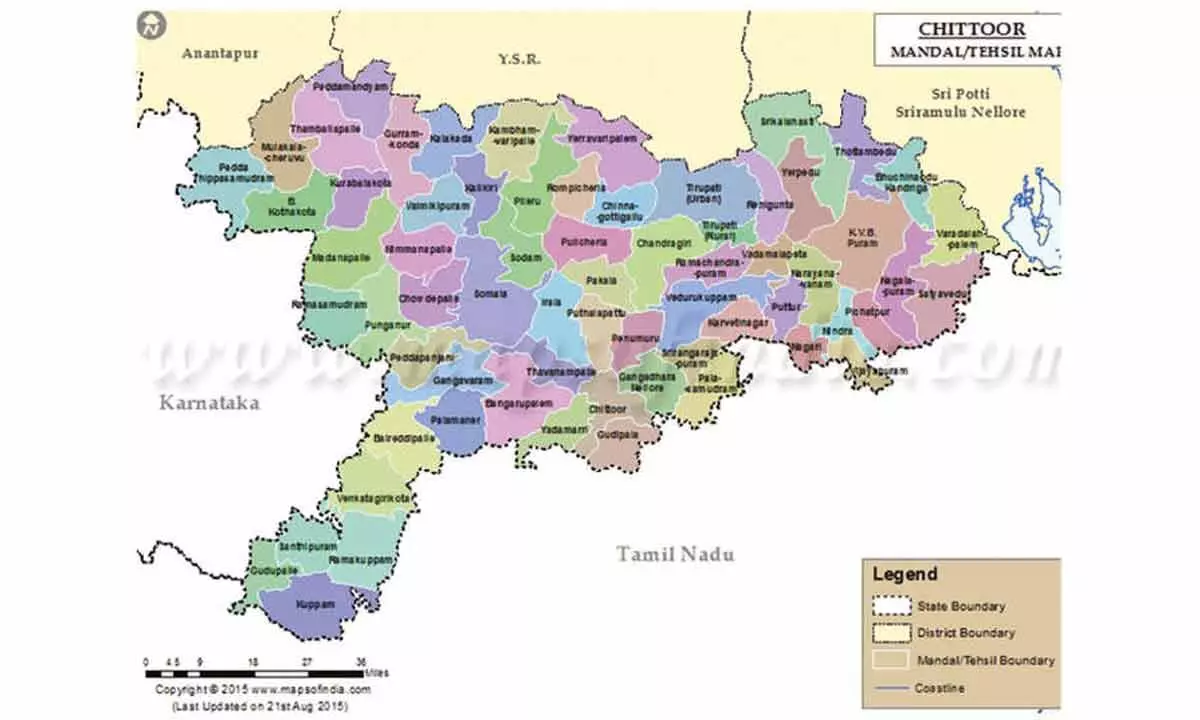
If implemented, the exercise is likely to bring substantial political and administrative changes in the erstwhile Chittoor district. At present, the united Chittoor district has 14 Assembly constituencies. A 50 per cent increase could raise the number to around 21 or 22 segments. Among the reorganised districts, Tirupati currently has the highest number of Assembly constituencies in the state, with nine segments.
Tirupati, Chandragiri, Srikalahasti, Satyavedu, Railway Koduru and Sullurupeta constituencies fall entirely within Tirupati district, while Nagari, Venkatagiri and Gudur constituencies extend partially into its jurisdiction.
During the proposed delimitation exercise, the number of constituencies in Tirupati district is expected to increase to 12 or 13. Political circles speculate that new constituencies such as Tirupati Rural, Renigunta and Naidupeta may be carved out. There is also a possibility of reviving the Puttur Assembly constituency, which existed prior to the previous delimitation, through reorganisation of neighbouring mandals.
In Chittoor district, Chittoor, Kuppam, Palamaneru, Puthalapattu and GD Nellore constituencies lie fully within district limits, while Nagari and Punganur fall partly within them.
If restructuring is undertaken along parliamentary segment lines, the seven Assembly constituencies presently under the Chittoor Lok Sabha seat could increase to 10 or 11.
Apart from the existing Chittoor and Tirupati parliamentary constituencies, a new Lok Sabha seat is likely to be created, with Madanapalle emerging as a probable headquarters. Of the three parliamentary constituencies, one may remain a general seat, while Tirupati and Chittoor are currently reserved for Scheduled Castes.
Speculation within political circles suggests that Bangarupalyam, Pakala and Puttur Assembly constituencies may be newly formed, while Nagari constituency could continue with minor territorial adjustments. Major changes are not anticipated in Kuppam constituency, which presently comprises four mandals.
However, Peddapanjani mandal in Palamaner constituency, which is earlier part of Punganur, may again be shifted, potentially leaving Palamaner along with V Kota, Baireddipalle and Gangavaram mandals.
There are also indications that Pileru and Vayalpadu could re-emerge as separate constituencies, similar to the pre-2009 arrangement.
Meanwhile, the proposed implementation of women’s reservation has added another layer of political uncertainty.
Tirupati, Chandragiri, Palamaneru, Srikalahasti and Madanapalle constituencies are being discussed as possible women-reserved seats based on demographic considerations.
As all these segments are currently represented by male legislators, the changes could significantly reshape the political equations in the region ahead of the 2029 elections.