Vizag Economic Region to be nat’l pharma hub by 2032

Amaravati: The Visakhapatnam Economic Region (VER), already one of India’s most significant manufacturing bases with a preponderance of pharmaceutical units, is now positioning itself to emerge as the country’s largest pharma cluster by 2032, under a strategy that combines large-scale manufacturing expansion with a decisive push into research-led life sciences and high-end medical devices.
Currently, the VER contributes an estimated 7-8 per cent of India’s pharmaceutical gross value added (GVA) and nearly 90 per cent of Andhra Pradesh’s pharma output, an unusually high concentration for a sub-regional economy.
In absolute terms, its pharma GVA of about US $ 1.4 billion in 2023 places it close to major pharma-producing states such as Telangana and Himachal Pradesh, highlighting the region’s industrial density and productivity.
State planners now aim to convert this scale advantage into national leadership. The blueprint rests on three major interventions covering innovation, medtech manufacturing and bulk drug production, designed to elevate the VER from a manufacturing-heavy base to a full-spectrum life sciences ecosystem.
The centre-piece is a proposed 3,000-acre greenfield integrated life sciences cluster in Srikakulam, envisioned as a “Boston-like” hub for pharmaceutical research and innovation. The cluster is planned to host an institute of national importance, the ‘National Institute of Pharmaceutical Education and Research (NIPER), alongside drug testing laboratories, shared R & D and manufacturing facilities, incubation centres for startups, and supporting commercial infrastructure. The intent is to anchor talent, research, and early-stage innovation locally, reducing dependence on traditional pharma hubs outside the state.
Alongside this, the government plans a 500-acre Medical Devices Manufacturing Zone 2.0, focused on electronic and high-value medical equipment such as imaging and diagnostic devices. While the VER already hosts India’s third largest medtech cluster by GVA, behind only Gurgaon and Hyderabad. the new zone is aimed at pushing the region up the value chain and reducing India’s import dependence in critical medtech segments.
The third pillar is the expansion of bulk drug manufacturing through a 2,000-acre Bulk Drug Park at Nakkapalli in Anakapalli district. The focus here is on accelerating occupancy and production to strengthen domestic active pharmaceutical ingredient (API) capacity, a vulnerability exposed during recent the global supply-chain disruptions. The park is expected to support both domestic formulations and export-oriented units, reinforcing India’s broader pharmaceutical self-reliance agenda.
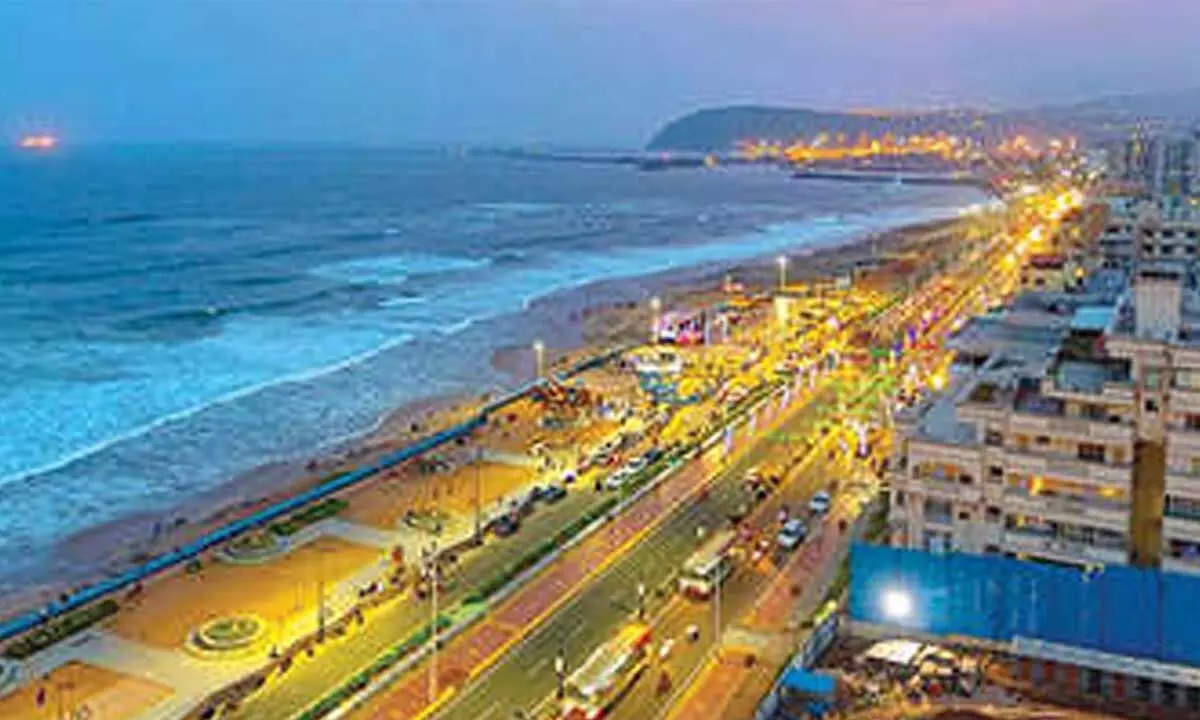
Spatially, the strategy leverages the VER’s coastal industrial geography. Existing pharma and medtech clusters, the new MedTech Zone 2.0, and the Nakkapalli bulk drug park are aligned along the Visakhapatnam–Anakapalli belt, while the life sciences cluster in Srikakulam creates a new northern growth node. Proximity to ports and established industrial corridors is expected to underpin export competitiveness and logistics efficiency.
Officials said that this combination of scale, sophistication, and innovation could embolden the VER to challenge established leaders such as Gujarat and Maharashtra in the coming decade. With manufacturing depth across APIs, formulations, and devices, and a planned shift towards research-driven growth, the VER is being positioned not merely as another industrial cluster, but as a nationally significant life sciences economy within a compact regional footprint.
If executed on schedule, the strategy could redefine India’s pharma cluster hierarchy by 2032, elevating Visakhapatnam from a dominant state-level hub to the centre of the country’s pharmaceutical and medtech ecosystem.