India set to become 3rd-largest economy with $7.3-trn GDP

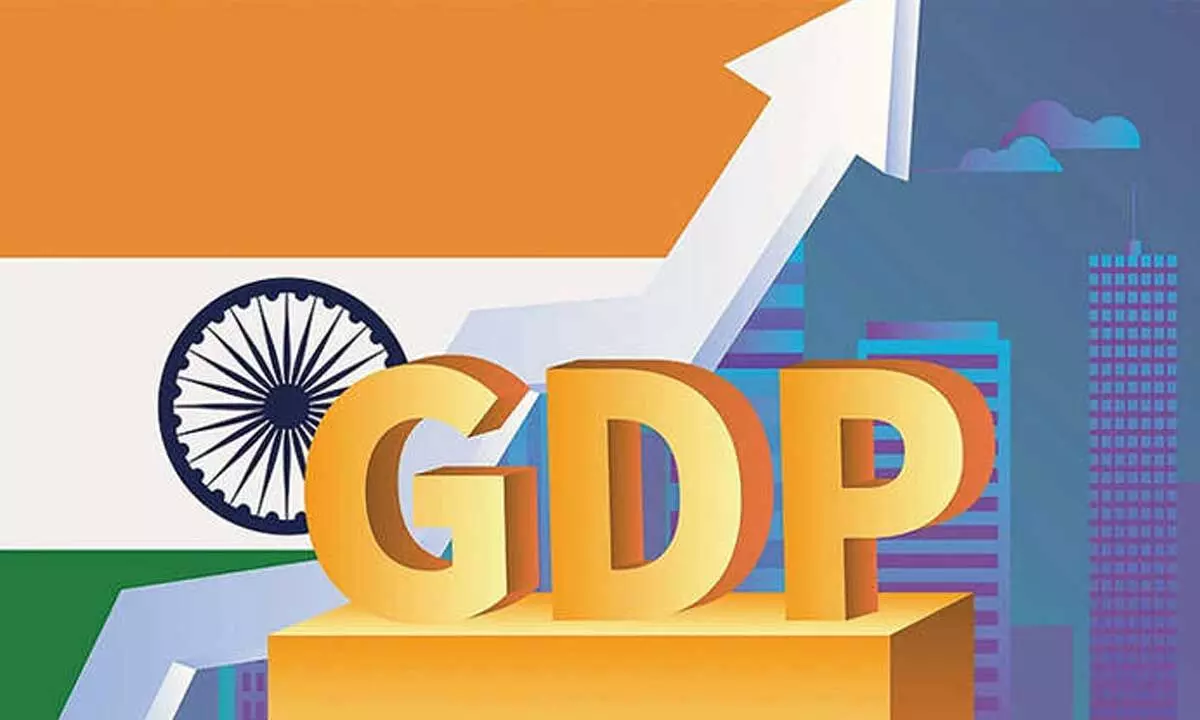
New Delhi: WithGDP valued at $4.18 trillion, India has surpassed Japan to become the world’s fourth-largest economy and is poised to displace Germany from the third rank in the next 2.5 to 3 years with projected GDP of $7.3 trillion by 2030, an official statement said on Monday.
The growth momentum further surprised on the upside, with GDP expanding to a six-quarter high in Q2 of 2025-26, reflecting India’s resilience amid persistent global trade uncertainties.
Domestic drivers-led by robust private consumption-played a central role in supporting this expansion, according to the statement.
India’s real GDP grew 8.2 per cent in Q2 FY2025-26, up from 7.8 per cent in the previous quarter and 7.4 per cent in Q4 of 2024-25, led by resilient domestic demand amidst global trade and policy uncertainties. Real gross value added (GVA) expanded by 8.1 per cent, catalysed by buoyant industrial and services sectors.
High-frequency indicators point to sustained economic activity: inflation remains below the lower tolerance threshold, unemployment is on a declining trajectory, and export performance continues to improve. Furthermore, financial conditions have stayed benign, with strong credit flows to the commercial sector, while demand conditions remain firm, supported by a further strengthening of urban consumption.
“India is among the world’s fastest-growing major economies and is well-positioned to sustain this momentum. With the ambition of attaining high middle-income status by 2047 -- the centenary year of its independence -- the country is building on strong foundations of economic growth, structural reforms, and social progress,” according to the statement. The RBI revised India’s GDP growth forecast for FY 2025-26 upwards to 7.3 per cent from the earlier estimate of 6.8 per cent.
India’s domestic growth is on an upward trajectory owing to multiple factors such as- robust domestic demand, income tax and goods and services tax (GST) rationalisation, softer crude oil prices, front-loading of Government capital expenditure (CAPEX), along with facilitative monetary and financial conditions, supported by benign inflation.