A radiant assembly of Indian mystics and persian qalandars

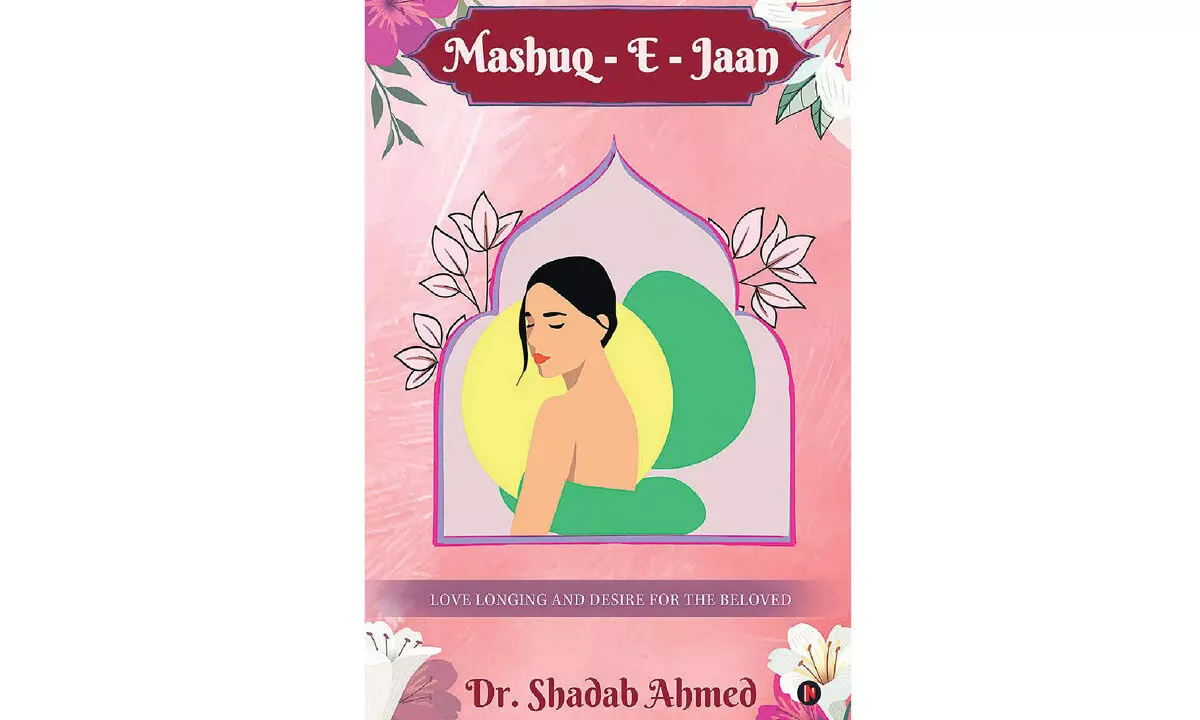
‘Mashuq-E-Jaan’ by Dr. Shadab Ahmed commemorates and salutes the atmosphere and aura of love, longing, and desire for the beloved through the lens of Indo-Persian history and the prism of ethnic trans-culturation.
This book boldly declares spiritual and mystical poetry as two of the most popular forms of devotion to the beloved. The verses in the book are carefully selected and edited from the Indian heartlands and Persian frontiers. Readers encounter a fascinating and captivating blend of Indian dramatists sharing space with Persian qalandars, and seeing them co-existing in a single volume of translated poetry is unadulterated literary grace. On one hand, you have the Indian leviathans—Kalidasa, Rajasekhara,Kabirdas, Jayadeva, and Jagannatha Panditaraja—churning out their prognostications of erotic love, alongside the Persian heavyweights Jalal-ud-Din Muhammad Rumi, Abolqasem Ferdowsi, Saadi Shirazi, Attar Naishapur, and Baba Taher, who prophesy the mystical elements of love in transcendental fashion.
Through the passages of the book, the reader can discern that eroticism and mysticism in love often appear confusingly entangled and inextricable. It becomes difficult to distinguish whether there is erotic love camouflaged under the illusion of mysticism, or mystical spiritual love tacitly masquerading as erotic proclivity. The book stands testament to the fact that, despite sensual reproach and carnal suppression, poets from both the Indian heartlands and Persian frontiers dared to write candidly and canonize their sybaritic love for the beloved. Many of them vanished, engulfed and eclipsed into their beloved; others dispersed, subsumed, and merged subconsciously with their demiurge.
Overall, ‘Mashuq-E-Jaan’ is a collection of translated shlokas, kavyas (both shravyas and drishyas), bhakti-kavyas, mahakavyas, khandakavyas, sangam-kavyas, natakas, champus, qitahs, masnawis, tadhkiras, divans, ghazals, and rubais. The verses and passages are meticulously researched and edited, accurately transmitting the quintessence and abstraction in which they were produced. Compositions from Sanskrit, Pali, Prakrit, Brajbhasha, Arabic, Persian, and Turkish are translated into conventional American English to cater to an international readership. There is a distinct magnetism and allure within the pages and narratives, but nothing less is expected from the Indian playmasters and Persian qalandars. This book is a definite addition to the library of any connoisseur of the genre.
(The writer is an internationally acclaimed literary critic and the founder of Authors Paradise Literary Group.)