Bharat’s AI bet on creativity

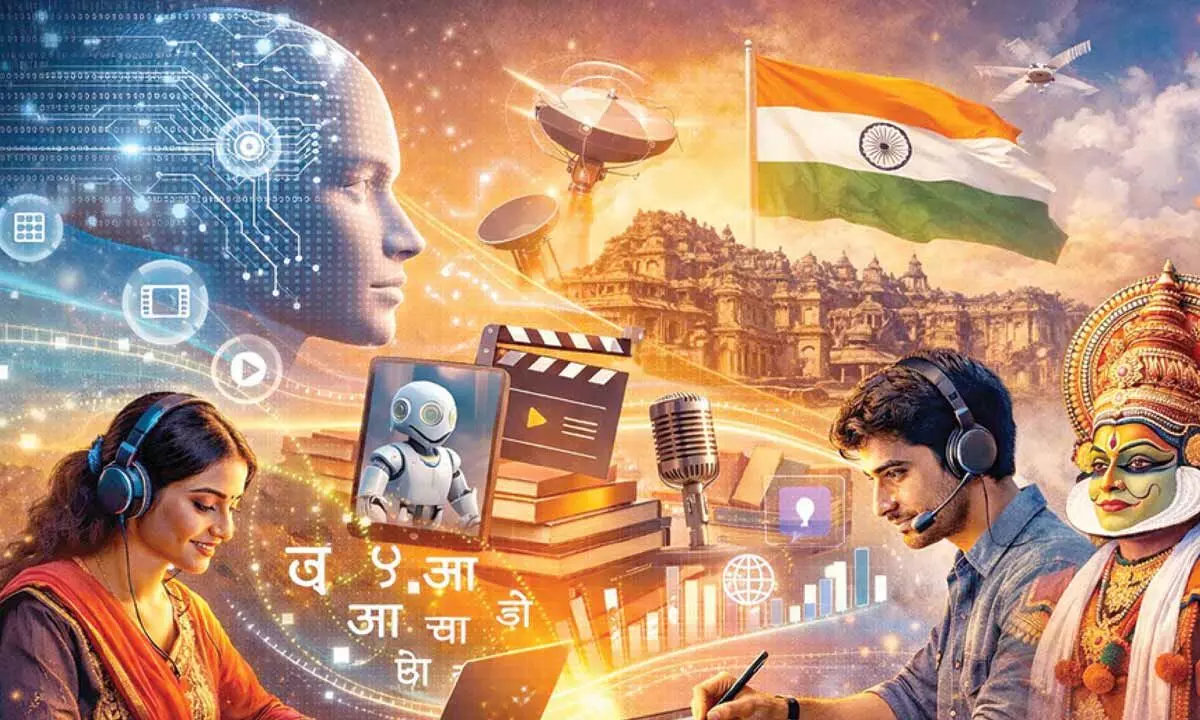
When business leaders discuss Artificial Intelligence (AI), the focus usually rests on productivity, automation, and cost optimisation. Yet Bharat’s AI journey is unfolding along a less obvious, but potentially more powerful path. The country is deliberately aligning AI with the creative economy, positioning culture, content, education, and intellectual property as serious engines of growth. At the centre of this strategy lies a simple insight with far-reaching implications: creativity scales only when technology understands language.
Globally, the creative economy already contributes more than USD 2 trillion annually and employs nearly 50 million people, according to UN estimates. In Bharat, the opportunity is even more compelling. Government and industry assessments value the media and entertainment sector at over ₹2.3 lakh crore, growing at double-digit rates. Add education technology, gaming, animation, digital design, advertising, publishing, cultural tourism, and creator-led enterprises, and the creative economy begins to resemble a core business sector rather than a cultural sidebar.
AI is accelerating this shift. Tasks that once required large teams—editing video, designing graphics, translating content, or generating learning material—can now be performed by individuals or small firms. This compression of cost and time has a direct business outcome: creativity becomes scalable, repeatable, and monetisable.
A People-Centric AI Strategy
Bharat’s approach to AI differs from that of many advanced economies. Rather than framing AI primarily as an industrial efficiency tool, the country has positioned it as a participatory national capability under Digital India. This philosophy is now formalised through the IndiaAI Mission, steered by the Ministry of Electronics and Information Technology.
The IndiaAI Mission commits significant public investment to shared AI compute infrastructure, open datasets, and startup enablement. Instead of concentrating resources solely on frontier model development, the policy focus is on application-layer innovation, where real economic value is created. For creative industries, this distinction matters. The value of AI here lies not only in the sophistication of algorithms, but in how effectively technology amplifies human imagination and cultural expression.
Language: The Real Economic Infrastructure
Bharat’s creative potential cannot be unlocked through English alone. Government data consistently shows that over 90% of new internet users prefer content in local languages, and vernacular users are growing much faster than English-language users. Creativity in storytelling, teaching, humour, and design emerges most naturally in one’s mother tongue.
This reality explains the strategic importance of Bhashini, the National Language Translation Mission. Bhashini provides open APIs for speech-to-text, text-to-speech, and translation across Indian languages, enabling startups and enterprises to build multilingual products without prohibitive costs.
For business, the implications are clear. A course created in Hindi can be sold across Tamil, Telugu, Marathi, and Bengali markets. A regional storyteller can reach national or global audiences. A small business can advertise and engage customers across linguistic boundaries. Language ceases to be a constraint and becomes a market-expansion tool.
Platforms Powering Creative-AI Startups
The country’s policy ecosystem actively supports AI startups targeting creative sectors. Under the IndiaAI Mission, startups gain access to shared compute resources and public datasets—critical inputs that are otherwise expensive and scarce. This allows founders to focus on applications such as AI-assisted video production, animation pipelines, design automation, and personalised content engines.
The wider startup landscape, supported by Startup India, reinforces this momentum. With more than 1.25 lakh registered startups, Bharat has one of the world’s largest entrepreneurial ecosystems. A growing segment operates at the intersection of AI and creativity, building tools for creators, educators, marketers, and media companies.
Bharat’s Digital Public Infrastructure (DPI) further strengthens this advantage. Open, interoperable systems for identity, payments, and language services reduce friction for experimentation and scaling. Creative startups can integrate AI, monetisation, and distribution quickly, without building proprietary stacks. Few global markets offer this combination of scale, openness, and linguistic reach.
Education as a Creative Supply Chain
From a business perspective, the long-term impact of AI-enabled creativity will be felt most strongly through education. AI tools are transforming classrooms into creation spaces. Students are producing podcasts, videos, comics, games, and interactive learning artefacts—often in local languages.
This aligns with the country’s education reforms that emphasise experiential learning and multidisciplinary thinking. For industry, this signals a future workforce that is not merely job-ready but idea-ready—comfortable with creation, collaboration, and cultural context.
Creators as Micro-Businesses
Perhaps the most visible outcome of Bharat’s AI strategy is the rise of creators as micro-enterprises. Language-enabled AI tools allow individuals to build sustainable livelihoods without English fluency, large studios, or corporate backing. A smartphone, cultural insight, and access to AI are increasingly sufficient.
This shift is especially powerful for youth in tier-2 and tier-3 cities, women entrepreneurs, and rural or traditional artists. Creativity becomes income. Culture becomes commerce.
A Strategic, Not Accidental, Advantage
Bharat’s edge in the global creative economy is not accidental—it is civilisational. The country possesses a living archive of stories, traditions, and knowledge systems. By aligning AI policy with language inclusion, open platforms, and startup enablement, India is converting that depth into economic value.
For business leaders, the message is unambiguous. The next phase of the country’s growth will not come only from factories or software services. It will come from ideas expressed at scale, across languages, powered by AI.
Bharat is not just preparing for the future of work.
It is preparing for the future of expression as an industry.