The celestial assimilation: Anand’s mastery

Eternity is not their cup of tea, The Beauty of their living lies in their mortality. — Anand
Seneca Award laureate Dr. Jernail Singh Anand is a towering literary figure whose work embodies a rare fusion of creativity, intellect, and moral vision. Credited with an opus of 190 books, Dr. Anand has been honoured with prestigious international recognitions such as The Charter of Morava (Serbia), Franz Kafka (Germany, Ukraine, Czech Republic), and Maxim Gorky (Russia) Awards. His name also adorns the Poets’ Rock in Serbia, a testament to his global literary influence.
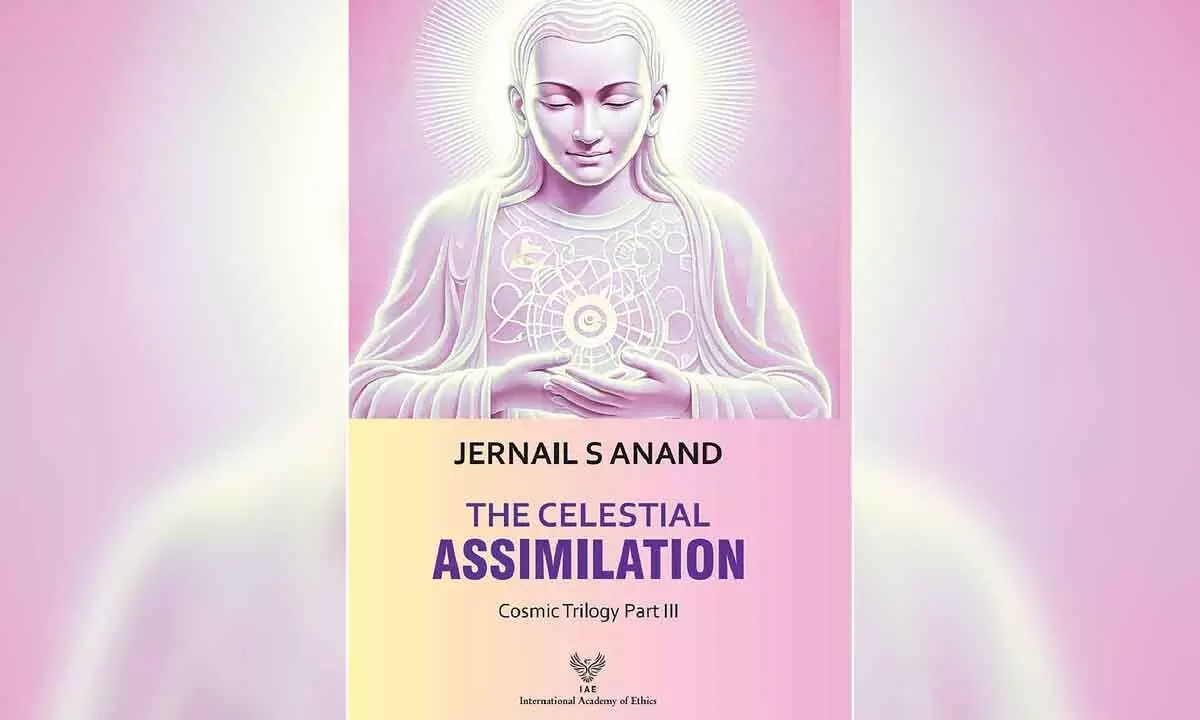
‘The Celestial Assimilation’ is Book III of his Cosmic Trilogy, which opens with ‘The Alternate Universe’ [Book I] and continues with ‘The Divine Order Crashes’ [Book II].
‘The Alternate Universe’ introduces Craza, a techno-king who seeks to enhance humanity with the help of artificial intelligence and usher in an era of transparency in divine operations. His innovations ring alarm bells for Lustus, a neo-mythological demonic figure from the Mahakaal Trilogy, who emerges as the corporate successor of Satan. Lustus, with the aid of Helen of Troy and Cleopatra, sets a honey trap for Craza—but the plan misfires spectacularly.
In ‘The Divine Order Crashes’ [Book II], the gods and goddesses, fearing Craza’s transparency, conspire to preserve the Mystery—the essential element that sustains the human fear of the Divine. The narrative deepens into existential questions about free will, human independence, and the conflicting interests between Craza, Lustus, and the gods themselves.
‘The Celestial Assimilation’ resolves these cosmic tensions. Here, God asserts His might, revealing that Craza and Lustus are not adversaries but essential forces maintaining universal balance—where even machines earn a sacred place in creation:
“A harmonious relationship
Between the five realms of creation,
Vegetation, Beasts, Machines, Men and Angels.”
Dr. Kul Bushan Razdan describes the work as “a magnificent celestial drama with the Almighty God also as a participant, increasing the reader’s curiosity to a breaking point, only to subside at the climactic end.” He observes that Lustus, once Satan’s successor, recedes into the background as Craza rises as the ruler of a dehumanized artificial world—a realm of humans reduced to living, talking, eating machines, echoing Kurt Vonnegut’s prophetic vision in Player Piano (1952). Yet Craza, like Orpheus, is “no Monster of Hubris,” for every action and character in the narrative carries divine sanction.
Dr. Maja Herman Sekulic, Serbian-American scholar and Nobel nominee, remarks: “Dr. Anand proves again that he is one of the leading authors of modern fantastic literature, ranging from J.R.R. Tolkien, father of modern fantasy, to Brandon Sanderson. What is unique in Anand’s epics is a rare blend of epic traditions with elements of science fiction, ecology, Western and Eastern mythologies and philosophies—all infused with a deeply ethical sense of humanity and morality.”
From the Mahakaal Trilogy—a dystopian vision of the modern world—to the Cosmic Trilogy, an audacious sci-fi epic probing AI’s role in reshaping human destiny, Dr. Jernail Singh Anand’s literary journey marks a profound evolution. His works confront the spiritual and ethical dilemmas of the technological age, positioning him as a visionary poet-philosopher whose moral and philosophical depth invites comparison with William Wordsworth, yet uniquely addresses the realities of globalization, artificial intelligence, and the human soul’s search for meaning.
(The writer is an Author, Commentator, Reviewer & Columnist)