Unlocking the mystery of human brain

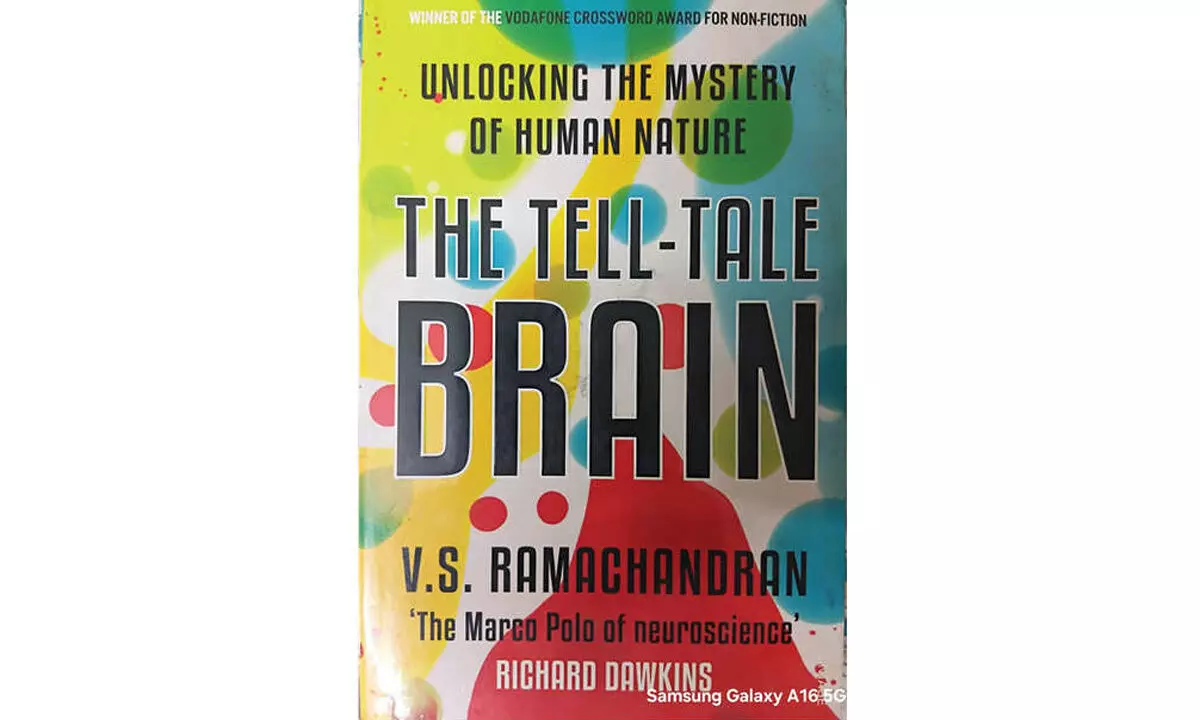
An ape can reach for a banana, but only humans can reach for the stars. That is the power of the human brain, which is composed of approximately 100 billion nerve cells. Each neuron forms between 1,000 and 10,000 connections with other neurons, making it the most complex structure in the universe. It is called ‘an organ of destiny’, and man’s ‘second favourite organ’ after the sex organ. There are two eternal mysteries. One is to understand the universe, and the second is to understand the self, which is capable of understanding the universe. V S Ramachandran, the Marco Polo of neuroscience, unravelled the mystery of the human brain in his book “The Tell-Tale Brain.” - Ramachandran states that modern neuroscience agrees with Freud that only a limited part of the brain is conscious. A conscious self is neither a concentrated essence that is in a special throne in the brain, nor a property of the whole brain. The self seems to merge from a relatively small cluster of brain areas that are linked into an amazingly powerful network. He defines seven aspects of self, such as unity (feel like one person despite diversity of sensory experiences), continuity (continuity of identity through time), embodiment (feel anchored in your body), privacy (your mental life is your own and unobservable by others), social embedding as all our emotions make sense only in relation to other people, free will with a sense of being able to consciously choose between alternative course of actions, and self-awareness. He explains these features of self by scientific analysis of psychological disorders stemming from damage to certain parts of the brain due to accidents or strokes.
Damage to the right frontoparietal region of the brain or the use of ketamine as anesthesia may result in a feeling that you actually left your body and are hovering over it, watching yourself from outside. Lack of oxygen to the brain also explains such out-of-body sensations in near-death experiences by some people. He cites scientific studies that during foetal development, different aspects of sexuality are set in motion in parallel: sexual morphology (external anatomy), sexual identity (what you see yourself as), sexual orientation (what sex you are attracted to), and sexual body image (your brain’s internal representation of your body’s sexual parts). Normally, these harmonise during physical and social development, but sometimes, they can become uncoupled, leading to deviations. Neurologists observed that autistic children often confuse the pronouns ‘me’ and ‘you’ in conversation, which shows poor differentiation of ego boundaries and a failure of the self-other distinction. Persons suffering from Cotard syndrome live in a peculiar state of derealisation (the world looks like a dream or myth) and depersonalisation (the self is dead or not real). In some cases of temporal lobe epilepsy, the affected person may feel extreme heighteningof empathy for others, for the self, and even for the inanimate world. It would feel like union with God. A person whose parts of both his frontal and temporal lobes of the brain are damaged will suffer from anterograde amnesia. Such a person is mentally alert and intelligent, but tends to forget past events. He is fortunate in the sense that he enjoys his wife every time, as if it were the first time, and reads the same detective novel over and over again, never getting bored.
Ramachandran is one of the pioneers in the discovery of mirror neurons, which allow humans to imitate the movements of others, feel the sorrow and joy of others, and play a crucial part in the cultural inheritance of our species. Some persons who lost their limbs in an accident may ‘feel’ their amputated limb as real due to mirror neurons. The human brain reached its present size and intellectual capacity about 3,00,000 years ago, but full-blown language appeared around 75,000 years ago only. He elucidated neurological cases where a person’s language aspects are located in the frontal lobe of the left hemisphere of the brain, known as Broca’s area.
Ramachandran asserts that aesthetics exists in birds, bees, and butterflies, but the word ‘art’ (with all its cultural connotations) is best applied to humans, even though, as we have seen, art taps into much of the same brain circuitry in us as in other animals. Humour is exclusively human, but laughter is not. After studying several neurological cases he states that one of the major roots of religion is that we tend to imbue nature itself with human-like motives, desire, and will, and hence we feel compelled to supplicate, pray to, bargain with, and look for reason why God or Karma or what have you has seen fit to punish us (individually or collectively) with natural disasters or other hardships. He dedicated this book, among others, to his ancestral sage Bharadwaja.