Where dharma breathes between shadows and light

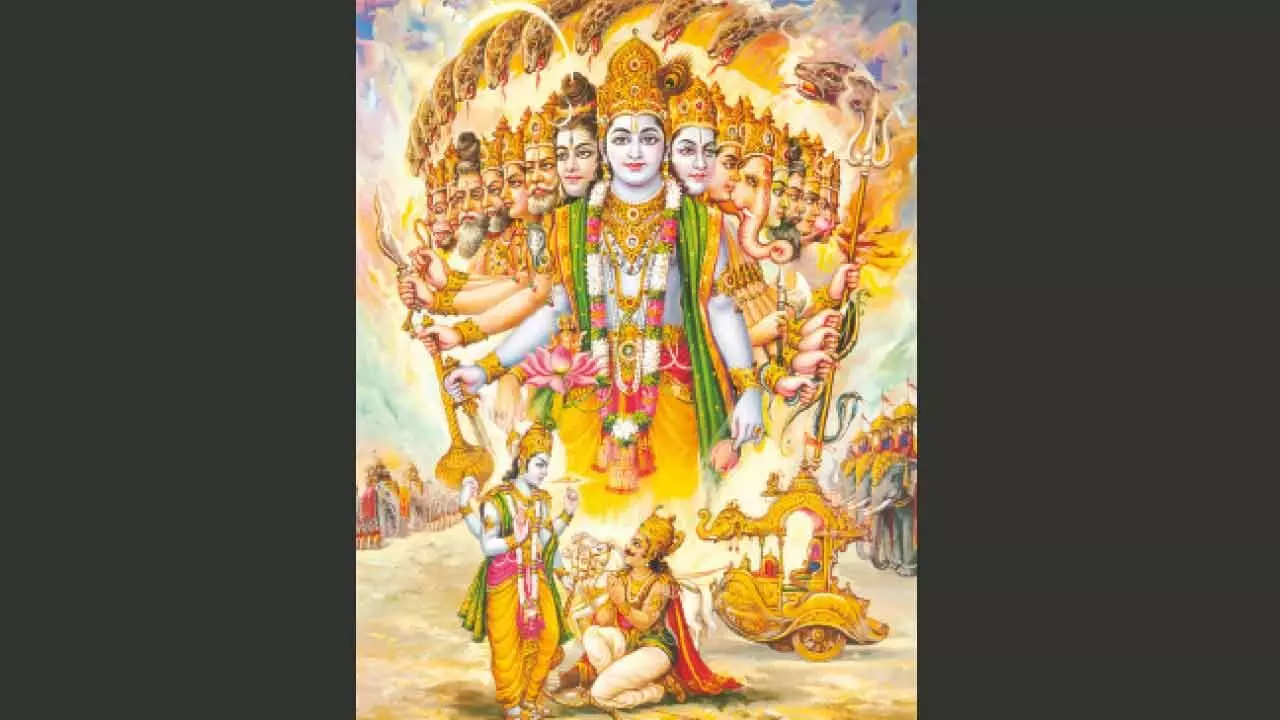
Sanatana Dharma has never been a fixed or static code, but a dynamic, vast, breathing universe, where morality, duty, and cosmic purpose intertwine with extraordinary subtlety.
Maharshis and Brahmarshis, highlighted Sanatana Dharma in the Vedas, Upanishads, Itihasas, Puranas, Mahabharata, Bhagavata, and Ramayana. They consistently show dharma as subtle (suksma), situational, contextual, kala-time, desa-place, and patra-nature, and eternally responsive. Time flows through yugas, each demanding its own moral calibrations. In an age where ethical debates often reduce right and wrong to rigid binaries, revisiting these ancient textures helps readers, especially those disconnected from Indian languages, recover the depth of a culture that embraced natural law.
The call to question and reflect is constant across scriptures, from the Mahabharata to Bhagavata, where sages urge humanity not merely to worship but to question, analyze, and contemplate. What appears flawed in divine or heroic actions often conceals cosmic intent.
Sanatana Dharma welcomes inquiry, even disagreement, because truth emerges only through reflection. It precisely encourages and will encourage the cause of reflecting, debating, contextualizing, and ultimately finding the deeper harmony beneath apparent contradiction. This openness makes the epics feel surprisingly modern. Puranic characters are not moral absolutes but mirrors reflecting human complexity.
The story of Yudhisthira and the subtle thread of duty shows how his fateful decision to gamble, though appearing reckless, was driven by dharma bound by time, place, and duty. Royal etiquette, kshatriya codes, and the cosmic necessity of the Kurukshetra war converged at that moment. When he uttered the half-truth about Ashwatthama, it was not deceit but a painful instrument to stop Drona’s devastation.
Such dilemmas reveal that leadership often demands imperfect choices for a larger good, something modern governance still wrestles with.
The perception of Krishna’s alleged partiality and the reality of dharma arise to the untrained eye that he seemed to favor the Pandavas. Yet Krishna never supported lineage, wealth, or personal bonds, despite both Arjuna and Duryodhana being his close relatives. He upheld righteousness alone. He gave equal grace to Sudama, Vidura, Draupadi, and all who approached him with humility. In an era filled with polarizing loyalties, Krishna’s stand teaches that true guidance aligns not with sides but with principles. His so-called favoritism was merely the radiance of ‘truth’ asserting itself.
The dilemma of Bhishma, Abhimanyu, and the cruel mathematics of war illustrates how Bhishma’s silence during the dice game, though haunting, arose from vows binding him to the throne. Any action would break one dharma to uphold another. Abhimanyu’s martyrdom, similarly, was not an isolated instance of unrighteousness, but exposed the inevitable brutality of war once dharma was abandoned by Kauravas’s side. These episodes remind critics that epics do not glorify war. They only expose the tragic and irreversible costs.
The actions of Rama’s dilemmas and protection beyond convention demonstrate that even Maryada Purushottam was compelled to transcend ordinary norms when confronting
Tataka and Vali. Killing a woman who endangered sages preserved societal safety, and striking Vali from concealment corrected deep ethical distortions. Today’s ethical frameworks often clash between law and empathy. Rama’s actions highlight that dharma may sometimes transcend surface morality to preserve deeper balance.
The portrayal of imperfect gods and the eternal quest for wisdom continues with Indra, whose flaws, the jealousy, fear, and impulsiveness, symbolize aspiration rather than perfection. Gautama’s curse upon Ahalya, whether she erred or was deceived, illustrates the power of purity and the cost of misunderstanding. These stories teach modern readers that status, whether earthly or divine, never exempts one from moral responsibility.
The tension between Drona, Ekalavya, and the burden of Dharma is one of the most debated dilemmas in the Mahabharata. Ekalavya’s brilliance was unquestionable, yet learning secretly under a guru’s name breached tradition and threatened state stability.
Drona, bound by his duties, responded in heartbreaking but principled adherence to the rules he upheld. In contemporary terms, it echoes debates about merit, unauthorized learning, and institutional boundaries. It also symbolizes sacrifice in pursuit of mastery.
The story of Kunti, Karna, and the weight of human helplessness shows how a young girl’s fearful invocation of a boon led to consequences she could not foresee, including abandonment of infant Karna. Her act was rooted not in cruelty but in helplessness within a rigid society. Karna’s rise proves that destiny is shaped not by birth but by perseverance.
Ramayana, Mahabharata and Bhagavata form not separate narratives but cosmic dialogues whose characters shine like constellations across time, and reflect the sunrise of Sanatana Dharma in different hues.
For readers distanced from Indian languages, these narratives offer a way to reconnect with a moral imagination that sees the sacred in the struggles of ordinary life.
The theme of the radiant lineage of duty and devotion emerges through Rama’s serene flame and
Lakshmana’s unwavering shadow, mirroring Krishna and Arjuna’s union of love, duty, and surrender. Bharata’s renunciation resonates with Uddhava’s devotion to Krishna’s final teachings.
Ravana and Vibhishana’s contrast are very interesting. Pride and purity show how Ravana’s extraordinary brilliance could have made him a legend of virtue, yet arrogance pulled him into darkness. From the same lineage rose Vibhishana, the lotus in stormy waters. Ravana’s fall foreshadows Duryodhana’s, while Vibhishana mirrors Vidura, voices of Dharma emerging from troubled homes. Their stories echo today whenever individuals choose integrity over inherited loyalty.
The fusion of Sita and spiritual sister Draupadi, and the voices of eternal womanhood show Sita as the embodiment of silent endurance and Draupadi as fiery courage.
They represent different yet equally powerful expressions of strength. The journey of Hanuman, Arjuna, and the courage to seek shows the former’s devotion as a bridge between service and strength, while Arjuna embodies human doubt before divine reassurance.
Jatayu, the divine vulture who tried to rescue Sita reproves that dharma belongs not to birth or status but to the courage to defend truth. In a time when moral action often bends to convenience, Jatayu’s story is a call to principled resistance.
For readers of this generation and critics alike, these intertwined destinies illuminate an eternal truth, that righteousness is not the triumph of perfection but the sincere striving toward harmony in a world of moral complexity. The universe itself is an embroidery of countless threads, and each life contributes to the timeless fabric of Dharma.