




- APCOB MD stresses deposit mobilisation and quality lending
- Collector inspects EVM warehouse at Dharmavaram market yard
- Control room open for nomination hurdles
- 18 YSRCP candidates filed nominations after SC intervention: Bhumana
- Kotamreddy family steps up campaign for Nellore municipal polls
- Moderate rains disrupt life in Nellore
- MP seeks support for coalition candidates
- NDA faces rebel trouble in urban local body polls
Oppn should stop dragging Tiranga into political battle
In Short
Political arguments must stand on facts
Share :
Oppn should stop dragging Tiranga into political battle
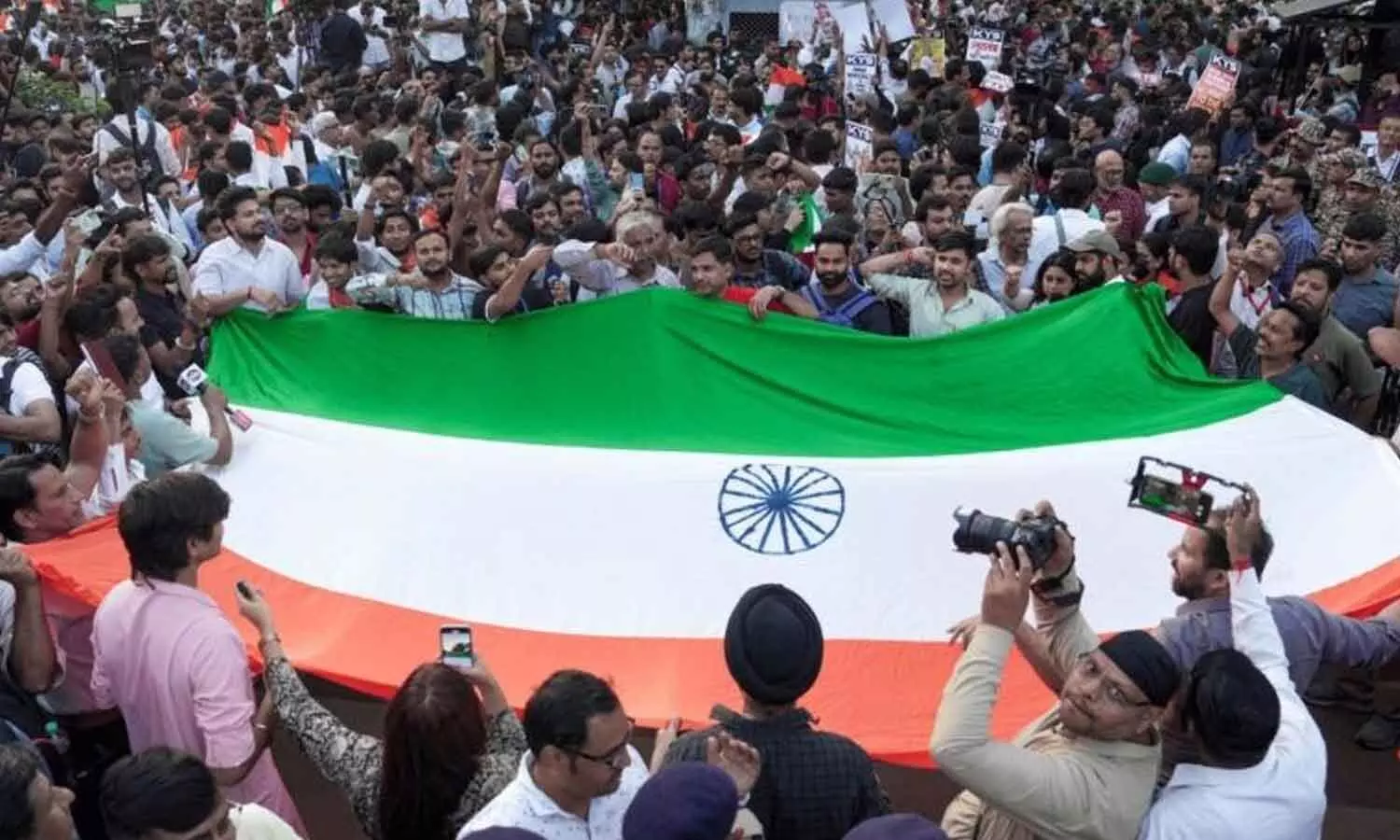
The Indian national flag, the Tiranga, symbolises our nation’s pride, unity and sovereignty. Unfortunately, it is increasingly being drawn into political battles and used as a shield for political activity. Political parties know very well that flying the Tiranga with respect and dignity is a fundamental right of every citizen, subject to constitutionally valid restrictions and laws protecting the national flag.
The Tiranga inspires patriotism, honours our freedom fighters and unites Indians beyond all differences. Yet, the Opposition seems determined to use it as a shield for almost anything and everything. CJP leaders were arrested for allegedly violating the rules governing protests at Jantar Mantar, trespassing on restricted premises and breaching the conditions of the bonds they had signed. However, the entire Opposition slammed the government, alleging an undeclared Emergency and questioning why the national flag could not be unfurled.
The issue of the Tiranga was reportedly neither mentioned in the FIR nor raised in the plea filed by the lawyers representing CJP leaders. The Congress and its wider Opposition ecosystem need to refresh their memory about the history of the National Flag and the restrictions that existed before the rules were liberalised.
Until the NDA government led by Atal Bihari Vajpayee introduced the Flag Code of India, 2002, ordinary citizens faced restrictions on flying the national flag. The new code came into effect on 2002 Republic Day, and permitted citizens, private organisations and educational institutions to display the flag on all days and occasions, provided its dignity and honour were maintained.
In January 2004, the Supreme Court delivered its landmark judgment in the case of Union of India v. Naveen Jindal. The Court recognised the right to fly the Tiranga respectfully as a fundamental right under Article 19(1)(a) of the Constitution. It also clarified that the right was subject to reasonable restrictions and applicable laws. Even now, it cannot be unfurled wherever one wants. There are mandated protocols for unfurling the flag.
The legal challenge arose after officials objected to industrialist Naveen Jindal flying the National Flag at his factory premises. The case established that displaying the Tiranga respectfully was not merely a privilege but a constitutionally protected expression of a citizen’s pride in the nation.
Yet, the Opposition appears to want a free pass for everything, even as its own positions invite questions about consistency. Sanjay Raut of the Shiv Sena (UBT) reportedly asked, “Bharat ka jhanda nahi lehrayenge toh kaunsa jhanda lehrayenge, Pakistan ka?” The question is politically provocative, but it does not answer the fundamental issue: the right to fly the flag does not confer an unrestricted right to violate the law.
The latest controversy concerns the removal of 74 photographs from an exhibition by Raihan Vadra, son of Congress leader Priyanka Gandhi Vadra, at Bikaner House in New Delhi, hours before the exhibition was due to open.
This issue needs to be examined from different angles. What was the purpose of the exhibition? Was it simply an effort to establish Raihan as a photographer and visual artist, or was it also intended to introduce him to a wider political audience as a representative of Gen Z when Rahul Gandhi was on a foreign visit? Did the Bikaner House management act in accordance with its rules? And were some photographs removed because they featured the national flag, as Raihan alleged?
One important fact must be understood: Bikaner House is a Rajasthan government-run venue, not a Central government establishment. Its management has cited a policy that bars political content, along with nudity and communal themes, from exhibitions. Photographs documenting recent protests were among those removed. The management said the photographs in question were inconsistent with its policy, while Raihan questioned the timing and the basis of the decision.
The Congress and its supporters should not automatically turn the dispute into an allegation that the National Flag itself was being targeted.
At the same time, there is a reasonable argument that photographs documenting public protests should be allowed in an art exhibition. In an age of social media and round-the-clock television news, such events are already widely documented. Their display in an exhibition would not necessarily create a new political controversy. However, if a venue has an established policy prohibiting political content, that policy must be applied consistently. If the rules are too restrictive or unreasonable, the proper course is to seek their revision rather than selectively demand exemptions. The aggrieved can even approach the courts.
The Opposition’s own record in similar disputes also deserves scrutiny. In Jaipur, during the Congress government’s tenure in 2023, the Swadeshi Jagran Manch alleged that its Swavlamban Mela faced cancellation because a Congress leader’s meeting was scheduled at the same venue.
In Kerala, the CPI(M)-led Left Democratic Front government objected to the display of a Bharat Mata portrait holding a saffron flag at an official function at Raj Bhavan in June 2025. Ministers questioned the propriety of displaying an image they associated with the RSS, and an official government programme was shifted from Raj Bhavan to the Secretariat after the Governor’s office declined to remove the portrait.
In Karnataka, disputes have also arisen over permission for RSS activities in public parks. Such cases must be judged on their specific facts and the rules applicable to each venue. The Opposition cannot claim that every restriction is an attack on democracy.
The larger principle is straightforward: rules must be followed until they are lawfully changed. At the same time, rules must be reasonable, transparent and applied consistently. It is therefore inappropriate to turn the removal of Raihan Vadra’s photographs into a controversy centred on the Tiranga without establishing that the flag itself was the reason for the action.
The controversy has also prompted Congress leaders to invoke the spectre of an undeclared Emergency. Priyanka Gandhi Vadra called the action “ridiculous” and accused the authorities of “muzzling the voice of the youth across the nation.” She also expressed solidarity with her son, arguing that the incident raised wider questions about freedom of expression.
The comparison with the Emergency of 1975–77, however, demands historical perspective. The Congress cannot discuss the Emergency without confronting the record of the government led by Indira Gandhi, Raihan’s great-grandmother, during that period.
Emergency was a period of severe restrictions on civil liberties and press freedom. Newspapers faced pre-censorship, opposition leaders were detained, and citizens’ ability to seek judicial remedies was severely curtailed. The film Kissa Kursi Ka, which satirised the political establishment, was seized and destroyed; the controversy later resulted in legal proceedings. The film Aandhi was also taken off screens during the Emergency, amid controversy over Suchitra Sen’s resemblance to Indira Gandhi. Kishore Kumar’s songs were banned from All India Radio and Doordarshan after he refused to cooperate with the government’s publicity efforts.
The media was pressured to promote the government’s 20-point programme and the sterilisation drive associated with Sanjay Gandhi. The restrictions went far beyond a dispute over an exhibition or the removal of photographs. Fundamental rights were curtailed, opposition leaders were jailed, and press freedom was subjected to total control.
The restrictions imposed during the Emergency cannot be equated with every contemporary dispute over permission to hold protests or display photographs. The two situations differ in scale, context and the nature of the restrictions involved.
The right to fly the Tiranga is a constitutional right, but it is not a licence to disregard the law. Equally, administrative rules should not become a pretext for attacking the Tiranga.
The Tiranga should remain a symbol of national unity and constitutional values, not a convenient shield in partisan battles.
(The author is former Chief Editor of The Hans India)
Andhra Pradesh: ZPTC, MPTC polls may be postponed to November 5
Needless row over Jaishankar-Rubio meeting in Mumbai
Enough clean chits to China: Kharge questions Modi
Gujarat: Vadodara civic body clears land allotment for Yusuf Pathan
Kerala Health Minister Muraleedharan hits back at three women predecessors of CPI-M over criticism
CM Adhikari announces Rs 342 crore special package for tribal community in Bengal's Jhargram


