




- TG is now Maoist-free, says DGP CV Anand
- MMC Commissioner inspects Amberpet sewage treatment plant
- Cyberabad Municipal Corporation Commissioner pushes for faster road, park works
- HYDRAA’s city-saving mission gets a musical tribute
- SJM urges Centre to deny licence to Musk's Starlink
- Email warns of bomb blasts at Big B home, Diljit concert
- APCOB MD stresses deposit mobilisation and quality lending
- Collector inspects EVM warehouse at Dharmavaram market yard
Needless row over Jaishankar-Rubio meeting in Mumbai
In Short
Discover why foreign policy shouldn't be reduced to political point-scoring. An analysis of S. Jaishankar's response to opposition criticism over foreign diplomatic venues and the urgent need for constructive discourse.

Share :
Needless row over Jaishankar-Rubio meeting in Mumbai
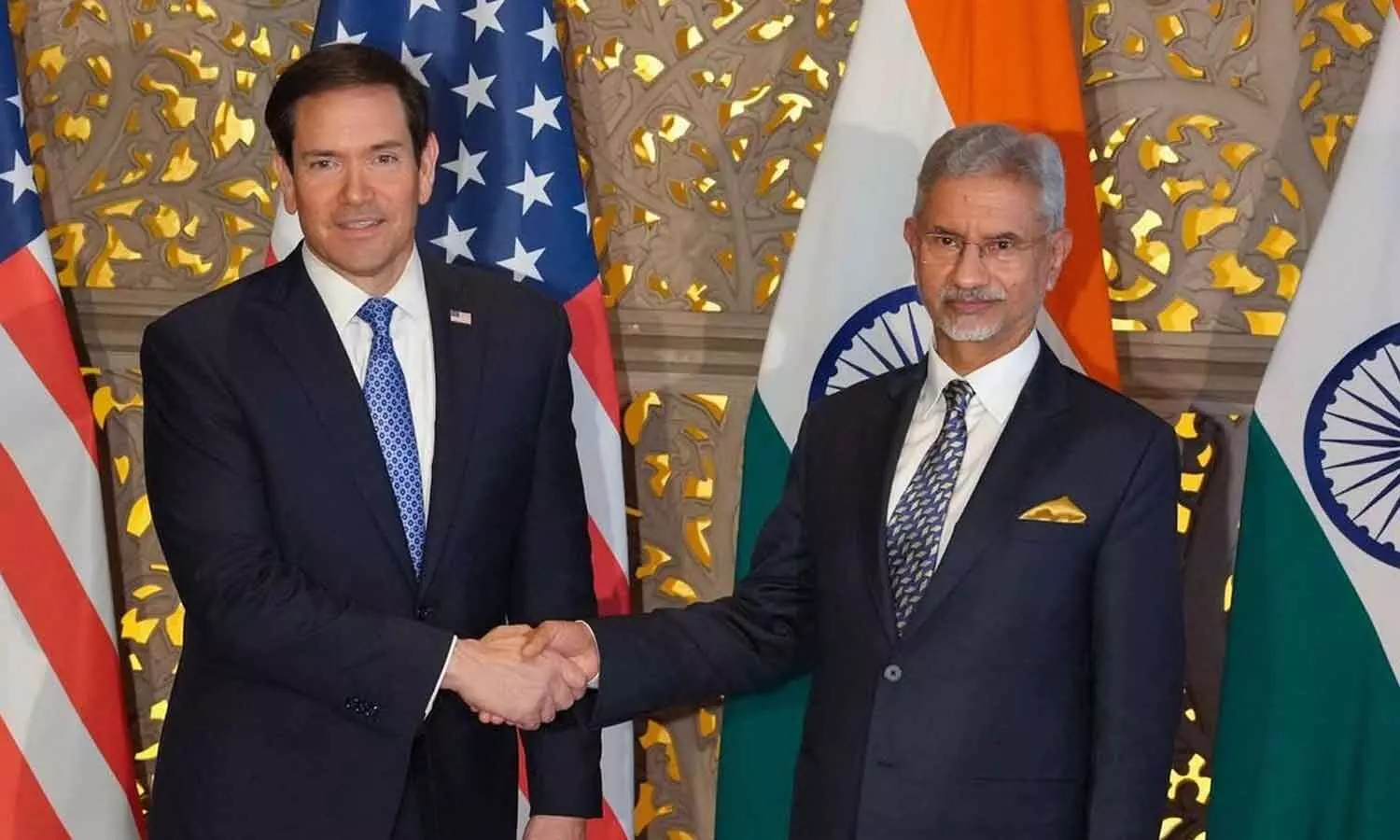
External Affairs Minister S Jaishankar has gently but convincingly addressed criticism of his government by refuting Leader of the Opposition Rahul Gandhi’s claim that US Secretary of State Marco Rubio summoned Jaishankar. Gandhi had said in a tweet, “Mr Rubio has summoned his employee to Mumbai. Modi ji, your officials in the External Affairs Ministry are confused about what’s going on. You might want to explain. Unless, of course, you want me to(sic).” Citing several past incidents in which top Indian government officials met visiting foreign dignitaries outside Delhi, Jaishankar made it clear that his meeting with his American counterpart in Mumbai was neither conspicuous nor unprecedented.
He pointed out that Indira Gandhi met Zulfikar Ali Bhutto in Shimla in 1972, resulting in the eponymous Shimla Agreement. Further, in 2013, Salman Khurshid, a minister in the Manmohan Singh government, hosted a lunch for the then Pakistan prime minister Raja Pervez Ashraf in Jaipur. Jaishankar, a former diplomat, added that he could add other instances too. The long and the short of the Mumbai meeting and its aftermath is the utter dumbing down of important issues.
A meeting between the foreign ministers of the world’s biggest democracies should throw up new ideas and start new conversations; even if there is criticism, it should be informed and constructive; what happens instead is a reaction intended to play to the gallery or, worse, trigger online stir. Jaishankar offered some wise counsel: “We are adults, let’s have an adult conversation.”
Unfortunately, adult conversation is often missing in any public debate, whether the subject is foreign policy, economic decisions, or political actions. In the case of foreign affairs, leaders from different parties claim that there should be consensus among the entire political class, appeal their rivals to not do politicking—and then they go on doing exactly that. Unsurprisingly, non-issues like the foreign minister meeting his visiting counterpart in another city become the biggest talking point.
This is not merely a reflection of the poverty of political discourse; it also reveals how political parties increasingly confuse publicity with politics, provocation with argument, and point-scoring with accountability. Instead of examining the substance of a diplomatic engagement—what was discussed, what interests were advanced, what differences emerged, and what opportunities might have emerged—politicians choose to debate its venue, as though the geography of a meeting were more consequential than its purpose.
Thus, spectacle triumphs over substance, while the public is invited to take sides in a controversy that may have little bearing on the national interest. The greater danger is that this style of politics gradually lowers the standards of public debate. Once political leaders discover that a provocative remark can command more attention than a substantive argument, the incentive to engage seriously with complex questions diminishes. Nuance becomes a liability, restraint is mistaken for weakness, and every development is squeezed into the binary framework of victory and defeat.
Diplomacy, which often requires discretion, patience, and an appreciation of competing interests, becomes particularly vulnerable to this performative approach. Ultimately, foreign policy cannot be conducted as an extension of an election campaign. India’s interests are larger than the fortunes of any political party, and its international standing should not cause collateral damage in domestic political skirmishes. Politicians must demonstrate bipartisan responsibility through their conduct.
Andhra Pradesh: ZPTC, MPTC polls may be postponed to November 5
El Nino impact: Revanth sounds alarm over prolonged drought in state
Revanth to host dinner meet in Delhi ahead of Global Summit
Jio IPO scripts global record with 1.39 cr applications
IMD warns of thunderstorms, gusty winds in Telangana
Needless row over Jaishankar-Rubio meeting in Mumbai


