130th constitutional amendment bill is a democratic regression

In a democracy, citizens form the backbone across segments in a democracy. While on one hand, they can choose their representatives to raise their needs and concerns in the Parliament and Legislative Assembly, they have the right to recall in direct democracies. Indirect democracies have constitutional and legal frameworks to disqualify elected representatives based on criminal offences. In certain democracies, disqualification of elected representatives applies after charges are framed by investigative agencies or conviction by courts.
In India, here comes a proposed One Hundred and Thirtieth (130th) Constitutional Amendment Bill that endeavours to hand over the authority to remove elected representatives in the hands of non-elected executives like the President and Governor that too in the name of democratic exercise. In a way, it takes away the citizens’ sovereignty and the right to elect. Thomas Jefferson observed that “I know of no safe depository of the ultimate powers of the society but the people themselves. And if we think they are not enlightened enough to exercise their control with a wholesome discourse, the remedy is not to take it away from them but to inform them of their discretion”.
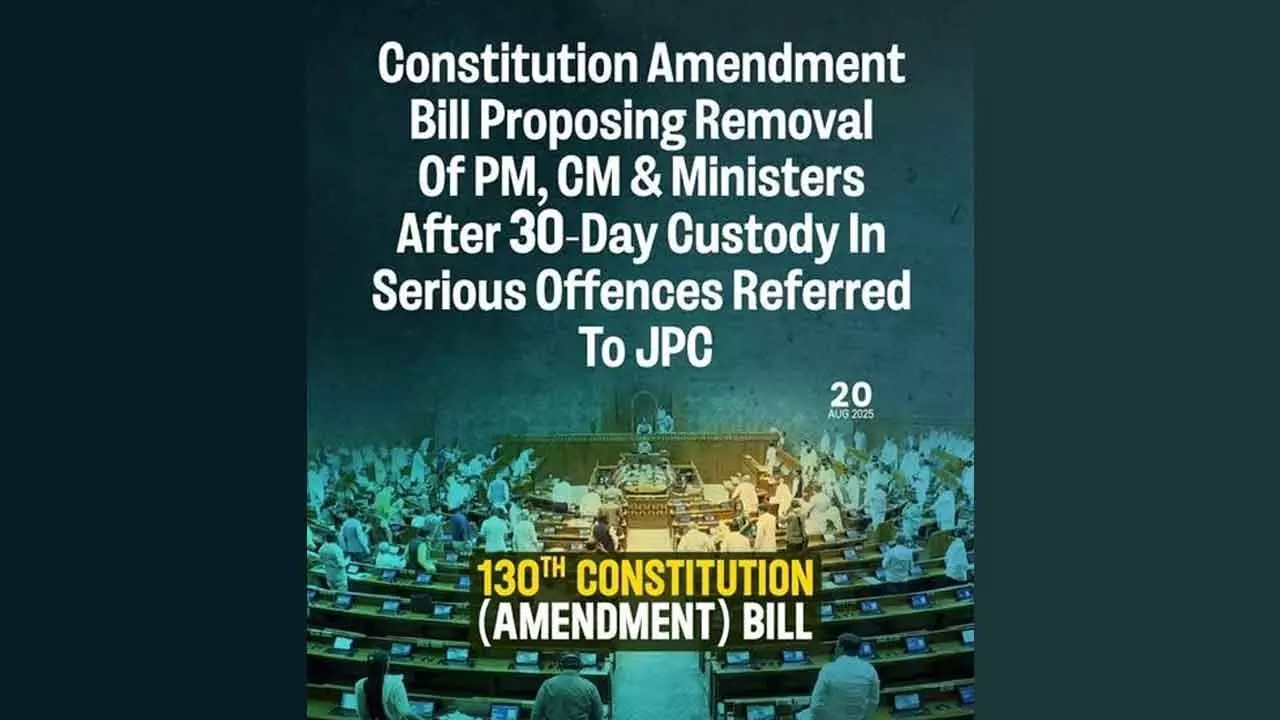
On August 20, 2025, Union Home Minister Amit Shah introduced the 130th Amendment Bill, with an aim to cleanse politics. However, it takes away the people’s power and hence it is a democratic regression (Larry Diamond, 2022). The bill is currently being examined by the Joint Parliamentary Committee.
The stated aim of cleaning the body politic is the need of the hour. Given the exponential rise of MPs with criminal charges from 24 per cent in 2004 to 46 per cent in 2024, it is imperative to address the issue in the right perspective to restore the vitality of democratic polity. Towards achieving this, the proposed bill enlists the objectives of (i) non-partisan and public welfare, (ii) sound character and exemplary conduct and (iii) constitutional morality and principles of good governance. To do this, the Amendment of Articles 75, 164 and 239AA is proposed to remove “a minister who is arrested and detained in custody on account of serious criminal charges”, including the Prime Minister and incumbent Chief Ministers.
At the face of this proposition, the intent to bring purity in politics is desirable and ideal for any democratic nation, especially India, where criminalisation of politics has eroded public confidence in body politic. The third objective of the bill reads as “A minister, who is facing allegation of serious criminal offences, arrested and detained in custody, may thwart or hinder the canons of constitutional morality and principles of good governance and eventually diminish the constitutional trust reposed by people in him”.
The most glaring part of this bill is its argument of constitutional morality and the principles of good governance. The principal agencies for arresting/detaining a person/elected representative are police with specifics of Central Bureau of Investigation (CBI), Enforcement Directorate (ED) at the Central level and Crime Investigation Department (CID) in states. The functioning of these agencies is well documented and has almost become political tools in the hands of ruling dispensations both at the central and state levels. Institutional immunity and functional autonomy are rarely exhibited by the leadership of these agencies due to political intrusion.
The lowest rate of conviction (a mere two per cent) among nearly two hundred cases by the ED and CBI in the last decade or so indicates their use for political purposes and to suppress voices of opposition parties by hook and crook. The Supreme Court’s directive to High Courts for a speedy disposal of all cases related to politicians facing serious criminal offences is going on too slowly. Massive vacancies of judges in HCs are resulting in snail paced dealing of cases pertaining to MPs and MLAs facing criminal charges.
In February 2025, the Union Government opposed the idea of a lifetime ban of convicted politicians in the Supreme Court. The 130th proposed bill stands contrary to this position as it takes away the right to elect by non-elected executives. Curiously, the timing of the bill coincided with the diminishing role of the Election Commission of India, and the push for the One Nation One Election approach.
While the intent to cleanse politics is laudable and desirable, the fact of the matter is that the bill, per se, falls short in terms of taking away the legal and constitutional immunities provided to the elected representatives. It also indirectly touches upon Article 32, the right to constitutional remedies when the elected representative is ousted from her/his position without being acquitted/convicted in the court of law.
Filling up of all vacant judges’ posts in High Courts, speedy setting up of fast-track courts as per the Supreme Court directive to deal with MP/MLAs cases, implementing the Law Commission recommendations on electoral disqualifications, strengthening the anti-defection law and last but not the least reforming the criminal justice system by barring political influence are the ways forward to ensure genuineness in politics. Without these steps, the proposed bill only encourages more political defections and thereby threatens the stability of elected governments and constitutional democracy.
(The writer is Assistant Professor, Symbiosis Law School, Pune)