




- Delhi CM Rekha Gupta slams Kharge’s objectionable remarks against PM Modi
- Terrorism as instrument of statecraft simply unacceptable, not all states display zero tolerance: EAM Jaishankar
- Arnab cyclone update: NTR District collectors urges officials to be alert
- Kashmir Marathon: J&K L-G calls for nurturing local talent, promoting healthy living
- Europe Braces for Another Weekend of Unrest as Protests Turn Violent in Several Countries
- Trump Says US Could Strike Iran on Sunday, Keeps Door Open for ‘Big, Beautiful Deal’
- Obama tears into Trump over Iran war, tariffs and ‘grifter’ presidency at Ohio rally
- CM Yogi welcomes PM Modi, Rajnath Singh to Varanasi for 'Wings over Ganges' air show
Bringing the scourge of famine to the spotlight is a good augury
In Short
There have been several famines in India under British rule, starting with the disastrous Bengal famine of 1770. Bombay and Madras Presidencies had famines in 1792 and in 1803. Between 1804 and 1830 there were altogether six major famines in Madras and Bombay. The Guntur famine of 1832 is popularly known as ‘Dokala Karuvu’, as it was reported that hungry people tore open the stomachs of others to find food. The Ganjam Famine of 1866 affected not only Orissa but also the Rayalaseema districts of Madras Presidency

Share :
Bringing the scourge of famine to the spotlight is a good augury
A Telugu period film, Ranabaali, which has hogged the limelight in both the Telugu states ever since its release a few days ago, has evoked unprecedented enthusiasm for hitherto unsung and overlooked historical aspects like the role of the Palegars, the saga of local rebellions, heart-wrenching tales of famines and starvation deaths, and the apathy of the government in coming up with relief measures in the drought-prone Rayalaseema region. Set in the mid-19th century, the movie has the Great Famine of 1876-78 as its central theme.
It is highly gratifying that the makers have been bold enough to choose a significant historical aspect of the Telugu-speaking area in Madras Presidency for a high-profile, star-studded commercial film. Ranabaali also sends a much-needed message that history is not to be confined only to classrooms to pass examinations and clear the All-India Services, but to remind us of the saga of suffering, economic exploitation, racial discrimination and unjust subordination perpetuated by the colonial rulers — the very reasons why Indians fought and won their independence in their own unique way by the mid-20th century.
Famines were widespread:
Though famines were not new to India prior to British rule, they were few and far between. They were highly localised, affecting only areas hit by natural calamities like drought. Whenever rains failed, crops failed in the vast agrarian country, resulting in scarcity of foodgrains leading to famine or near-famine conditions in that area. By and large, famines during pre-colonial times were highly localised, and at no time did they affect the entire country. Under British rule, however, famines became more severe, more frequent and more widespread.
Apart from drought, famines are also caused by natural calamities or swarms of pests. At times, they are caused by human factors, as in the case of the Bengal Famine of 1943, which was man-made, as the British government wanted to punish the people of Bengal for their active participation in the Quit India Movement in 1942 by withholding civil supplies. War, trade depressions and over-taxation have also led to famines.
There have been several famines in India under British rule, starting with the disastrous Bengal famine of 1770, when about one-third of the population perished. In 1783 there was a famine in Madras and the next year, famine in entire North India. Bombay and Madras Presidencies had famines in 1792 and in 1803. Between 1804 and 1830 there were altogether six major famines in Madras and Bombay. The Guntur famine of 1832 is popularly known as ‘Dokala Karuvu’, as it was reported that hungry people tore open the stomachs of others to find food. The Ganjam Famine of 1866 affected not only Orissa but also the Rayalaseema districts of Madras Presidency.
Whenever there was famine anywhere in the south, it found its echo in Rayalaseema. However, the Great Famine of 1876 was the most devastating of all during colonial times.
Dhatu famine (1876-1878):
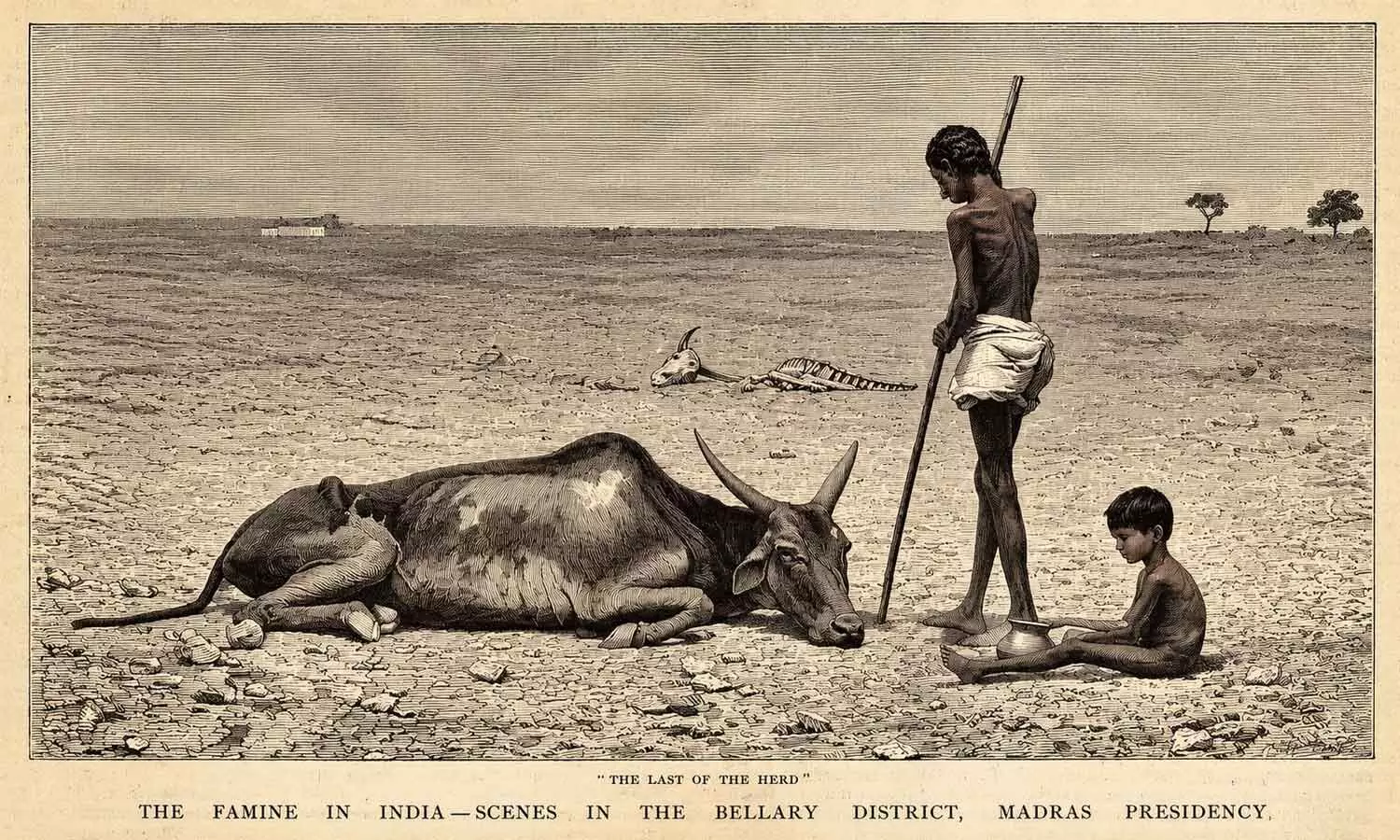
The Great Famine, variously called the ‘Dhatu Famine’ as it occurred in the Hindu cyclic year of Dhatu, and ‘Madras Famine’ as it affected the entire Madras Presidency, was also known as the ‘South Indian Famine’ as it affected most parts of the subcontinent south of the Vindhyas. But its crushing impact was felt mostly in dry regions like Rayalaseema. Of the 21 districts in Madras Presidency, approximately 14 were affected, including Bellary, Anantapur, Cuddapah and Kurnool.
This famine lasted two long years, during which not a single drop of rain fell and the total deaths in the Presidency was estimated at 55 lakh people. Failure of three successive monsoons, drying up of crops, high prices of agricultural produce, meagre wages for labourers, scarcity of food grains, and hoarding by traders aggravated the suffering during those two dreadful years. About a year before the outbreak of the Great Famine, in 1876, there were heavy rains throughout the Rayalaseema region. In three days ending October 1874, 20 inches of rain was recorded in several parts of Cuddapah District. All tanks near river channels breached and crops failed. Foodgrains became scarce and prices began to soar.
A famine officer, Engledow, wrote to the Board of Revenue on the prevailing situation: “The starving people devoured Devadaru leaves and the pith of the aloe — both of which they cooked into a kind of broth.” These brought only virulent diarrhoea, which, in turn, caused enormous deaths. Starvation deaths became common in Cuddapah and Anantapur districts.
Of such deaths, F A Coleridge, a sub-collector at Madanapalle, then in Cuddapah district (Chittoor district was formed only in April 1911), recounted what he heard from his predecessor J D B Gribble: “Corpses were to be found on every furlong of road — men, women and children in a perfect state of nudity being devoured in broad daylight by packs of jackals. With soil baked hard as a rock and the labourers unfit for protracted work for digging pits, it was not possible even to give a proper burial to the corpses of the famine victims.”
It was during this time that peasants’ riots were reported due to non-availability of foodgrains in several parts of south India. In early 1876 such riots took place in Poona and spread to other places. These came to be popularly known as ‘Deccan Riots’. The passing of the Deccan Agricultural Relief Act of 1879 by the government was the result of those riots.
Relief Works:
The government was not quick to come to the aid of the famine affected. When the situation turned alarming, and based on the reports submitted by collectors, the Board of Revenue permitted opening of certain relief camps where cooked food was given. Gruel was cooked and served to those who thronged in large numbers. ‘Poor Homes’ or Langarkhanas were established in several places in Rayalaseema. Small amounts of cash were distributed to the old and infirm. But for the able-bodied, government works like road-laying, tank-cleaning and grass-cutting for fodder were taken up.
When relief camps were opened, people in distress flocked in such large numbers that roads had to be divided into sections with sanitary and water arrangements. As the situation deteriorated, many officers from Bengal were deputed for relief work in Rayalaseema. A special Famine Relief Officer, Major E W Shaw, was exclusively sent to supervise relief works in places like Ramasamudram in the Punganur Zamindari area, the worst hit. The weekly reports submitted by such officers provide graphic descriptions of the sufferings of the famine-stricken and the relief doled out to them.
Temple wages:
It was at the height of the Great Famine that Sir Richard Temple, Lt Governor of Bengal, was tasked by the Government of India to visit famine-affected places and suggest ways to mitigate suffering. Richard Temple, who had earlier organised relief measures during the Bengal famine of 1873, arrived in Kurnool on 14 January 1877 and visited many places in Rayalaseema.
His visit had disastrous consequences as far as payment of wages to coolies at relief camps was concerned. As wages for men, women and children were 2 annas, one-and-a-half anna and 1 anna respectively, they were found to be “too higher”, and he instructed relief officers to reduce wages to make them “less attractive.” The wages thus reduced, much to the disappointment of the coolies, came to be contemptuously called ‘Temple wages.’
Famine Commission:
The severity of the Great Famine was such that in May 1878 the Government of India appointed a Famine Commission with Sir John Strachey as its chairman to suggest ways to prevent such future occurrences. The Commission’s Report of 1880 suggested, among other things, that it was the responsibility of the State not to allow anyone to die for want of food. Remission of revenue taxes, village relief, provision of irrigational facilities, creation of an agriculture department, forest conservancy, formulation of Famine Codes etc., were also suggested. Yet another important suggestion was to lay at least 5,000 miles of railway lines as famine relief work.
It is interesting to note that the 227 km Pakala-Dharmavaram metre-gauge line was taken up because of the Famine Commission report and was opened for traffic in 1891. It was soon connected to the Katpadi-Pakala line and other lines towards Nellore. What started as a famine-relief strategic line in 1891 became the lifeline of Chittoor, Tirupati, Annamayya and Anantapur districts in Rayalaseema.
“Our sweetest songs are those that tell the saddest thoughts” (P B Shelley).
Famines in India under British colonial rule do bring us such saddest thoughts. These accounts of famines and human suffering should not merely fill the pages of history books but should be made known to people through every possible genre. A movie on such famines in Rayalaseema is something that brings all-round cheer.
(The writer is retired Professor of History at the University of Hyderabad)
Bringing the scourge of famine to the spotlight is a good augury
Govt must engage with Rahul; Congress leader must oblige traders
21 disaster response force teams deployed as Andhra Pradesh braces for cyclone
CM Pema Khandu stresses transparency, dialogue on Siang hydropower project
India, Cuba discuss strengthening parliamentary exchanges, cooperation in healthcare
Jamia Protest Continues Over Students’ Union Demand; Four on Hunger Strike, Security Tightened


