Christian atomic crusade: Sunjugating the non-christian Japan

World War II(1939–1945) was a global conflict that reshaped nations and claimed millions of lives. The Allied powers—United States, United Kingdom, Soviet Union, and others—fought the Axis powers, led by Germany, Italy, and Japan. Germany’s invasion of Poland in 1939 sparked the war, but by August 1945, the US dropped atomic bombs on Japan, not Germany, the actual perpetrator.
This article contends that the US decision to use nuclear weapons against Japan, while sparing Christian Germany, was driven by an Abrahamic worldview dividing humanity into believers and non-believers, with a mandate to convert, subjugate, or destroy the latter.
The war was largely an intra-Christian struggle, with Japan, rooted in Shinto and Buddhist traditions, as an outsider. The atomic bombings were not militarily necessary but a deliberate act to test apocalyptic weapons on a non-Christian nation, exploiting Japan’s cultural “otherness” to assert Christian dominance. Strategic justifications—ending the war, saving lives—are rationalisations masking a deeper intent: to unite Abrahamic powers against a non-Abrahamic adversary, reducing Japan to a U.S. vassal through nuclear devastation and demilitarisation.
It is time to examine the historical context, Abrahamic theology’s influence, Japan’s demilitarisation, and a lesson for non-Abrahamic peoples to avoid intra-Abrahamic conflicts.
Centre of an Intra-Christian War:
Germany’s invasion of Poland, following annexations of Austria and the Sudetenland, ignited World War II. By 1940, it had overrun Christian nations like Denmark, Norway, and France while perpetrating the Holocaust, targeting six million Jews and others within the Abrahamic fold. The war was primarily an intra-Christian conflict, with Axis and Allied powers competing within their shared Abrahamic heritage.
Japan stood apart. Its alliance with Germany via the Tripartite Pact of 1940 was a miscalculation, drawing a non-Abrahamic nation into an Abrahamic struggle. By early 1945, Germany’s defeat was imminent, with Soviet and Allied advances culminating in Adolf Hitler’s suicide and Germany’s surrender on May 8. With the war’s primary instigator neutralised, attention shifted to Japan, exposing the Abrahamic bias that led to its nuclear devastation.
Targeting the non-Christian ‘other’:
The official narrative claims the atomic bombings of Hiroshima and Nagasaki were necessary to force Japan’s surrender and avoid a costly invasion. This explanation falters under scrutiny. By August 1945, Japan was militarily crippled—its navy and air force destroyed, cities devastated by conventional bombing, and supply lines severed. The firebombing of Tokyo in March 1945 killed one lakh civilians approximately, proving the US’s capacity for destruction without nuclear weapons. The Soviet Union’s invasion of Japanese-held Manchuria further weakened Japan.
The claim that Operation Downfall would have caused massive casualties is speculative, ignoring Japan’s dire situation. Evidence suggests Japan’s government sought peace in 1944, though military hardliners resisted. The Potsdam Declaration’s demand for unconditional surrender met hesitation, but Soviet intervention and conventional bombing likely would have forced capitulation without nuclear escalation. The atomic bomb was a deliberate choice, rooted in the Abrahamic view of non-Christians as “heathens” subject to annihilation. Japan’s Shinto and Buddhist foundations marked it as an “other.”
With Germany defeated, the Manhattan Project’s Trinity test in July 1945—named by J. Robert Oppenheimer, the project’s scientific director, after John Donne’s poem invoking the “three-person’d God” of the Christian Trinity (God the Father, God the Son, and God the Holy Spirit)—provided a weapon of unprecedented power. This choice, rooted in the Christian cultural milieu of the project’s leadership, reinforced the religious bias guiding the bomb’s use.
The US, shaped by Abrahamic ideology, chose non-Christian Japan as its target.
Abrahamic ideology-The theological driver:
The American decision to bomb Japan while sparing Germany reflects an Abrahamic impulse to unite against non-Abrahamic peoples. Christianity’s worldview, rooted in biblical narratives, often portrays non-believers as divinely condemned, justifying their subjugation. Japan was seen as a “heathen” nation, unlike Germany, a Christian state deemed redeemable despite its atrocities.
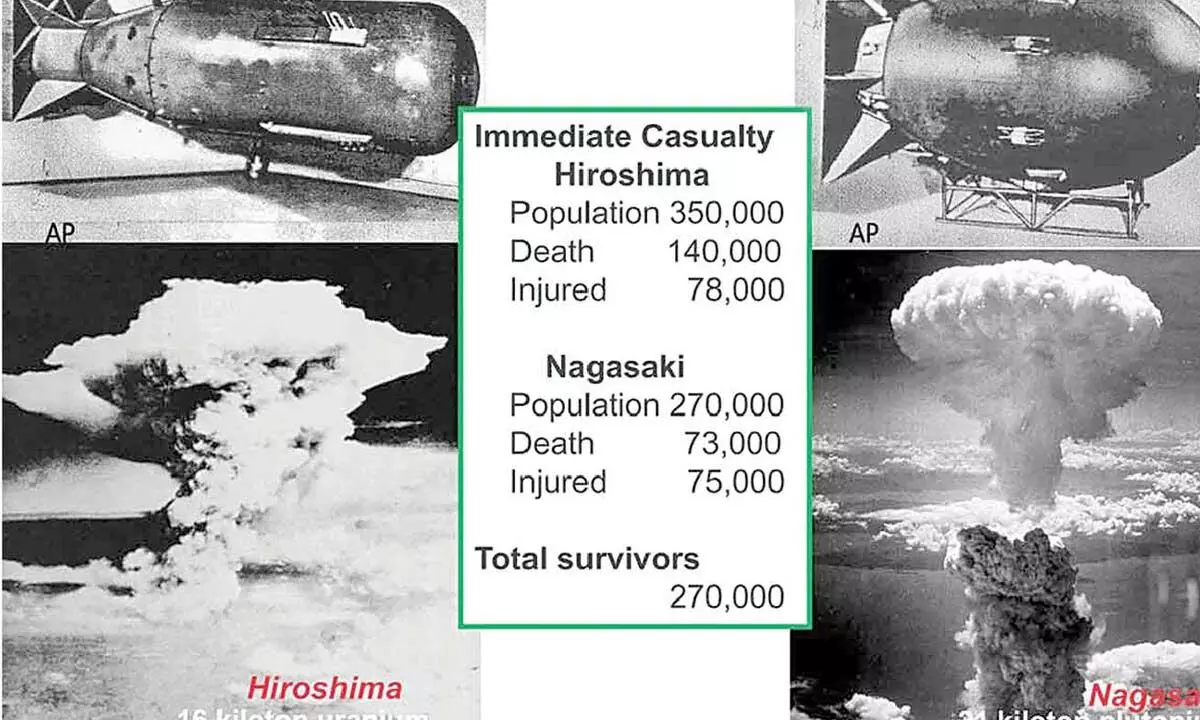
Wartime propaganda reinforced this divide, depicting Japanese as fanatical and subhuman, while Germans were portrayed as a Christian nation misled by a tyrannical regime. The firebombing of Dresden, though horrific, used conventional weapons, whereas the atomic bombings of Hiroshima (1.40 lakh deaths) and Nagasaki (74,000 deaths) marked a new level of destruction reserved for a non-Christian nation.
President Harry S Truman operated within a Christian cultural framework. While intra-Christian conflicts were intense, Japan’s non-Abrahamic status united Christian powers against it, framing the bombings as a punishment for its cultural distinctiveness and a demonstration of Christian dominance.
Japan as a nuclear testing ground:
The US used Japan as a laboratory for its atomic weapon. Hiroshima and Nagasaki, relatively unscathed by prior bombing, were ideal sites to assess the bomb’s impact on urban centres and populations. Post-bombing studies by American scientists documented radiation effects and structural damage, revealing the bombings’ experimental purpose. The bombings showcased US technological superiority, signalling to the world that the Christian West held unrivalled power.
Post hoc justifications-Concealing religious motives:
The rationale that the bombings were necessary to end the war is fragile. Soviet intervention further ensured Japan’s capitulation. The US knew this but chose nuclear weapons to punish a non-Christian nation and assert post-war hegemony. Targeting civilian cities like Hiroshima and Nagasaki, rather than pursuing diplomatic or conventional alternatives, reflects a willingness to sacrifice non-Christian lives unthinkable in a Christian context.
Japan’s demilitarisation-A vassal of the Christian west:
The atomic bombings paved the way for Japan’s complete demilitarisation, a fate unique among Axis powers. Under the Allied occupation (1945–1952), led by General Douglas MacArthur, Japan’s military was dismantled, its war industries dissolved, and its ability to wage war permanently curtailed. The 1947 Constitution, drafted under US oversight, included Article 9, renouncing war and prohibiting Japan from maintaining armed forces with war potential. This unprecedented demilitarisation stripped Japan of sovereignty over its defence, rendering it a US vassal reliant on American military protection. Once a divine figure in Shinto belief, the Emperor was reduced to a ceremonial role, eroding Japan’s cultural and religious identity.
In contrast, Germany faced division into East and West but retained significant autonomy, particularly in West Germany, which rebuilt its military under NATO by 1955. Germany’s Christian heritage aligned it with Western allies, allowing it to regain status as a European power, culminating in reunification after the USSR’s collapse. Demilitarisation, coupled with the nuclear devastation of Hiroshima and Nagasaki, ensured Japan’s subordination to the Christian west, its cultural distinctiveness suppressed under US dominance. This disparity underscores the Abrahamic bias: a Christian nation was redeemable, while Japan’s “heathen” identity justified its subjugation. Bereft of military, Japan is a vassal state of the US.
Lessons for non-Abrahamic people:
Abrahamism—encompassing Judaism, Christianity, and Islam—divides humanity into believers and non-believers, labelled “heathens” or “kafirs,” who are seen as inferior.
This worldview, evident in historical crusades and colonialism, underpinned the American nuclear attack and demilitarisation of Japan.
World War II was an intra-Christian struggle, and Japan’s alliance with Germany drew it into this conflict with catastrophic consequences. Its non-Abrahamic status made it a target for nuclear devastation and subjugation. Non-Abrahamic nations—Hindu, Buddhist, Shinto, or others—must avoid entanglement in Abrahamic conflicts. Abrahamic powers often prioritise their shared heritage over outsiders, viewing non-believers as expendable. Japan’s fate illustrates the peril of Abrahamic rivalries, risking cultural erosion and loss of sovereignty.
Conclusion:
The atomic bombings and demilitarisation of Japan were not necessities but manifestations of Christian bias, targeting a non-Christian nation while sparing Christian Germany.
World War II, an intra-Christian conflict, saw Japan bear the ultimate cost for entering an Abrahamic rivalry. Strategic justifications obscure the intent: to punish a religiously alien nation and assert Christian dominance through nuclear devastation and enforced demilitarisation. Japan’s reduction to a U.S. vassal underscores the consequences of this bias.
Non-Abrahamic people must avoid Abrahamic conflicts to escape Japan’s fate.
(The writer is a retired IPS officer and former Director of CBI. Views are personaI).