Eco-friendly aviation is the order of the day

Today is world environment day
As the global passenger footfall touches an enormous growth of nine per cent with 10 billion passengers and 100 million aircraft movements in 2024, let us understand its environmental impact. Due to its speed and altitude, aircrafts require more power and energy than other modes of transport. Therefore, the aviation industry faces critical challenge of balancing growth with sustainability. The global aviation industry emitted 882 mmt of CO2 last year. Because of the height at which the emissions are released, the effect of these emissions on environment is high. Aircraft emit not only CO2 but also other emissions-nitrogen oxide and water vapour, which have greater effect. Aviation CO2 emissions should be multiplied by 1.9 times to consider added impact of other gasses. An inter-governmental panel on Climate Change estimated that aviation accounts for three per cent of the total climate impact. Though growth is desirable, high carbon footprint is unacceptable. Towards this, the International Civil Aviation Organisation (ICAO) has set up core sustainability goals among global aircraft manufacturers, airlines, airports, aviation fuel manufacturers and national regulators to ensure eco-friendly aviation.
Key initiatives of ICAO:
CO2 emissions standard set by ICAO in 2016 applies to all new aircraft designs from 2020 and newly-built existing models from 2023. It emphasised the value of a globally harmonised approach to reduce green house gas emissions and climate change around airports, by-state action plans; sustainable alternative fuels, market-based measures; and global aspirational goals to ensure the long-term sustainability of aviation.
The ICAO is actively working towards sustainable aviation through various initiatives:
Global coalition for sustainable aviation:
This enables development of new ideas, accelerate implementation of innovative solutions and raise awareness about eco-friendly aviation.
Global framework for sustainable aviation fuels:
This is a collective aspiration for a five per cent reduction in aviation CO2 emissions by 2030. SAF has the greatest potential to reduce CO2 emissions from aviation.
Carbon offsetting:
CORSIA is a market-based scheme that aims to cap net aviation emissions at 2020 levels through 2035.
Operational and technological improvements:
ICAO encourages airlines and manufacturers to adopt technologies that reduce emissions, optimize flight operations, and implement best practices to minimise fuel consumption.
Non-CO2 impact mitigation:
ICAO addresses non-CO2 impacts of aviation such as noise pollution and the use of other greenhouse gases by developing standards and guidance.
Finvest hub:
ICAO has established a global platform to facilitate dedicated pathways for funding SAF production, clean energy infrastructure, and other aviation decarbonization initiatives.
Long-term global aspirational goal (LTAG):
This outlines a long-term aspirational goal for the aviation industry to achieve net-zero carbon emissions by 2050. Aircraft manufacturers are using cutting edge light-weight materials such as carbon composites to build aircraft and components,.
Recent technological improvements like wing tip devices increase aerodynamic efficiency and reduce fuel usage. New generation aircraft are 20 per cent more fuel efficient as they produce 80 per cent less CO2 per seat than the first jets in the 1950s.
Electric aircraft:
The research towards eVTOL (Electric Vertical Take-off and Landing) aircraft is another encouraging factor towards this direction. eVTOL promises quick urban mobility without heavy investment on land and airport terminals. DGCA India has already issued guidelines in this regard.
As battery technology develops, increased energy storage may make electrically-powered commercial flight a reality.
Sustainable aviation fuel SAF):
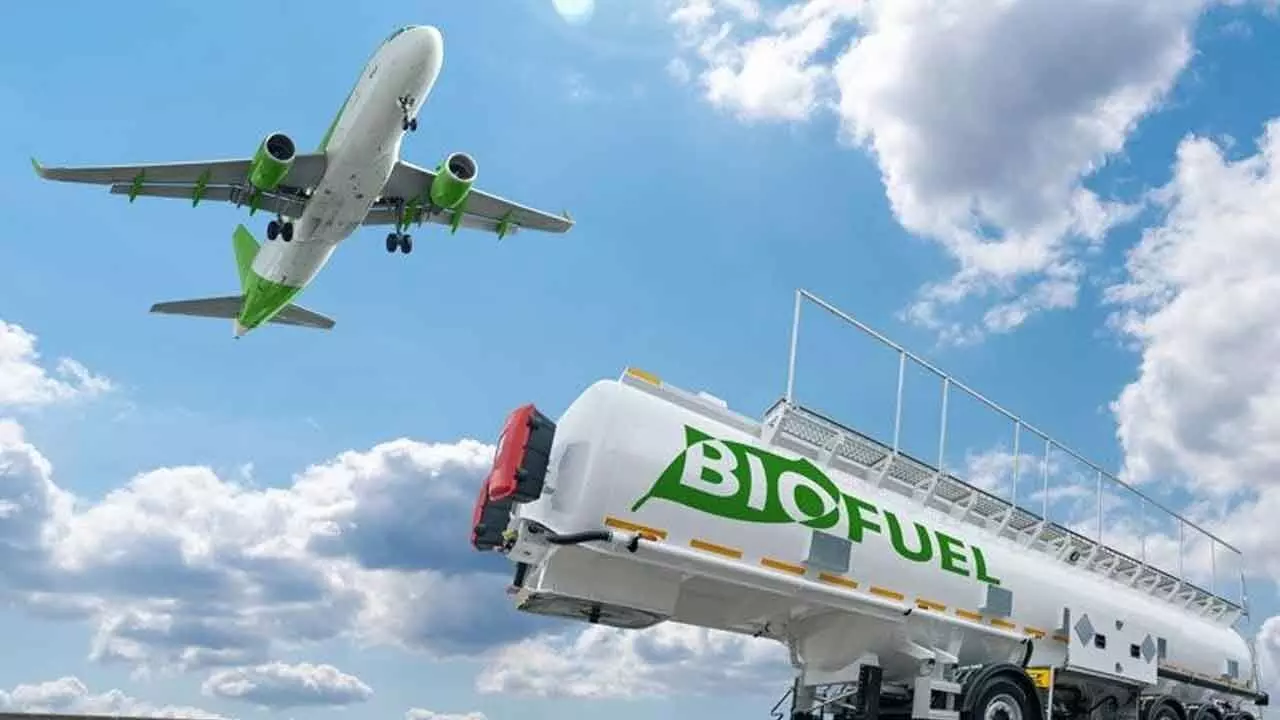
This is a biofuel produced from renewable sources like agricultural waste or used cooking oil and can be used in blends with traditional jet fuel, or in some cases, even one hundred per cent SAF. However, using biofuels in aircraft faces limitations related to production costs, feedstock availability, and compatibility with existing engine infrastructure. While biofuels offer potential for reduced emissions, their higher production costs and the need for significant upgrades to meet jet fuel specifications hinder widespread adoption. Additionally, biofuel production may have environmental drawbacks, including land and water resource requirements, and potential for increased GHG emissions.
Hybrid technology: There is also a lot of research into hybrid options – combining the performance of liquid sustainable aviation fuel with the electric propulsion.
Conclusion:
Aviation has been successful in achieving far lower emissions growth than the industry’s growth. While air traffic is increasing at an average of nine per cent annually, the growth of CO2 emissions is now lower at around only three per cent.
(The writer is a retired Jt General Manager, Airports Authority of India)