Firecracker units have become the new killers

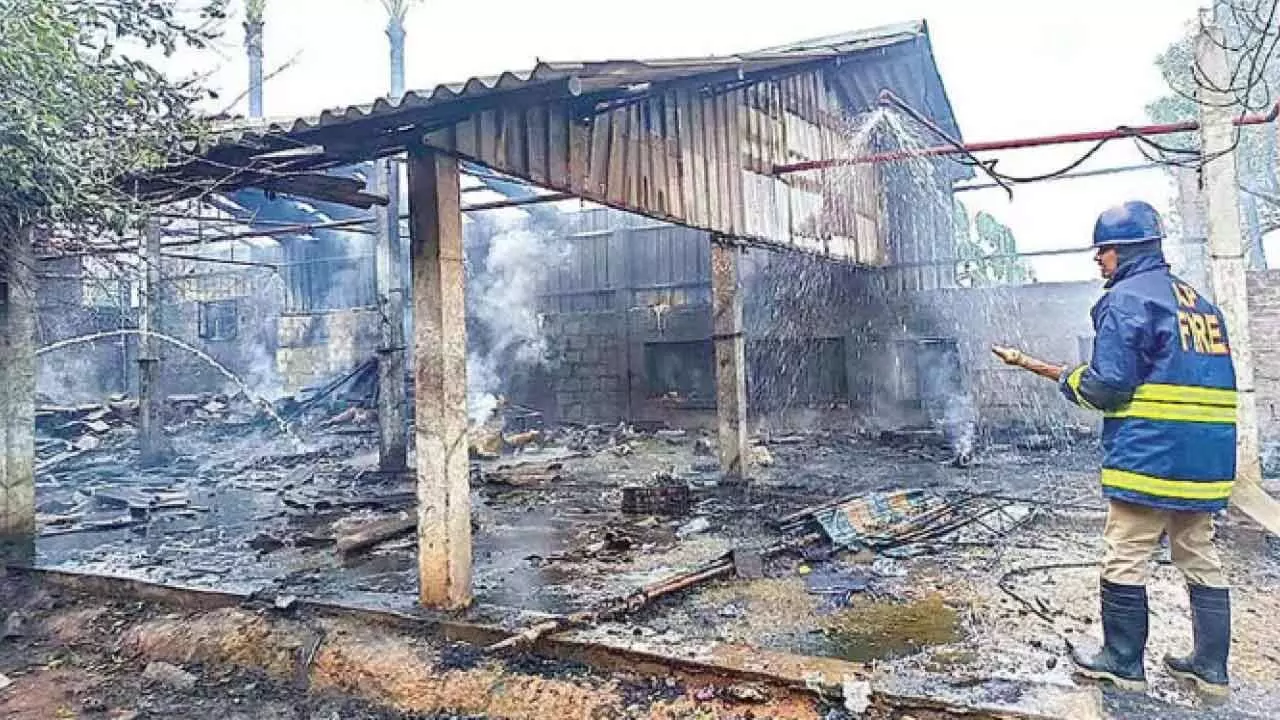
Firecrackers have become deadly! If vendors who run these businesses like those running shops in the ordinary market-selling goods without following safety regulations-are allowed to make fireworks and firecrackers in the run-up to Diwali with unskilled, low-paid workers, and authorities do not immediately rein them in, the number of casualties from such accidents will keep rising each day.
This dangerous trade, produced without any precautions whatsoever, has become a business of hazards. If this bundle of explosives, which has turned into a “high-risk industry,” is not regulated, both the number of fire accidents and the death toll will inevitably keep growing.
Last October in the Konaseema district of Andhra Pradesh, a major fireworks explosion in Grand Fireworks claimed ten lives. When Sri Surya Fire Crackers exploded in Vetapalem village, 20 persons lost their lives in an instant. It was later discovered that both units belonged to the same person. In fact, even though the government had ordered the Vetapalem unit to be shut down as early as January, it is shocking that this controversial company was allowed to continue. It caused yet another deadly disaster.
In the early days, Diwali fireworks used to bring immense joy to everyone! But because the use of explosive materials was less, hazardous situations were not common. Streets would buzz with activity—sparkling flowerpots, moonlight crackers, sparklers and small ground-spinners—making the festival a source of immense happiness for families, especially for children.
Nagpur in Maharashtra and Sivakasi in Tamil Nadu have the most number of manufacturers of fireworks. Back then, even though strict safety rules were not always followed, the limited use of explosives in manufacturing did not cause any large scale deaths. When accidents did occur, media coverage would spur governments into immediate action to prevent any loss of life or property. The officials responsible for overseeing fireworks also acted responsibly and took appropriate measures whenever needed.
Having seen those days, today thinking about the accidents happening these days makes for a terrifying proposition! In Nagpur, an explosion at the SBEL Energy factory killed 90 workers, most them being women. In the last two years alone, over 20 people have lost their lives in accidents at these very units. We should also remember that two people died in solar explosions. This solar plant is huge. Its owner even received the Padma Shri award. Locals mockingly talk about that award, implying it reveals the political connections the owner must have had.
It is because of such political connections that officials responsible for enforcing the relevant laws turn a Nelson’s Eye to the sordid goings on. The tragic irony is that those working in such hazardous units are vulnerable as they are unprotected. Whether or not the governments care, accidents keep happening, which is a grievance that the locals keep cautioning about but to avail.
People complain that because adequate safety measures are not implemented to the required levels and as the managers of those units are not prosecuted under the law, accidents are becoming too frequent. In fact, Nagpur has a safety organization responsible for ensuring that protective measures related to petroleum and explosives are in place and in working condition. Because of whistle-blowers from that organisation, there have been CBI investigations. Investigations into PESO officers, accused of issuing licenses and taking bribes, have been carried out, yet explosions and loss of life continue unabated.
It is now crucial that there be a comprehensive review of safety procedures and a deep study of the extent the senior officials are supervising the works in the factory and are swearing by the dos and don’ts.
Investigations must determine whether the businesses are providing safe, convenient, and accident-free environments, Licenses should be revoked and criminal action taken against all violators. Otherwise deaths and property losses from these incidents will not stop.
In Sivakasi, because authorities have enforced strict measures to prevent accidents and have ensured that child labour is not used in such hazardous units, the number of incidents — and consequently the loss of life — has decreased to noticeable levels.
Many years ago, Diwali firework shops used to be located away from towns. That made it clear that precautions were being taken so that, if accidents happen by mistake, the damage would be limited. Police were often stationed near those shops, constantly checking whether the merchants were taking proper safety measures. Shops opened and closed on schedule. Even if many people went from shop to shop to buy crackers, arrangements were so made that they could leave quickly. Today, even though more shops are set up in crowded places, safety measures are being tossed out.
Experience shows that stalls and shops selling items meant for the Diwali celebration were run in ways that never brought sorrow or anguish to families.
(The writer is a retired IPS officer, who has served as an Additional DGP of Andhra Pradesh)