




- Hyderabad: Selection of Indiramma Towers beneficiaries on Nov 3, 4
- Commercial surrogacy: Illegal egg trading racket busted in Hyderabad
- Air Chief Marshal AP Singh retires
- Telangana Govt sanctions funds to provide drinking water in districts
- ‘Modi kahin nahi jaayega’ now a nationwide catchphrase
- Govt reviews watershed projects in Pune, urges upkeep of water structures
- Sardar Patel's relative recalls meeting PM Modi, calls him 'visionary' like Iron Man
- Manipur has 36 communities, govt must protect everyone’s interests: CM Khemchand Singh
From protests to governance: Gen Z posing a huge challenge to party politics
In Short
Just as the 1965 Anti-Hindi Agitation permanently locked Congress out of power in Tamil Nadu, or the Assam movement shifted from student safety to geopolitical citizenship battles, the CJP rapidly expanded its trajectory.

Share :
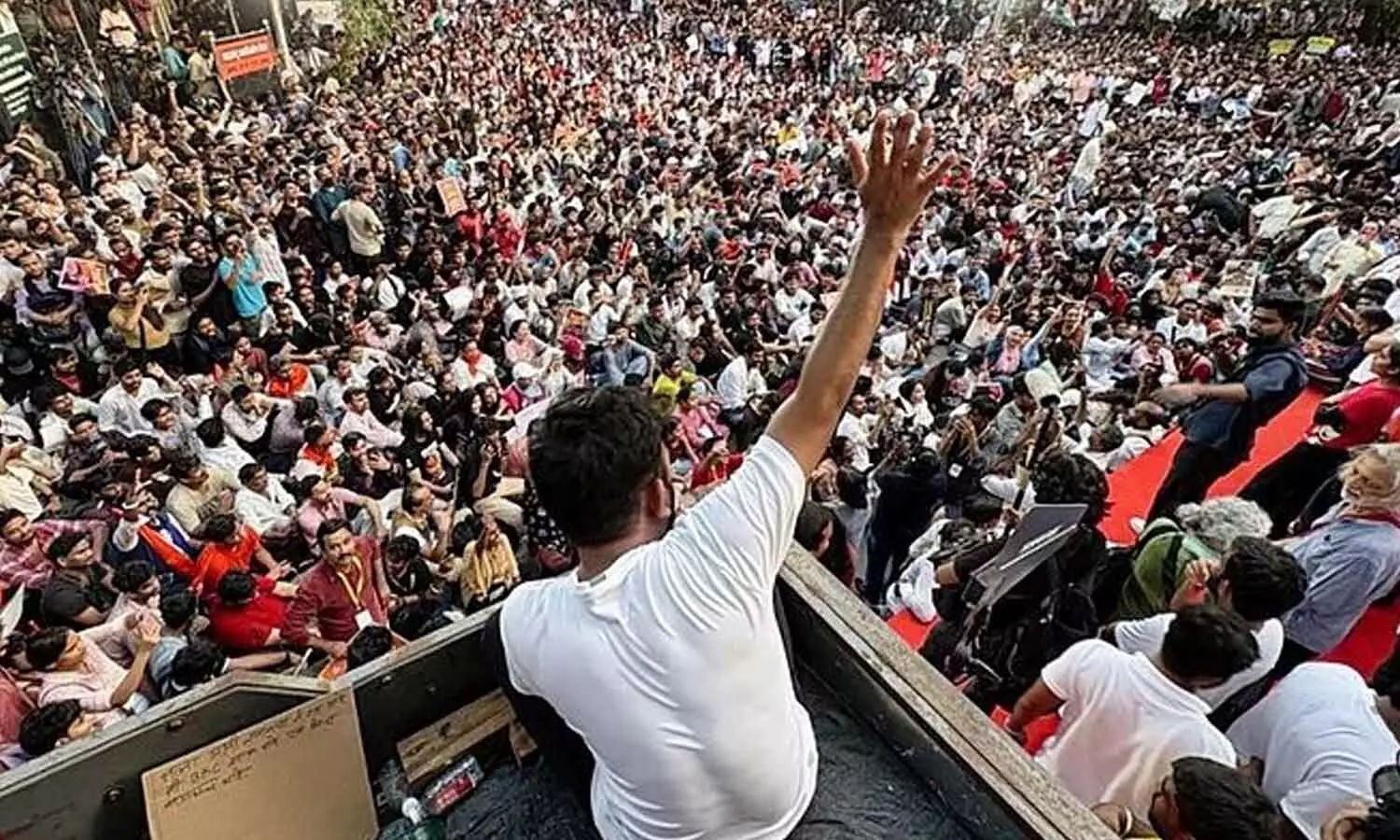
From protests to governance: Gen Z posing a huge challenge to party politics
The recurring waves of youth uprisings sweeping across Europe and Asia—from the square occupations in Spain and Portugal to the regime-toppling mobilisations in Bangladesh, Sri Lanka, and Nepal—provoke a critical inquiry into the modern architecture of dissent: Do students fill the political vacuum when mainstream political parties fail?
This global phenomenon, echoed inside India by the rapid transformation of the Cockroach Janta Party (CJP) from a satirical Gen Z meme into a potent grassroots pressure group, suggests that traditional democratic channels have grown increasingly unresponsive to structural crises like youth unemployment, economic stagnation, and institutional complacency. Unburdened by pragmatic, horse-trading compromises that define conventional party politics, student movements are stepping into the breach. They go in for direct action, digital subversion, and sophisticated online coordination to force long-ignored grievances into the national spotlight, functioning as vital societal pressure valves when elected representatives lapse into self-serving stagnation.
Far from being mere chaotic disruptions, these contemporary agitations demonstrate an unprecedented capacity to translate raw street protest into structural, institutional governance. Whether by forcing a technocratic transition that cleared the path for free elections in Bangladesh, propelling fresh reformist parties like Nepal’s Rastriya Swatantra Party to absolute majorities, or co-opting elite insults to force ministerial resignations in India, Gen Z is actively rewriting the rules of political engagement. While the local triggers vary ranging from housing crises and social media bans to national exam leaks, the underlying regional and global commonalities reveal a deep generational exhaustion with old-guard political duopolies.
Using past and present examples, this article shows how modern student movements do not want to replace political parties forever. Instead, they act as a spark to fix democracy - shake the old guard and give a voice back to the public when leaders fail to deliver on basic promises.
The European scenario:
If we look at the recent developments driving student movements in Europe and analyze the latest European Parliament Youth Survey, following common grounds such as tuition fees, climate change, housing shortages, and geopolitical solidarity form the core grievances.
These four key areas and their underlying issues are:(a) Economic strain and privatisation: Protests have frequently been against rising tuition fees, cuts to university budgets, and the cost-of-living crisis. In many countries, severe shortages of affordable student housing have catalyzed direct action and occupations. (b) Climate inaction: Traditionally European youth heavily mobilize around environmental policies, utilizing university occupations (such as the “End Fossil: Occupy!” campaigns) to demand immediate state and institutional divestment from fossil fuels. (c) Geopolitical solidarity: European campuses regularly become focal points for international human rights issues, anti-war demonstrations, and global justice movements. (d) Education Policy Reforms: Structural overhauls that prioritize market-driven metrics over academic freedom or student well-being have frequently triggered nationwide university strikes.
Finally, one must recognize and understand that there are different issues raised in different countries and political contexts, but they have something very important in common for Gen Z: They shape a young person’s ability to imagine the next stage of life!
The Asian Spring:
The modern wave of youth uprisings across South and Southeast Asia—collectively termed the “Asian Spring”—proves that Gen Z and student movements share a deeply identical systemic background. From regime changes in Bangladesh, Nepal, and Sri Lanka to policy shocks in Indonesia and the Philippines, India’s 2026 youth agitations fit perfectly into this regional framework across five dimensions:
1. Broken promises-Degrees without jobs: Parallel to Bangladeshi graduates fighting biased quotas and Indonesian youth trending #KaburAjaDulu, Indian Gen Z faced severe economic disconnect. Given this background, with graduate youth unemployment under 25 nearing 29 per cent in 2026, systemic failures like the NEET paper leaks transformed academic anxiety into an explosive battle for economic survival.
2. Out-of-touch leaders and elite insults: Uprisings in Manila, Jakarta, and Dhaka exploded when politicians openly minimised youth struggles. The name India’s Cockroach Janta Party (CJP) was born when a senior official dismissively compared protesting youth to “cockroaches crawling on the streets.” Students co-opted the insult as a badge of honour.
3. Digital censorship and internet blackouts: Governments have increasingly relied on digital censorships, such as Nepal’s blanket ban on 26 social media communication platforms. In the same way, Indian authorities deployed internet blackouts and social media curbs to halt the Jantar Mantar protests. Indian youth bypassed this censorship by deploying advanced counter-tools like the Saakshi encrypted vault to document misconduct in real time.
4. Rejecting traditional politics: Mirroring Nepal’s push to dismantle its old-guard political duopoly, modern youth movements bypass traditional opposition frameworks. In the same way, launched as a leaderless collective, CJP forced accountability directly from state institutions. This culminated in the October protests targeting the Chief Election Commissioner following allegations of a voter roll purge.
5. Using memes and satire as weapons: In fact, India leads the region in pioneering hyper-modern, decentralized protest aesthetics, matching the pop-culture and anime symbolism seen in Jakarta and Manila. The Indian movement weaponized social media satire on a scale never seen before in South Asian political history. By utilizing viral Gen Z memes, pop-up street theatre, and decentralized digital networks, they made it impossible for traditional state mechanisms to predict or contain their mobilization.
The perspective:
Student movements in independent India have repeatedly served as powerful catalysts for political change, occasionally forcing the collapse, resignation, or electoral defeat of administrations. The 2026 stir of CJP—founded by Abhijeet Dipke as a satirical Gen Z meme before transforming into a grassroots pressure group—shares striking thematic parallels with historic uprisings like the Navnirman Andolan, the Bihar movement, and the Telangana agitations, though it operates under a modern digital infrastructure.
Both historical and modern movements began with localized grievances before expanding into indictments of broader structural inequality:
Navnirman Andolan (1974): Sparked by a 20per cent hike in university mess fees in Gujarat, it escalated into a massive statewide socio-political uprising targeting widespread government corruption, hoarding, inflation, and skyrocketing food prices that forced the dissolution of the state assembly.
The Bihar Movement (1974): It illustrates how local student grievances can escalate to reshape national politics. Triggered by university mismanagement and high inflation, student unions invited Jayaprakash Narayan (JP) to lead them. JP transformed the local strike into a nationwide campaign for Sampoorna Kranti (Total Revolution). The resulting political instability heavily influenced Prime Minister Indira Gandhi’s decision to declare a National Emergency in 1975. Post-Emergency, this unified, student-backed opposition successfully toppled the central government in the 1977 general elections, ushering in India’s first non-Congress administration.
The Assam Agitation (1979–1985): Led primarily by the All-Assam Students’ Union (AASU), this six-year struggle erupted over the detection, disenfranchisement, and deportation of undocumented immigrants following regional voter roll anomalies. The sustained student rebellion paralysed the local state machinery for years. It concluded with the signing of the historic Assam Accord in 1985. Immediately following the accord, the student leaders transitioned directly from university hostels to state politics, forming the Asom Gana Parishad (AGP) party, which won the subsequent state elections and took over the government with student leader Prafulla Kumar Mahanta becoming the Chief Minister.
The Telangana movements (1969; 2000s): They are textbook examples of student mobilization fracturing political establishments. While the 1969 wave focused on the violation of “Mulki” local employment rules—disrupting Congress hegemony in erstwhile Andhra Pradesh—the 2000s resurgence broke the Andhra-dominated regime. When political leader K Chandrashekar Rao (KCR) was arrested during an indefinite hunger strike in 2009, students from Osmania and Kakatiya universities stepped in as the movement’s nerve center. Their intense mobilization triggered a massive political collapse, rendering the state assembly dysfunctional through mass resignations and ultimately forcing the central government to pass the Andhra Pradesh Reorganization Act in 2014, leading to KCR becoming Telangana’s first Chief Minister.
The CJP Movement (2026): Sparked by a May 2026 NEET paper leak and a comment comparing unemployed youth to “cockroaches,” intense protests at Jantar Mantar forced the resignation of Union Education Minister Dharmendra Pradhan in July. However, CJP activists face severe state repression, including internet blackouts, mass preemptive detentions, and the closure of historic protest sites.
Just as the 1965 Anti-Hindi Agitation permanently locked Congress out of power in Tamil Nadu, or the Assam movement shifted from student safety to geopolitical citizenship battles, the CJP rapidly expanded its trajectory.
Backed by the INDIA bloc and third-front leaders, the movement shifted focus from education to the architecture of democracy. By October, it evolved into nationwide protests demanding the resignation of Chief Election Commissioner Gyanesh Kumar over the alleged removal of 130 million marginalized voters from electoral rolls.
In this way, the CJP mirrors the different structural forces which have served as powerful catalysts for political change in India, demonstrating that student agitations remain a primary driver of Indian political realignment which is again on the agenda today.
(The writer is a former Legislator and former faculty at Humboldt-University)


