




- APCOB MD stresses deposit mobilisation and quality lending
- Collector inspects EVM warehouse at Dharmavaram market yard
- Control room open for nomination hurdles
- 18 YSRCP candidates filed nominations after SC intervention: Bhumana
- Kotamreddy family steps up campaign for Nellore municipal polls
- Moderate rains disrupt life in Nellore
- MP seeks support for coalition candidates
- NDA faces rebel trouble in urban local body polls
Global hunger index: India’s persistent hunger challenge
In Short
The country’s trajectory is positive, but it remains far from the ‘moderate’ category

Share :
Global hunger index: India’s persistent hunger challenge
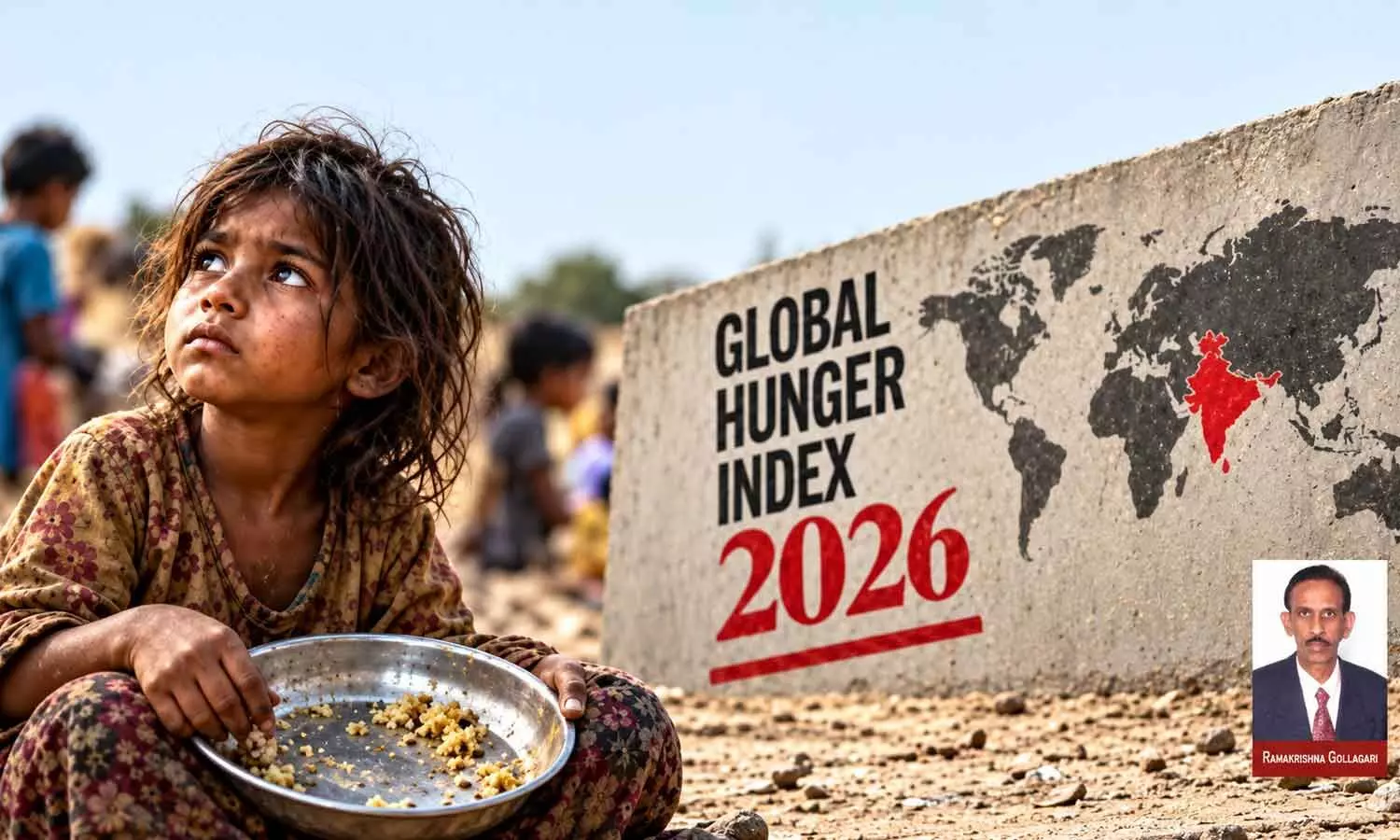
The Global Hunger Index (GHI) 2026, themed “No security without food security,” ranks India 100th among 122 countries, with a score of 24.1. This places the country in the “serious” hunger category. The number reveals both how far India has come and how much remains to be done.
In 25 years, India has cut hunger substantially, but the gains have slowed, and one indicator, child wasting, is moving in the wrong direction. India’s challenge is now less about a shortage of calories than about the nutrition of its youngest children.
How hunger is measured:
The GHI index combines four indicators: undernourishment, child stunting, child wasting, and under-five mortality. Undernourishment measures the share of the population with insufficient calorie intake. Stunting, low height for age, reflects chronic nutritional deprivation.
Wasting, low weight for height, reflects acute malnutrition. Under-five mortality captures the deadly consequences of poor nutrition and the environments in which children grow up. Together, these indicators give a fuller picture of hunger than food availability alone.
The story of improvement:
India’s progress since 2000 is real. Its GHI score has fallen from about 38.1 in 2000 to 24.1 in 2026, which marks a substantial reduction. The individual indicators also tell a similar story. Child stunting has dropped from 50 per cent in 2000 to 29.3 per cent today. Undernourishment has declined from 18.1 per cent to 9.8 per cent over this period.
Meanwhile, only 2.7 per cent of children are dying before their fifth birthday. The report attributes India’s lower hunger score largely to improvements in mortality and stunting. These numbers reflect millions of lives improved. A child born today is far less likely to be stunted, go hungry, or die young than a child born at the turn of the century. India’s rank also improved slightly from the previous year, a small but welcome sign.
Slowing momentum:
This progress has not been in uniform over time. Improvements have slowed compared with the rapid gains India achieved between 2006 and 2012. That earlier period shows what is possible when policy, economic growth, and public health efforts align, and the later slowdown suggests that the easier gains may already have been captured.
Reducing stunting from 50 per cent to the high twenties was one task, while bringing it close to zero is a harder one, requiring greater improvements in maternal health, sanitation, diet quality, and access to services.
Nearly three in ten Indian children still experience chronic undernutrition. That is a large number in absolute terms, given India’s population. This means that tens of millions of children begin life with physical and cognitive disadvantages that can follow them into adulthood.
Child wasting-The most serious concern:
Child wasting is India’s most serious nutrition problem. Around 19 per cent of children under five are wasted, a rate among the highest in south Asia. More troubling is that wasting has risen recently from 16.9% to 19.0%. In an index where most indicators are improving, this reversal stands out. Wasting matters because it signals acute malnutrition, a condition in which children have lost weight rapidly or have failed to gain it.
It can result from insufficient food, repeated illness, or poor feeding practices, and it raises the risk of death and long-term health problems. Its persistence explains why India’s hunger indicators show mixed progress, with some improving and others deteriorating. Acute malnutrition remains a major public health challenge, and the report stresses the need for stronger maternal and child nutrition interventions to address it.
Thus, India’s main challenge is no longer just calorie deficiency but child malnutrition, especially wasting. The population-wide measure, undernourishment at 9.8%, looks comparatively manageable. The child-focused measures reveal where the real vulnerability lies.
India in the regional and global context:
India’s position looks different depending on the comparison. Globally, the 2026 GHI score stands at 18.1, so India’s 24.1 is well above the world average, meaning worse hunger woes. Global progress has stagnated because of conflicts, climate shocks, and economic stresses, and India is not exempt from these pressures. Within South Asia, the picture is mixed.
The region’s overall GHI score is 23.5, close to India’s, and the regional situation is also classified as “serious.” India performs better than Pakistan, which ranks 106th with a score of 25.5, and Afghanistan, which ranks 108th with 28.6. But it trails Bangladesh (19.2), Nepal (14.5), and Sri Lanka (10.2), all of which fall in the “moderate” category.
India’s neighbours are therefore proof that faster progress is possible in similar regional conditions. Sri Lanka’s score, less than half of India’s, is a particularly striking benchmark.
What lies ahead:
The report’s conclusion for India is balanced. The country’s trajectory is positive, but it remains far from the ‘moderate’ category, and closing the gap will require a shift in emphasis. Policies that successfully reduced hunger in the past, which concentrated on food availability and broad reductions in stunting and mortality, may not be sufficient to address acute malnutrition.
This calls for stronger maternal and child nutrition interventions that focus on the first thousand days of life, the health of mothers, early detection and treatment of wasting, and the underlying conditions, such as clean water, sanitation, and disease prevention, that determine whether food translates into nourishment.
Hunger is tied to stability, health, and economic potential. A generation of children who grow up undernourished is less able to learn, work, and contribute, and the costs accumulate over decades.
Conclusion:
India’s 100th place in the Global Hunger Index 2026 is neither a story of failure nor one of triumph. The fall in the GHI score from 38.1 to 24.1, halving of undernourishment, and the sharp decline in stunting and child mortality are significant achievements. Yet slowing progress, a ‘serious’ classification, and rising child wasting show that the work is unfinished.
India’s neighbours demonstrate that better outcomes are attainable, and the evidence points to where effort should be concentrated: on the nutrition of mothers and young children. If wasting can be reversed as stunting has been reduced, India’s long climb out of serious hunger could finally gain pace.
(The writer is an economist and visiting Professor at CESS, Hyderabad)
Andhra Pradesh: ZPTC, MPTC polls may be postponed to November 5
Global hunger index: India’s persistent hunger challenge
Oppn should stop dragging Tiranga into political battle
Needless row over Jaishankar-Rubio meeting in Mumbai
Enough clean chits to China: Kharge questions Modi
Gujarat: Vadodara civic body clears land allotment for Yusuf Pathan


