Redefining the role of religion in India: Random musings

Historically, India’s religious record has been a mixed bag and a chequered legacy. It also played an important part in the evolution of a great civilisation by offering different philosophical perspectives and approaches, which created a dynamic context for cross-fertilisation of creativity and innovation in fields such as art, music, and philosophy
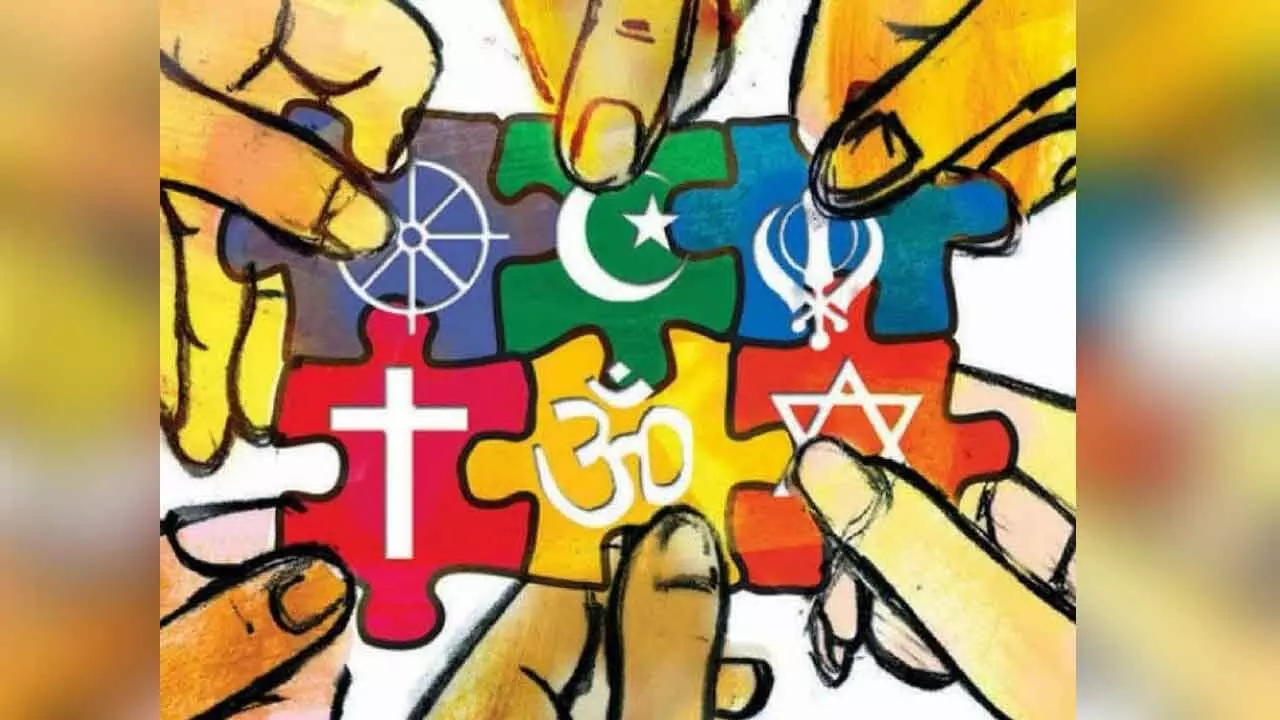
India has always been religiously multi-faceted, and multi-polar, besides being the birthplace of four great religions--- Hinduism, Jainism, Buddhism and Sikhism, the preferred faiths of roughly 20 per cent of the world’s people. Hindus constitute 79.8 per cent of India’s population. It is also home to the world’s third-largest Muslim population (14.2 per cent), and projected to head the league by year 2050. Islam is also the world’s second-largest --- and fastest growing --- religion.
Although relatively minuscule in numbers, other Indic religions significantly contributed to India’s civilizational excellence and spiritual sangam. Globally, far from receding in a secular world, and in the face of seismic technological changes, religious evangelism has become a significant force in geopolitics. In this emerging scenario, how India copes with its religious demographics will be critical not only to its domestic stability but also to its global standing.
Historically, India’s religious record is a mixed bag and a chequered legacy. It also played an important part in the evolution of a great civilisation by offering different philosophical perspectives and approaches, which created a dynamic context for cross-fertilisation of creativity and innovation in fields such as art, music, and philosophy.
Pluralism was at the epicenter, symbolized by the famous Rig Vedic adage, Ekam Sat Vipra Bahudha Vadanti, whichSwami Vivekananda translated as ‘That which exists is One; the sages call It by various names’. It was that philosophy that accommodated a wide range of beliefs and practices, from polytheism to monotheism, to explicit atheism.
Although such catholicity sustained severe damage with the advent of religions that advocated proselytization, like Christianity and Islam, which resulted in large scale destruction of religious symbols and shrines, Indian society still remained religiously harmonious. But it was the British Raj that did the most damage by institutionalizing religious differences and, above all, by the hurried and callous way of partitioning India.
It is this that created, and left scars of religious rancor in post-independent India. Less noticed but more damaging was that the British popularized the term ‘Hinduism’ as a single, homogenized European-style religion, at the expense of the eclectic and open-ended Sanatana Dharma!
Our Constitution, drafted in the looming spectre of religion-rooted partition ,tried to contain the ‘damage’ and ensure lasting religious entente by at once making the state secular and empowering minorities with affirmative rights, a rareblend for a federal polity.
To succeed, India needed a religious ambience of mutual respect, which was lacking. It was a collective failure, bringing to mind Ambedkar’s warning about the fate of the Constitution:“If things go wrong under the new Constitution, the reason will not be that we had a bad Constitution. What we will have to say is that man was vile’.
That ‘vileness’ in regard to religion manifested in the way our netas emulated the British ploy of ‘divide-and-rule’ for political gain and to win elections, sabotaging both secularism and democracy. People, in turn, followed suit to share the spoils. The result is that, of the three Cs that divide society--- creed, caste, and class--- it is the first that there is minimal mixing
The deeper reason is that the very rationale of religion got subverted. The deeper reason is the popular belief that to be ‘religious’,‘belonging’ is important, not behaviour. There is lot of ‘ ‘bhakti’ but bereft of dharma. There is no doubting the devotee’s devoutness or the authenticity of ardour, but in their mind that insulates them both from any personal wrong-doing and ‘moral injustice’--- doing nothing in the face of wrongdoing.
It is a part of generic moral malaise, compounded by the absence of moral modesty, paving the way for the rise of pseudo-spirituality., a multi-billion dollar industry far exceeding even the IPL of cricket.
So, what must we do?
We must, up front, realize that religion happens to be, whether we like it or not,too profoundly transformative to allow it to be not only abused, misused but even underused. If that realization is firmly in place, inter-religious harmony cannot be far behind. That is not possible unless the inter-religious relations are in a state of relative harmony.
That should not be too difficult because being good inter-religiously does not require becoming bad to one’s own religion. What is needed is being faithful to the true spirit of their own ‘faith’ in their social life. The conundrum is that most people in India are, one way or the other, religiously conditioned but that, on the ground, it is , to say the least, not of any social utility. In the public arena the wheels of Indian democracy are riding roughshod over religion. Religion and politics in India now constitute an ‘unholy alliance’.
What, however, offers some room for a smile is that historically, religion was always both a conservative force and a factor for change; not only an ‘opium’ that preempts social protest by making a virtue out of suffering, but also as neo-Marxist Otto Maduro suggested, also the power for revolutionary renewal, by offering a moral rationale and a platform for resistance against all forms of oppression. In the case of India, this is more pertinent because religion was never merely a private belief system but a foundational element of the social order, making purely secular radical reform difficult to engineer.
The transcendental aura around religious institutions also provide the much-needed credible infrastructure. All in all, if wisely harnessed, can incubate the right religious impulse can help to fight stubborn social problems like systemic injustice and entrenched corruption, which have defied conventional approaches.
Helpfully, all religions concur on this score. At the very heart of Hinduism’s doctrine of avatars is, in the words of Lord Krishna, in the Bhagavad Gita,‘Abhyutthānam adharmasya’,( ensuring) the predominance of unrighteousness, which includes fighting injustice.
The Quran (Surah Al-Ma’idah 5:2)says: “Cooperate in righteousness and piety, but do not cooperate in sin and transgression”. In Judaism, it is reflected in the instruction to “Follow justice and justice alone” (Deuteronomy 16, 20).
The Bible enjoins its faithful to “Learn to do good; seek justice, rescue the oppressed”. (Isaiah 1:17).In Sikhism, the very basis of the concept of the Sant Sipahi symbolizes this spirit. In Buddhism, the idea of ‘socially engaged’ Buddhism entails an active participation in combating socio-economic-ecological injustice.
In Jainism, this takes the form of refusal to participate in, or benefit from, systems that create the conditions. If we can translate this into action it would have a salutary effect. The very sight of religious leaders of different faiths coming out, shoulder-to-shoulder for common good could overcome vested interests and bridge other divides in society
But in a society so vitiated with vituperation and vitriol, how to symphonize and orchestrate such a seismic shift. For that, we should fully leverage India’s broad religious grassroots base to create a ‘critical mass’ of committed citizens. They would then so routinely participate in the practices of other faiths that it becomes a reflexive habit. That will amount to religious pluralism in action, creating the ambience necessary to momentum for inter-faith amity
The war within
If it is so self-evident, why has this happened? The primary reason is that there are too many of us--- politicians, religious leaders, zealots--- who have a stake in the status quo. That makes creating the ‘critical mass ‘ very difficult. We need mindset change and that requires an inner struggle.. .Like the Islamic ‘Jihad al-Akbar’ or ‘greater war’, against internal foes like greed, lust, and anger, the broader struggle of redefining the role of religion in society too,requires similar, if not deeper, depth and drive.
And for that, we must learn to better ‘feed’ what Abe Lincoln called our ‘better angels’than those that Hinduism calls ‘arishtavargas’ or internal enemies in everyone’s war within.