Mt Everest toughest ascent, says youngest conqueror of seven summits

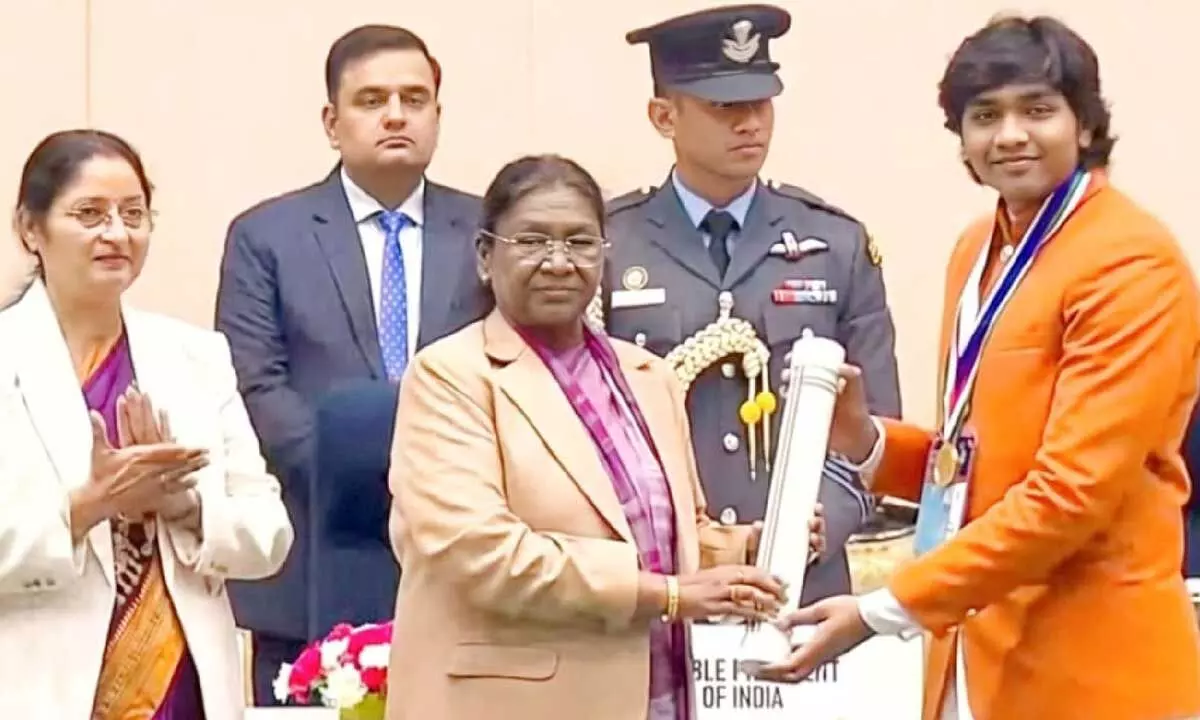
Hyderabad: In a moment of national pride, the Government of India conferred the Pradhan Mantri Rashtriya Bal Puraskar 2025 on Hyderabad-based mountaineer Vishwanath Karthikey Padakanti, recognising his historic achievement as the youngest Indian and the second youngest person in the world to complete the prestigious Seven Summits Challenge. The national honour was presented by President Droupadi Murmu, observed annually as Veer Baal Diwas.
The Pradhan Mantri Rashtriya Bal Puraskar is awarded to children below the age of 18 for exceptional achievements across six categories—Bravery, Social Service, Environment, Sports, Art and Culture, and Science and Technology. Vishwanath received the award for his extraordinary contribution to sports and self-service through mountaineering.
The Seven Summits Challenge involves scaling the highest peaks on each continent: Mount Everest (Asia), Aconcagua (South America), Denali (North America), Mount Elbrus (Europe), Mount Kilimanjaro (Africa), Mount Kosciuszko (Australia), and Mount Vinson (Antarctica). Vishwanath completed the challenge at just 16 years of age, finishing with the successful ascent of Mount Everest on May 27, 2025.
Excerpts from an interview
When and how did your mountaineering journey begin?
I began mountaineering during the Covid-19 pandemic in 2020, when I was 11 years old. My elder sister was preparing for an expedition to Mount Rudragaira in Uttarakhand, and I was determined to accompany her. Although I could not reach the summit, that expedition changed my life. From that moment, mountaineering became not just my passion, but my purpose. Born on October 30, 2008, in Hyderabad and currently residing in Ferozguda, Balanagar, I slowly began training seriously for high-altitude climbing.
What inspired you to aim for the Seven Summits Challenge at such a young age?
I have always been inspired by patriotic movies and the idea of doing something meaningful for my country. Mountaineering gave me a platform to combine my passion with service. At the age of 13, I officially started my self-service challenge with Mount Elbrus, and from there, the dream of completing the Seven Summits slowly took shape.
Can you highlight some of your early achievements?
At the age of 13, I climbed Mount Elbrus, Europe’s highest peak, from both the east and west routes within 24 hours, on the occasion of India’s 75th Independence Day. I also climbed Mount Kangyatse II and Mount Zojonga within 72 hours, becoming the youngest person to achieve this. Later, I climbed Kangyatse I and Island Peak, again as the youngest climber. Over the last five years, I have climbed 23 mountains across continents, setting multiple age-related benchmarks.
Which summit was the most difficult for you, and why?
Mount Everest was the most difficult and defining climb of my life. The temperatures dropped to –40 to –45 degrees Celsius, and the air in the Khumbu Icefall was extremely dry. I suffered severe throat damage, intense coughing, and even bleeding from my mouth. After a week on the mountain, I completely lost my voice.
During the descent, my water bottles fell—one was empty and the other, which had water, was lost. For the final four days, I had no proper food or water and survived only on Coca-Cola, which I had carried for emergency energy. I also had to push for the summit twice due to bad weather, and for nearly 48 days, there was no network connectivity to contact my parents.
How did you prepare physically and mentally for such extreme challenges?
I trained rigorously under Aishwarya Rivas Sir at Dream Fitness Gym, along with technical training at the Nehru Institute of Mountaineering. My training routines were extremely demanding and often began at 4 a.m. I trained until failure, focusing on endurance, strength, and mental conditioning. This discipline helped me stay calm and resilient in extreme conditions.
How did you balance school, training, and expeditions?
Balancing everything was challenging, but I followed one rule—complete focus on one thing at a time. During expeditions, I focused only on climbing. When I returned home, I dedicated myself fully to academics and training. My school, teachers, and friends supported me immensely by helping me cover missed portions and exam priorities.
What does the Pradhan Mantri Rashtriya Bal Puraskar mean to you?
This award is more than a recognition—it has ignited a fire within me to inspire others. It gives me confidence that if I can achieve my dreams, others can too. It also strengthens my responsibility to spread awareness about mountaineering ethics and environmental conservation.
You have spoken about environmental responsibility. Why is this important to you?
During my Everest expedition, especially at Camp 4, I saw alarming amounts of garbage left behind by climbers. Mountains are fragile ecosystems, not playgrounds. I want to educate people about responsible mountaineering, carrying waste back, and preserving mountains for future generations.
What are your future plans?
I plan to pursue a Bachelor’s degree in Digital Science and Management. In the short term, I aim to join the Viksit Bharat 2047 initiative with Green Earth Guardians, where I will continue spreading awareness about mountaineering, sustainability, and environmental responsibility.