Karanth’s dream project in ruins again as Balavana slips into neglect

The family of late Jnanpith Award winner Dr. Kota Shivarama Karanth, who donated 3.5 acres of prime land in Puttur town for a children’s cultural centre, is crestfallen as the Dr. Kota Shivarama Karanth Balavana—conceived as a vibrant learning space—has once again fallen into disrepair.
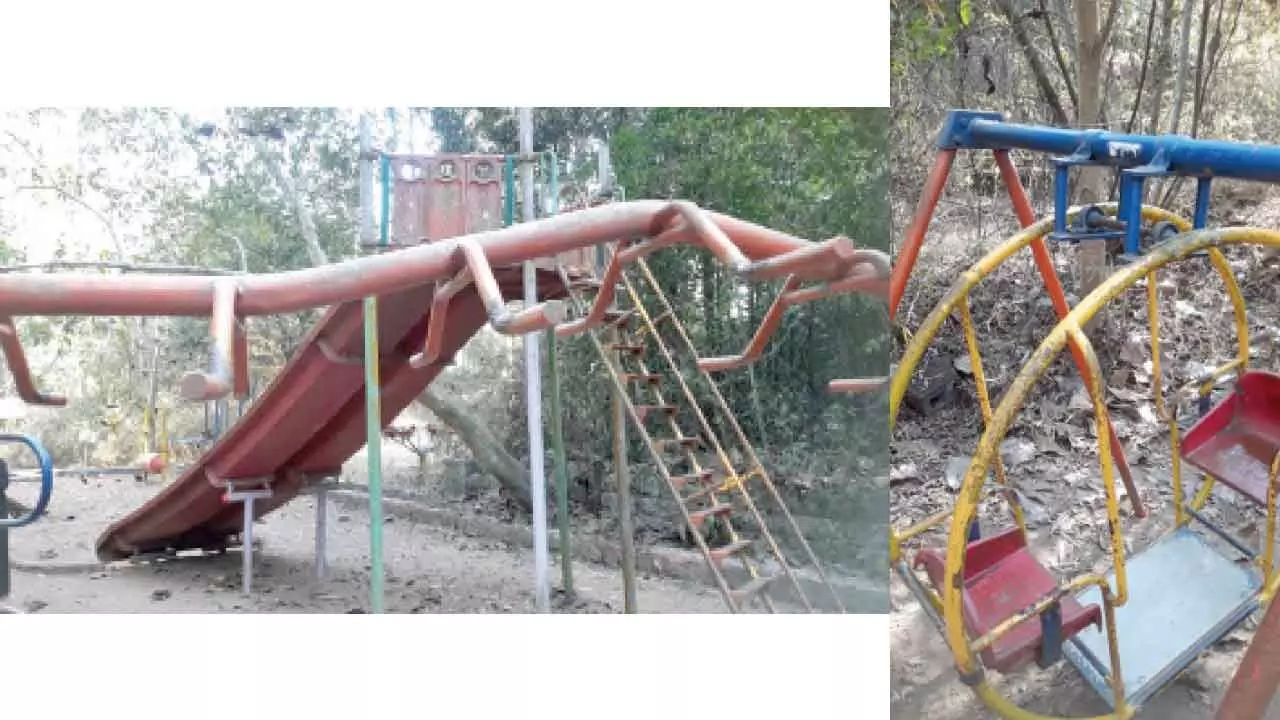
Once envisioned as a centre where children could “learn while they play”, Balavana today presents a grim picture. Rusting play equipment, withered greenery due to lack of water, dried leaves strewn across pathways, and poorly maintained premises and toilets have become a source of embarrassment for the town, according to senior residents.
Elders of Puttur say the neglected condition of the children’s park not only undermines its purpose but also poses safety risks. The rusted play equipment could potentially injure children and expose them to health hazards, yet parents continue to bring their children to the park due to the absence of alternative play spaces.
Dr. Shivarama Karanth, one of the greatest cultural icons of coastal Karnataka, passionately advocated experiential learning for children. Through his writings, films, Yakshagana contributions, and cultural initiatives, he consistently emphasised holistic education. Balavana was meant to embody that philosophy.
Speaking to The Hans India, Dr. Amrut Malla, a close admirer of Dr. Karanth, said the upkeep of Balavana had “never been worse.”“This institution was created to preserve and perpetuate the memory and work of Dr. Karanth. Before moving to Kota-Saligrama in Udupi in 1973, he donated his house and land to the government with a clear mandate—to develop it as a children’s cultural centre focusing on Yakshagana, art, music, films and creative writing,” he said.
Dr. Karanth’s son Dr. Ullas Karanth and daughters Dr. Malavika Kapoor and Kshama Rao were members of the State-level committee overseeing Balavana, which included eminent personalities such as Dr. B.A. Viveka Rai, Chiranjeevi Singh, and M. Veerappa Moily. “Despite this, local authorities have failed to give this priceless legacy the care it deserves,” Dr. Malla added.
Adding to the concern is the unrealised ecological potential of Balavana. Researchers from the Indian Institute of Science (IISc), Bengaluru, have identified the 5.6-acre campus as a potential lung space for Puttur town, with scope for development as an eco-tourism centre alongside its cultural role.
A research team led by Divyasusuma, which presented a paper at the Lake 2016 – 10th Biennial Lake Conference on Ecologically Sensitive Regions of the Western Ghats held in Moodbidri, documented rich biodiversity in the area.
The study recorded 83 species of angiosperms, two species of gymnosperms, 71 butterfly species, 52 bird species, and 13 animal species, recommending Balavana as a strong candidate for eco-conservation.
Spread over nearly 5.9 acres, the Balavana campus includes Dr. Karanth’s residence, a printing press, a theatre, a library, and houses his Jnanpith Award. What was meant to be a living tribute to a towering cultural figure now stands as a stark reminder of institutional neglect. For many in Puttur, the continued deterioration of Balavana is not merely administrative failure—it is a betrayal of Dr. Karanth’s vision and a loss to future generations.