Maharshi Karve: The torchbearer of women’s empowerment whose legacy the present generation must remember

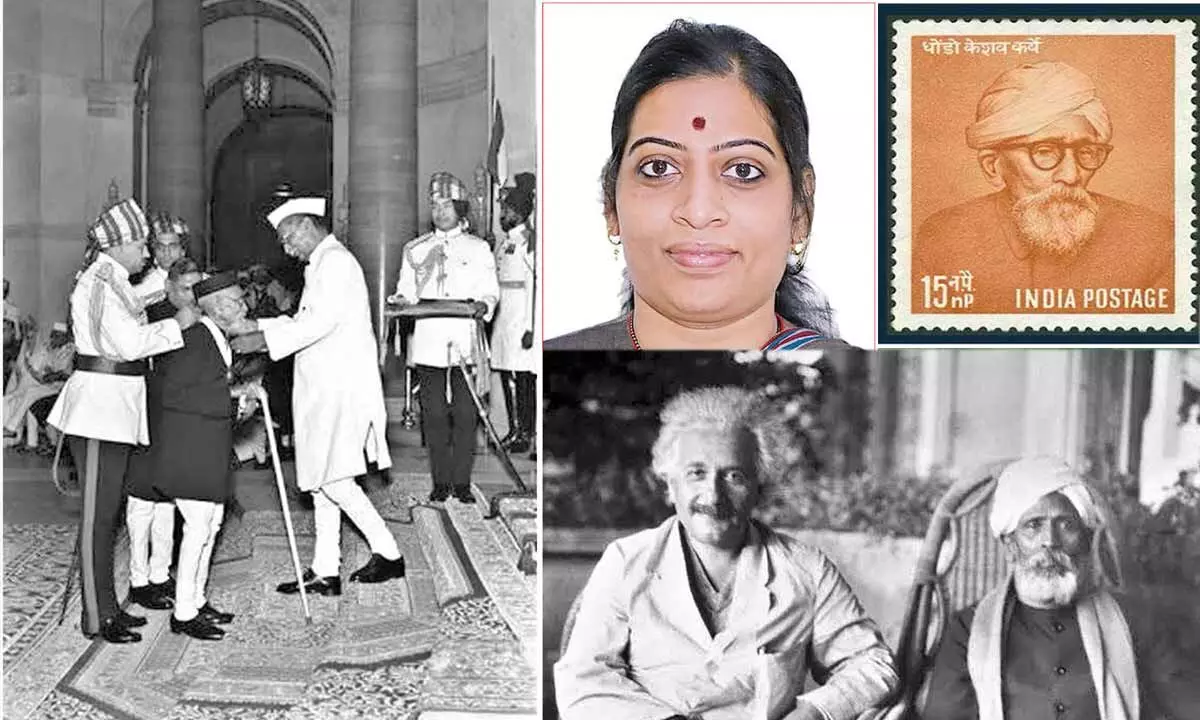
In the vast canvas of Bharat’s social reform movements, few figures shine as luminously as Maharshi Dhondo Keshav Karve. He is a visionary who transformed the discourse on women’s rights long before these ideas gained global momentum. Born on 18 April 1858 in Murud, Maharashtra, Karve was a pioneer in advocacy for women’s education, dignity, and self-reliance, which can be achieved through quiet perseverance rather than agitation.
Dr. Pandiri Harsha Bhargavi
In the vast canvas of Bharat’s social reform movements, few figures shine as luminously as Maharshi Dhondo Keshav Karve. He is a visionary who transformed the discourse on women’s rights long before these ideas gained global momentum. Born on 18 April 1858 in Murud, Maharashtra, Karve was a pioneer in advocacy for women’s education, dignity, and self-reliance, which can be achieved through quiet perseverance rather than agitation.
At a time when the country was facing social challenges, Karve built institutions that opened the doors of learning to girls, widows, and socially ostracized women. His work was so transformative that the world took notice. Even global scientific genius Albert Einstein expressed deep admiration for him and sought to meet him during his visit to the country.
Life Built on Courage and Conviction
As a young mathematician and professor at Fergusson College, Pune, Karve appeared destined for an academic life of comfort. Yet, the plight of widows deeply moved him. Widows were marginalized, denied education, and often condemned to a life of seclusion. His revolutionary decision to marry a widow, Godubai, in 1893 (at a time when such an act invited social boycott) marked the beginning of his lifelong mission.
Karve channelled his personal experiences into public action. He founded the HingneStreeShikshan Sanstha in 1896, which began as a home for widows and gradually expanded into a centre for women’s education. What started as a modest effort grew into a powerful movement, shaping the destiny of thousands of women.
Founding Bharat’s First Women’s University
Karve’s most enduring contribution came in 1916 with the establishment of the Bharat Women’s University, later known as SNDT Women’s University (ShreematiNathibai Damodar Thackersey Women’s University). At a time when women’s enrolment in schools was considered unnecessary, creating a university exclusively for them was unprecedented.
Today there are more than 10 million women students are with the institution. The institution offers holistic education which includes academics, vocational training, teacher education, and life skills—tailored for women from varied socio-economic backgrounds. Today, SNDT stands as a testament to Karve’s foresight. It continues to empower millions, reaffirming his belief that society’s progress rests on the education of women.
Global Recognition and Eminent Visitors
Karve’s transformative work drew international attention. Scholars, reformers, and global leaders visited the country to understand his model of women-centric education and social transformation.
Among them, the iconic physicist Albert Einstein held Karve in high regard. Recognizing his extraordinary contribution to humanity, Einstein expressed his desire to meet him during his visit to India—a symbolic gesture that elevated Karve’s work to a universal plane. Many other eminent personalities, including international educationists and social reformers, interacted with him to understand his vision for an egalitarian society.
Karve’s contribution was later recognized with the Bharat Ratna in 1958, on his hundredth birthday, cementing his position as one of the country’s greatest nation-builders.
A Life of Spartan Simplicity
Despite worldwide recognition, Karve lived a life of austere simplicity. His attire remained basic, his food simple, and his lifestyle minimalistic. He refused personal accolades that overshadowed his mission. At an age when most people retire, Karve continued establishing new institutions—hostels for working women, vocational training centres, and rural development initiatives.
His autobiography “Looking Back” remains a powerful narrative of a man who transformed adversity into action. It reveals his unshakeable patience, moral courage, and extraordinary clarity of purpose.
Why the Present Generation Must Remember Maharshi Karve
Today’s world speaks of gender equality, women empowerment, and inclusive development—concepts Karve practiced more than a century ago. His relevance today is not merely historical; it is deeply contemporary.
1. A Role Model for Social Leadership
Karve demonstrated that true leadership is rooted in service. He worked without expectation of recognition, showing that meaningful change begins at the grassroots level.
2. Champion of Women’s Education
In an era where the country aims to increase female workforce participation and STEM education for girls, Karve’s vision remains a guiding force. He believed that educating a woman transforms a family, community, and the nation.
3. Embodiment of Courageous Reform
He challenged social norms not through confrontation but through constructive action. His approach teaches today’s youth that societal transformation requires patience, conviction, and moral clarity.
4. Inspiration for Institution Building
Karve built institutions that outlived him—an essential lesson for a generation that prioritizes instant results. Sustainable change comes from creating systems.
5. Symbol of Compassion and Humanism
At the heart of Karve’s work was empathy. His ability to see dignity in every human being makes him a timeless inspiration.
A Legacy Carved in Compassion
Maharshi Karve’s journey from a small village in Maharashtra to becoming a global figure of social transformation is a testament to the power of vision coupled with action. His work reshaped society, inspired global admiration, and created educational opportunities for millions of women who were once denied basic rights.
As the country strides toward becoming a knowledge-driven and inclusive society, remembering Karve reminds us of the values that must guide the nation’s future. His life urges us to ask: Are we doing enough to build a just, equal, and compassionate society?
For today’s generation, Maharshi Karve is more than a historical figure. He is a beacon and a reminder that one individual, armed with conviction and compassion, can transform the destiny of a nation.
(The writer is a Creative Economy Expert)