MyVoice: Views of our readers 3rd February 2026


Views of our readers
Duty exemption on cancer drugs is a life-saving move
In a major initiative, the Union Budget 2026-27 has given customs duty exemption on cancer medication drugs and brought down life-saving medications at affordable rates, which is a widely appreciable initiative.
One must remember that cancer patients are increasing by over a million every year in India. Another good augury is the government’s proposal to establish over 200 cancer care centres across the nation. One fondly hopes that this will bring a huge relief to cancer-inflicted patients and their families from the middle- and low-income groups.
Saketh Sirasanagandla, Hyderabad
Middle class ignored, yet again
The 2026-27 Union Budget ignores the middle class by retaining income-tax slabs and rates, while increasing securities transaction tax. The super rich are incentivised by write-offs of their loans and lower class is enjoying the benefit of freebies and free/subsidised housing,
However, the middle class has to bear the brunt huge education costs, EMIs for essential consumer goods and rising house rents on the one side and loss of job security and rising unemployment or underemployment owing to technological progress and adverse changes in labour codes, on the other side.
P R Ravinder, Hyderabad
High-speed rail corridors must include Warangal
The Union Budget 2026–27 has announced three high-speed rail corridors for Hyderabad connecting Pune, Bengaluru and Chennai, projecting them as “growth connectors.” However, the complete omission of Warangal—the second-largest city of Telangana and a major educational, industrial and cultural hub—is deeply disappointing and economically short-sighted. Equally concerning is the proposal to divert nearly half of the rail traffic through the Bibinagar–Nadikudi section. Instead of upgrading Kazipet into a modern transit hub, the current plan risks turning it into a congestion bottleneck.
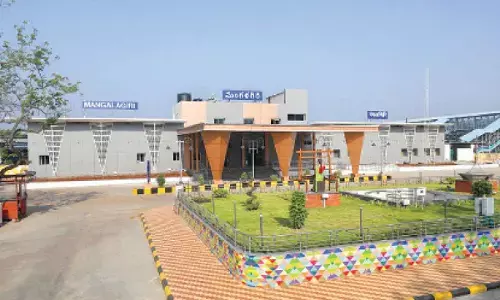
Warangal has been repeatedly assured of a railway manufacturing unit and redevelopment under the Amrit Bharat Stations Scheme. I urge the Ministry of Railways and the Telangana Government to re-examine the corridor alignments and include Warangal–Kazipet in the high-speed rail framework, ensuring that Telangana’s development is not confined to Hyderabad alone.
Vidyasagar Reddy Kethiri, Hanumakonda-506009
Oppn has chosen rhetoric over reason
The Opposition’s criticism of the Union Budget 2026-27 appears less an exercise in economic scrutiny and more of a reflexive political ritual. Ignoring fiscal constraints, global uncertainty, and inflationary pressures, it has chosen rhetoric over reason.
The budget’s calibrated focus on capital expenditure, infrastructure push, fiscal consolidation, and targeted welfare reflects pragmatic governance, not indifference. To dismiss these measures as “anti-people” without credible alternatives only exposes an unwillingness to engage with hard economic realities.
S Lakshmi, Hyderabad
Unbecoming of Cong, DMK and TMC
The Congress, TMC and DMK have indulged in irresponsible fault-finding over the Union Budget, branding it with a variety of pejorative labels rather than engaging with its substance. Such rhetoric is uncalled for at a time when the economy demands constructive debate and policy seriousness. Instead of offering credible alternatives or acknowledging fiscal constraints, the Opposition has chosen theatrics over analysis.
Budgetary scrutiny is vital in a democracy, but reducing a complex financial exercise to slogan-driven criticism only weakens parliamentary discourse and does little to advance national economic interests.
Sakunthala K R, Hyderabad
Should the Centre fund development projects in states?
The Union Budget sets out how the Centre will spend money on national priorities like national highways, railway corridors, power grids, defence, and large infrastructure projects. States, on the other hand, prepare their own budgets to meet local needs like irrigation canals, hospitals, schools, and village roads. Transfers from the Union Budget to states happen in several ways. First, tax devolution: a constitutionally mandated share of central taxes recommended by the Finance Commission. Second, grants-in-aid: funds given to states to cover revenue deficits, disaster relief, or special needs.
Third, centrally sponsored schemes: programmes like MGNREGA or PMAY, where both Centre and states share costs. Fourth, central sector schemes: fully funded by the Centre but implemented in states, such as PM-KISAN. Chief Ministers often criticize the Union Budget because it does not announce state-specific projects or increase their share of funds. They feel their states are ignored when allocations are shown only in aggregate. The Union Budget builds national infrastructure, while state budgets decide local development priorities.
Dr O Prasada Rao, Hyderabad