




- Labour and Employment Minister Mandaviya launches EPFO services through WhatsApp
- Gyanesh Kumar 'vanished' votes in Bengal by centrally hijacking system: Mamata Banerjee
- We will find out Gyanesh Kumar even if he hides underground, asserts Congress chief Kharge
- Congress wishes to run democracy according to the law of Gandhi family, says BJP chief Nitin Nabin
- CM Revanth Reddy vows to fight for the fight against vote deletion
- Food arrangements near the polling station raise questions over possible voter inducement
- Symbol Mix-Up in Vijayawada's 55th Division Brings Polling to a Halt
- Nandigama Records Highest Polling at 17.99% in NTR District
“Karvayi Hogi, Hogi, Hogi”: Rahul’s Threat Takes Centre Stage at Ramlila Maidan
In Short
The rally introduced a new element into the political narrative. Samajwadi Party chief Akhilesh Yadav alleged that the CEC was not merely responsible for deleting 13 crore votes but had also removed one crore Hindu votes.

Share :
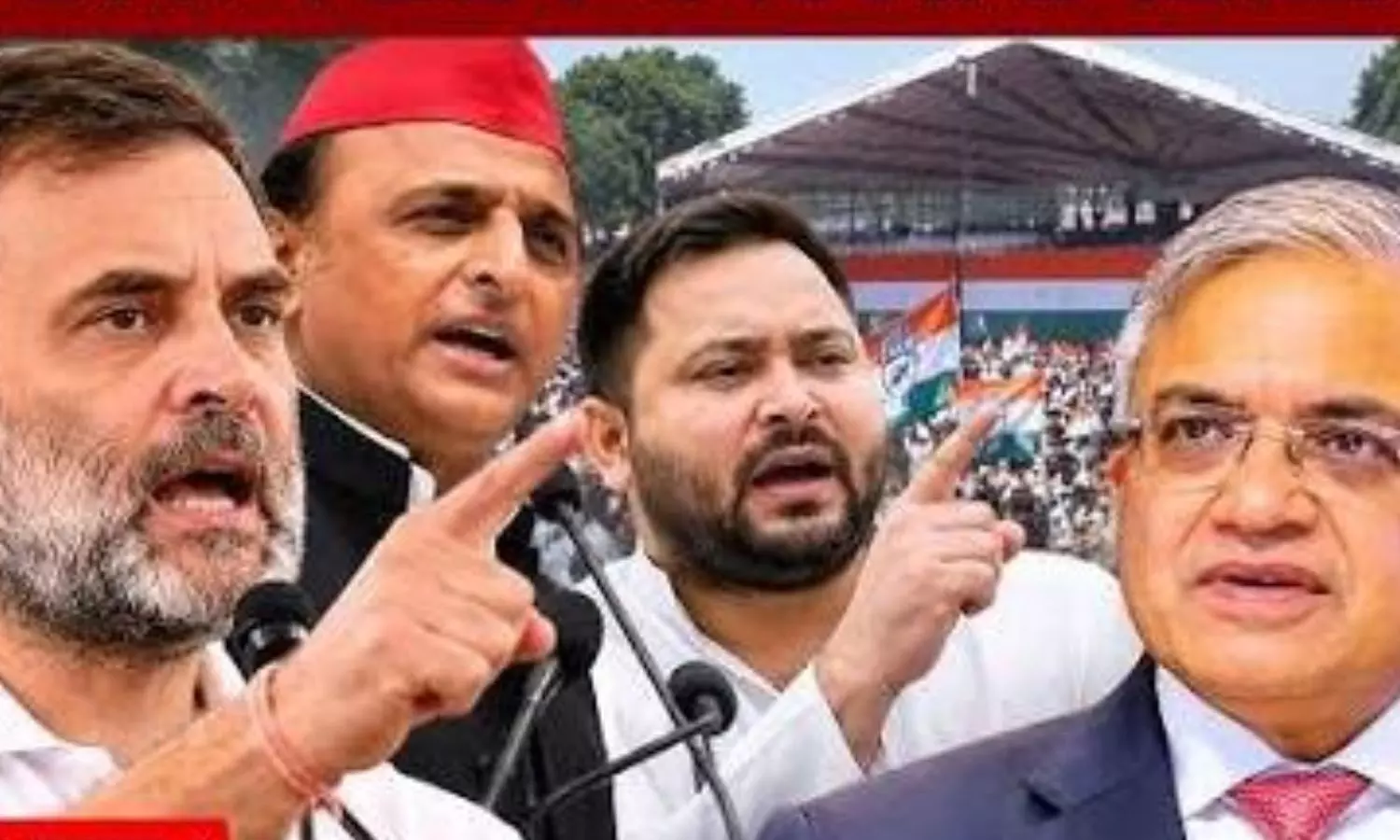
“Karvayi Hogi, Hogi, Hogi”
What began as a rally demanding the removal of Chief Election Commissioner (CEC) Gyanesh Kumar over alleged vote theft has taken a new turn, with the opposition shifting its pitch to “Modi Hatao, Loktantra Bachao”.
The rally introduced a new element into the political narrative. Samajwadi Party chief Akhilesh Yadav alleged that the CEC was not merely responsible for deleting 13 crore votes but had also removed one crore Hindu votes. Leader of the Opposition in the Lok Sabha Rahul Gandhi echoed the charge. By bringing a communal angle into the controversy, the two leaders have indicated that this could become a major plank of their campaign. It remains to be seen how the BJP responds to this new strategy, particularly the attempt to question the integrity of the electoral rolls.
Another striking feature of the rally was the difference in the approach adopted by the opposition leaders. While Congress president Mallikarjun Kharge, West Bengal Chief Minister Mamata Banerjee, Mehbooba Mufti and Rahul Gandhi directly targeted Prime Minister Narendra Modi more than the CEC, Akhilesh Yadav refrained from naming either Modi or Union Home Minister Amit Shah. Despite peppering his speech with sharp jibes and idioms, he struck a relatively restrained note.
Kharge alleged that the CEC was hiding somewhere and declared that the opposition would track him down and punish him, wherever he might be. He accused the BJP of winning elections in Bihar, Uttar Pradesh, West Bengal and other states through vote theft.
“Jab Modi Jayega, Tabhi Democracy Bachega,” he declared, giving the rally the slogan “Loktantra Bachao”.
Samajwadi Party chief Akhilesh Yadav claimed that the BJP was nervous because it had realised that people were no longer with it. He cited the results of the Kashi MLC election as an indication of the changing political mood, saying that those who came to power through Kashi would now have to leave Kashi. All the tricks of the so-called double-engine government had failed, he said, alleging that the BJP had to rely on the CEC to win elections through vote theft, including in West Bengal.
Recalling the 2022 Uttar Pradesh Assembly elections, Akhilesh said the Samajwadi Party had submitted several affidavits to the CEC detailing alleged electoral irregularities but the commission had failed to act. Now that people had understood the BJP's game plan, the ruling party was nervous, he claimed.
Taking another swipe at the BJP, Akhilesh said that, according to the ruling party, only those who supported it should remain on the electoral rolls. Explaining why the opposition had chosen Ramlila Maidan for the rally, he said it was a place from where sinners had to disappear. He described the venue as the opposition's “Haldighati” in its battle to protect democracy.
He also raised the issue of “Chand Chori”, apparently seeking to revive a controversy that has so far failed to make much political impact. Other leaders, including Mehbooba Mufti, spoke about restoring full statehood to Jammu and Kashmir. At one point, the rally appeared to be turning into a mixed bag of demands and political grievances.
Mamata Banerjee appeared particularly bitter over her party's defeat in the West Bengal Assembly elections. She insisted that voters had not defeated her but that the CEC had done so through alleged vote theft. Predicting that Gyanesh Kumar would eventually disappear from the scene, she broke into a nursery rhyme: “Gyanesh, Gyanesh, Yes Papa, Vote Chori, Yes Papa…”. Raising her voice, she shouted, “Democracy loot liya, Counting loot liya.”
Rahul Gandhi, meanwhile, warned that his “Mohabbat ki Dukan” was about to open. He said the country wanted love, not hatred, accusing Modi, Amit Shah and the RSS of spreading hatred. He described the CEC's alleged role in electoral manipulation as “rarest of rare treason” and asserted that nobody could save him from facing the consequences.
The LoP maintained that he had no personal animosity towards Modi, Amit Shah or Gyanesh Kumar. Protecting the voice of the people was his “dharm”, he said, adding that this required the removal of the Modi government.
He also alleged that industrialists Gautam Adani and Mukesh Ambani had captured the country's infrastructure. Even the drones seen over Ramlila Maidan, he claimed, belonged to Adani. He accused the industrialist of gaining control over airports, the power sector, educational institutions and other key areas, insisting that such a situation was unacceptable.
Taking a jibe at the BJP's counter-slogan, “Modi Kahin Nahi Jayega”, Rahul said Modi could not go anywhere and that the opposition would not allow him to escape accountability. After Gyanesh Kumar, it would be the turn of others to face legal consequences, he warned, adding that they too would not be able to escape.
“We are not anarchists, but we cannot remain silent when democracy is under attack,” Rahul said, insisting that the opposition did not hate its political rivals.
He also spoke of his vision of a country where everyone could participate in “Shiv Tandav”.
Bolsonaro backs off Brazil poll challenge after Trump says 'I’m not running Brazil'
Dinesh Ganvir takes charge as GSI chief, to step up hunt for critical minerals
CM Yogi Adityanath to visit Ayodhya ahead of grand Deepotsav celebrations
Rahul Gandhi Says Modi, Shah and Gyanesh Kumar Attacked India's Democratic Values
AP Municipal Elections live updates: Polling begins in 92 urban local bodies
INDIA Blox Chalo Delhi rally live updates: Activists flock to Ramlila Maidan
Rahul Gandhi Leads INDIA Bloc March to Ramlila Maidan, Mamata and Akhilesh Join Protest
AP Formation Day: President extends greetings to people
Municipal polls continue in Vizag hassle-free
Polling begins in 92 urban local bodies in AP


