SC verdict awaited in Prez plea on timeline for Bills

Should 'custodian of Constitution' sit idle, asks apex court
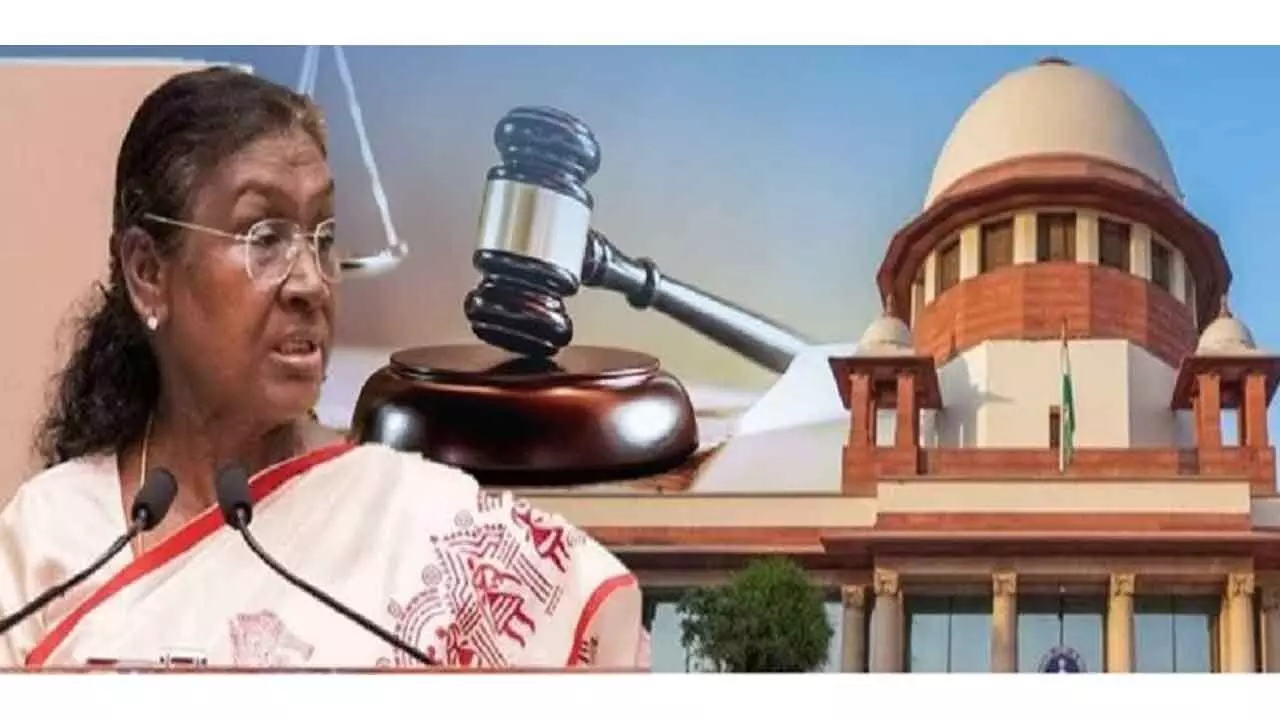
New Delhi: Calling itself the “custodian of the Constitution”, the Supreme Court on Thursday asked if it could ‘sit idle’ if a Constitutional functionary like Governor failed to discharge duties, as it reserved its verdict on the Presidential reference on grant of assent to Bills.
In the marathon hearings spanning 10 days, a Constitution Bench, headed by Chief Justice B R Gavai, heard legal luminaries, including Attorney General R Venkataramani, Solicitor General Tushar Mehta and senior advocates Kapil Sibal, Abhishek Singhvi, Gopal Subramanium, Arvind Datar and others, on the Presidential reference which centered around Articles 200 and 201 and the key issue whether constitutional courts can impose timelines for Governors and President to assent to Bills. On the last day, the bench, also comprising Justices Surya Kant, Vikram Nath, P S Narasimha and A S Chandurkar, interjected when Mehta referred to the separation of powers as one of the basic structures of the Constitution and said the court should not fix timelines and interfere with the discretionary powers of Governors.
“Whosoever high one may be, as a custodian of the Constitution (refers to SC)... I publicly say that I am a firm believer in the doctrine of separation of powers and though judicial activism has to be there, there should not be judicial terrorism or adventurism. But at the same time, if one wing of democracy fails to discharge its duty, is the custodian of the Constitution powerless and would sit idle?” the CJI asked.
Mehta said, “Not only the court, the executive is also a custodian of the fundamental rights of citizens.Legislature is also custodian, all three organs.”
The law officer went on, “But, issuing mandamus (a writ asking a person to perform a public duty) to Governors with regard to the legislatively discretionary functions of a coordinate constitutional functionary would violate the theory of separation of powers and this separation of power is a part of the basic structure."
Mehta said while Governors couldn't sit perpetually over a Bill, it didn't mean they lacked discretionary powers under Article 200 and timelines could be fixed for granting assent as a “straitjacket formula”. He went on to outline the Governors' discretionary powers even in the case of promulgation of ordinance by the state government.
Assailing the submissions of Opposition-ruled states which stressed the Governor ought to act on the aid and advice of the council of ministers only, Mehta asked, “Suppose a state legislature passes a Bill declaring it will no longer be a part of the Union of India, the Governor has no choice but to withhold assent.” He underscored the constitutional discretion to Governors and President in certain contexts, though he said their actions were ordinarily guided by ministerial aid and advice. Article 200, he said, provides the Governor four options on Bills and contains implied discretion, particularly in situations where a Bill undermines constitutional values or carries national implications. The law officer said the term “as soon as possible” used in Article 200 cannot mean indefinitely. He reiterated that 90 per cent of the Bills passed by state Assemblies since 1970 have received gubernatorial assent within a month, whereas assent was withheld by Governors only in 20 instances of the total 17,150 Bills.