Plans afoot to resume SLBC tunnel works

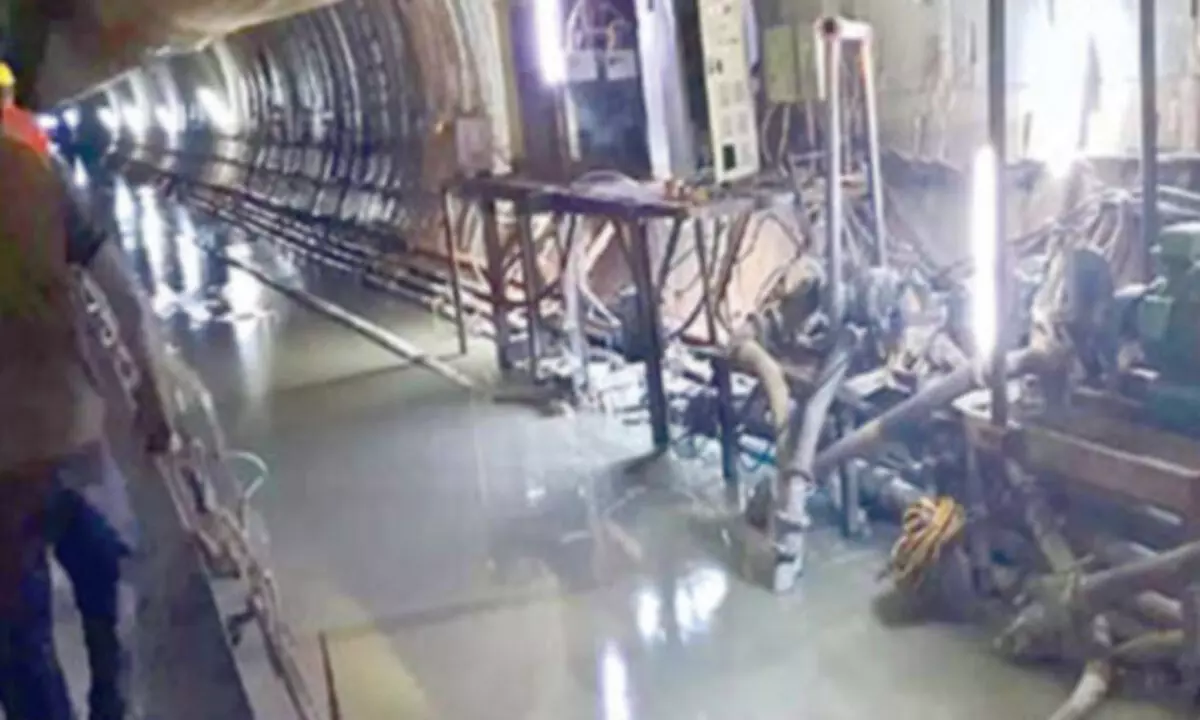
Hyderabad: The Telangana government is all set to resume tunnelling operations in the Srisailam Left Bank Canal (SLBC), where a cave-in had resulted in the death of eight workers in February this year. The government has roped in NGRI (National Geophysical Research Institute) and Geological Survey of India (GSI) to complete the tunnel works.
Irrigation minister N Uttam Kumar Reddy conducted an in-depth review of the long-pending SLBC tunnel works and directed the officials to immediately resume remaining tunnel operations, including drilling and blasting. An estimated 10-km of tunnel work remains to be completed.
Calling SLBC a crucial lifeline for Telangana, Uttam said its completion must be treated as a top priority and executed with urgency.
The SLBC tunnel work is being taken up using the latest electromagnetic survey technology in collaboration with the National Geophysical Research Institute (NGRI) and the Geological Survey of India (GSI). To ensure precise planning and seamless execution, the minister directed the officials to expedite the aerial LIDAR survey. He met earlier in the day with NGRI scientists to finalise the technical modalities of the survey. He reiterated that cost would not be a constraint, but quality and speed must be maintained at the highest standards.
The meeting also marked the first formal interaction with Colonel Parikshit Mehra, a globally acclaimed tunnel engineering expert who has recently joined the Irrigation Department on deputation. The minister expressed confidence that Mehra’s expertise would help resolve long-pending technical challenges and fast-track the completion of SLBC and other key tunnel projects. He also announced that General Harpal Singh, former Engineer-in-Chief of the Indian Army, would soon be appointed as Honorary Advisor to strengthen the department’s technical capacity and execution capabilities. The minister also reviewed water availability across all major reservoirs in Telangana and directed the Irrigation Secretary and Engineer-in-Chief to prepare a scientific and practical plan for optimal utilisation of water during the ongoing Kharif season. He said the plan must take into account current reservoir levels, expected monsoon inflows, and the total ayacut that can be served effectively. He noted that the Irrigation and Agriculture departments had worked in close coordination during the previous Kharif and Yasangi seasons, leading to a record production of 281 Lakh Metric Tonnes (LMT) of paddy.