PPP medical colleges row takes interesting turn in AP

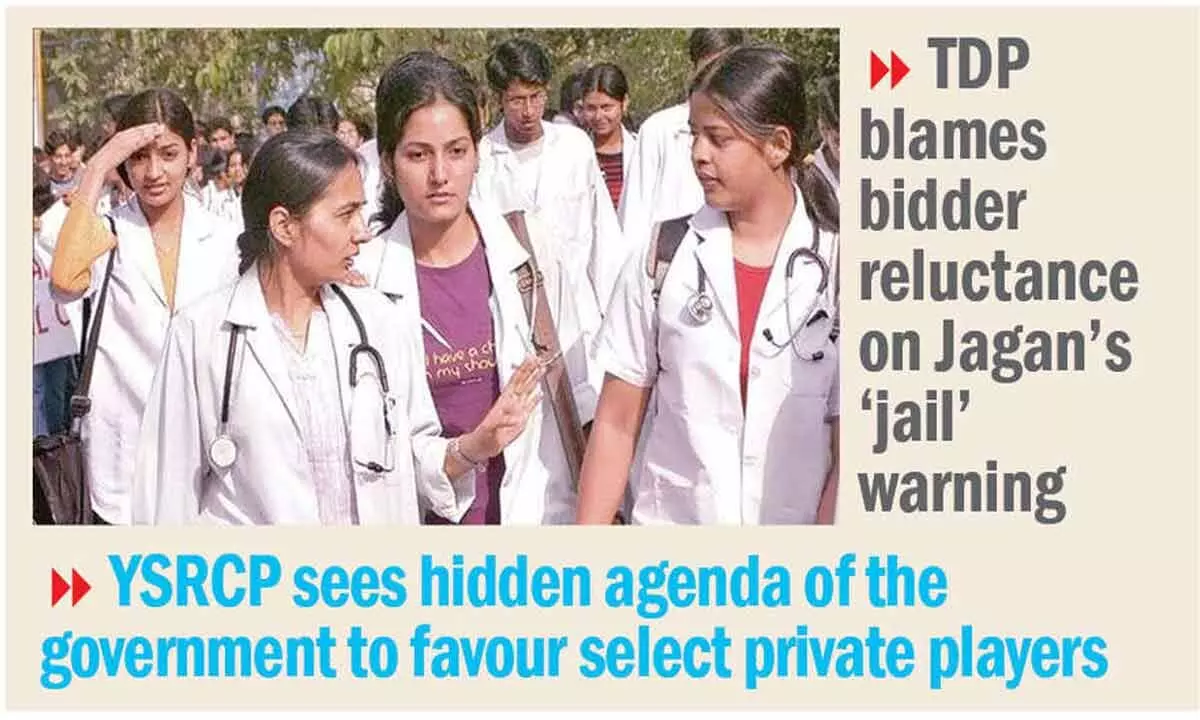
Amaravati: The raging controversy over the proposal for management of government medical colleges under the Public-Private Partnership (PPP) model has taken an interesting turn in Andhra Pradesh, with the lukewarm outcome of the tendering process in itself becoming a bone of contention between the ruling Telugu Desam Party (TDP) and the opposition YSR Congress Party (YSRCP).
The Centre had sanctioned 17 medical colleges for Andhra Pradesh, of which around seven were completed during the previous YSRCP government, while the rest are at different stages of construction. After coming to power, the NDA-led State government decided to operationalise nearly 10 of the remaining colleges through the PPP route, triggering sustained opposition from the YSRCP over the past few months.
In the first phase, the Andhra Pradesh Medical Services and Infrastructure Development Corporation (APMSIDC) invited tenders for four medical colleges proposed at Adoni, Markapuram, Pulivendula and Madanapalle. When the tender deadline closed on December 22, only one bid was received, for the Adoni college, while no bids were submitted for the other three. The muted response has intensified the political debate, with both sides interpreting the outcome to suit their narratives and claiming vindication of their respective stance.
The issue gained traction in the wake of former Chief Minister Y S Jagan Mohan Reddy’s recent warning that anyone participating in the PPP model for medical colleges would be sent to jail within two months if the YSRCP returned to power.
TDP leaders privately argue that these remarks have had a chilling effect on potential bidders, discouraging private participation despite continual efforts by the state government to attract investors.
According to official sources, the department conducted two pre-bid meetings and subsequently revised tender conditions, addressing concerns related to technical requirements, financial viability, and operational responsibilities. The tender deadline was extended twice, yet bidder interest remained muted.
While the state government has not issued a formal statement, TDP leaders contend that fear generated by the opposition leader’s statements is the primary reason for the poor response, citing past instances of PPP projects, including in the renewable energy sector, being cancelled during the YSRCP regime. They point to two pre-bid meetings, multiple clarifications on technical and financial issues, and extensions of the tender deadline as evidence that the government attempted to attract serious investors.
The YSRCP, however, has offered a different reading. While some leaders cite the lack of bids as “proof” that their resistance to ‘privatisation’ of medical education has worked, others express suspicion over the government’s next steps. With the state government indicating that fresh tenders would be called with additional relaxations and incentives, YSRCP leaders allege that the ruling party may be preparing the ground to favour select private players.
YSRCP spokesperson Venkata Reddy questioned the government’s move to proceed with the single bid at Adoni, arguing that tender norms require cancellation when only one bid is received. He said the decision reinforced suspicions about the transparency of the process.
With Chief Minister N Chandrababu Naidu and Health Minister Satyakumar indicating that fresh tenders will be called with further relaxations and financial incentives, YSRCP leaders allege that the ruling party could be preparing the ground to hand over the colleges to favoured private players.
Meanwhile, Chief Minister Chandrababu Naidu has taken a firm public position, asserting that there would be no compromise on providing quality medical education and healthcare to the poor. He has directed officials to finalise the agreement for the Adoni medical college without delay and to expedite the tender process for the remaining colleges after further consultations with prospective bidders.
YSRCP leaders argue that if fear of political retribution was genuinely keeping bidders away, no amount of concessions would change the situation. They maintain that the eventual outcome of any fresh tender process will determine whether the current impasse was a result of political pressure or a calculated strategy.
With both parties virtually crediting Jagan Mohan Reddy for preventing the transfer of government medical colleges to private hands, the final political impact is likely to hinge on public perception, and on whether the next round of tenders attracts enough participants or reinforces the prevailing uncertainty.