




Green buildings open up opportunities for startups
In Short
AI-driven energy management, smart cooling systems and low-carbon construction materials emerge as promising areas

Share :
Green buildings open up opportunities for startups
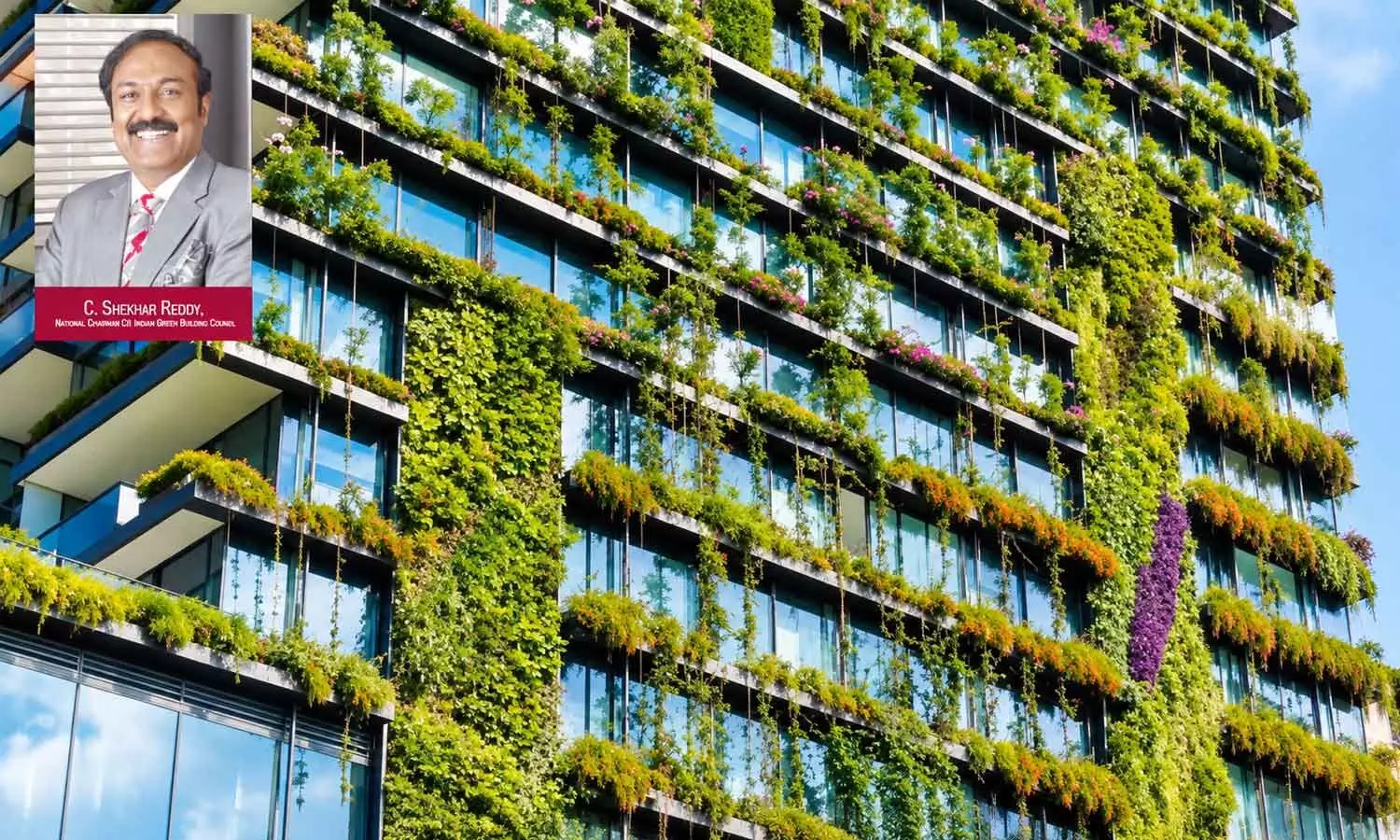
Hyderabad: India's expanding commercial real estate sector is creating new business opportunities for startups and technology providers developing solutions to reduce energy consumption, improve building efficiency and lower operating costs, according to C. Shekhar Reddy, National Chairman of the CII Indian Green Building Council (IGBC).
As developers and corporate occupiers increasingly focus on sustainability and energy efficiency, demand is growing for technologies that can deliver measurable savings in electricity and water consumption. The opportunities extend from artificial intelligence (AI)-driven energy management and smart building automation to efficient cooling systems, green construction materials and renewable energy solutions.
“India's expanding commercial real estate sector presents significant opportunities for startups, technology providers and manufacturers developing solutions that make buildings more energy-efficient, resource-efficient and intelligent,” Shekhar Reddy says.
One of the promising areas is AI-driven energy management, supported by smart building automation and Internet of Things (IoT)-enabled monitoring systems. These technologies can help building operators track energy consumption, identify inefficiencies and optimise the use of electricity according to occupancy and operating conditions.
Intelligent building management systems can adjust energy use to actual requirements, while advanced heating, ventilation and air-conditioning (HVAC) systems, efficient chillers and smart controls can reduce cooling loads and electricity consumption.
The opportunity is particularly relevant for commercial buildings in India, where cooling accounts for a substantial share of energy demand. Hyderabad's IT offices and high-rise commercial buildings, in particular, can benefit from technologies that reduce heat gain and improve air-conditioning efficiency.
Shekhar Reddy says developers need to give greater attention to building design, including the use of high-performance glazing, external shading, roof insulation and reflective surfaces. Glass-heavy facades without adequate solar control can increase indoor temperatures and air-conditioning demand.
“The objective is not to eliminate glass, but to use it intelligently,” he says, pointing to the need to combine climate-responsive design with efficient cooling technologies.
For startups, this creates opportunities to develop smart controls, energy-monitoring platforms, building automation systems and cooling solutions suited to Indian climatic conditions. Technologies that can demonstrate measurable reductions in electricity consumption and operating expenditure are likely to be particularly relevant to commercial property owners.
Green construction materials offer another growth avenue. “Low-carbon cement, recycled and resource-efficient materials, high-performance glazing, roof insulation and products that improve the thermal performance of buildings can help developers reduce the environmental impact of construction and improve energy efficiency.Opportunities are also emerging in rooftop solar, building-integrated photovoltaics, battery storage, water recycling and on-site waste management as buildings move towards net-zero performance,” he said.
According to him, the opportunity for Indian startups and manufacturers goes beyond supplying individual products. There is scope to develop integrated solutions that combine energy management, cooling, automation and resource efficiency to improve the overall performance of buildings.
“For Indian startups and manufacturers, the opportunity extends beyond supplying individual products to developing integrated, scalable solutions tailored to Indian climatic conditions and building requirements,” he says.
The economics of green buildings could further support demand for these technologies. According to Shekhar Reddy, incorporating green features typically adds 3% to 5% to construction costs, significantly lower than the 12% to 18% estimated in the early 2000s. The additional investment can be recovered through lower operating expenses, with typical payback periods of around three to six years, depending on the building's design, energy consumption, occupancy and operating practices.
Commercial buildings can also benefit from improved tenant appeal and lower running costs. Green-certified commercial properties in strong markets can command rental premiums of around 10% to 25%, although the premium varies according to location, asset quality and market demand.
These factors create a business case for developers to adopt technologies that improve building performance while reducing lifecycle costs.
“The market will increasingly reward technologies that demonstrate measurable energy and water savings, lower lifecycle costs and reliable performance,” he says. The next generation of green buildings will be defined not simply by the technologies installed, but by how intelligently those technologies work together to deliver measurable sustainability outcomes, Shekhar Reddy noted.
KCR tried to grab Rs 50k-cr Miyapur land, alleges CM Revanth
Bhatti’s call at NAREDCO TG property show: Realty must become partner in TG’s growth
Shah to join Nov 2 Hyd ‘Maha Padayatra’
Kids' edu videos attract attention, not learning: ISB study
Institutional autonomy must be respected by everyone in the country
Much ado about one MLC seat: Million memes, noise and political theatre


