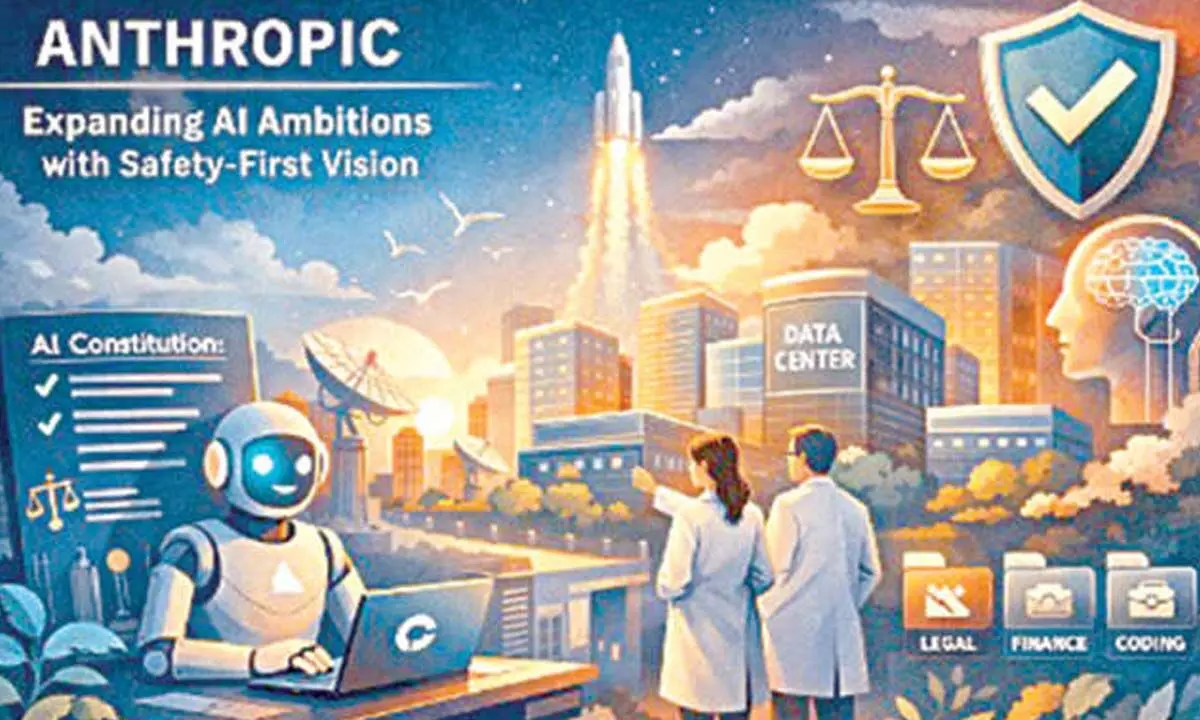
How US-based Anthropic is expanding AI ambitions with safety-first vision

Anthropic competes directly with OpenAI which has collaborated with Nvidia, Oracle and Broadcom
Anthropic is a leading American artificial intelligence research company founded in 2021 by former OpenAI executives including Dario Amodei and Daniela Amodei. Established as a Public Benefit Corporation (PBC), the company balances commercial success with a clearly stated public mission: building AI systems that are reliable, interpretable, and aligned with long-term human interests. Unlike many AI firms focused primarily on rapid expansion, Anthropic places safety at the center of its identity. The company consistently frames its goal as developing AI that is “helpful, honest, and harmless,” positioning safety not as an afterthought but as a foundational design principle.
Constitutional AI: Safety by Design
A key pillar of Anthropic’s strategy is its Constitutional AI framework. Under this system, AI models are guided by an explicit “constitution” consisting of ethical principles and behavioral rules. During training, the model critiques and revises its own responses based on these principles rather than relying solely on human feedback.
This structured approach to alignment reflects Anthropic’s broader governance philosophy. As a Public Benefit Corporation, the company is legally required to consider societal impact alongside shareholder returns, a distinction that has drawn attention amid global debates about AI oversight and accountability.
Claude: From Chat Assistant to Enterprise Platform
Anthropic’s flagship product is Claude, a family of large language models designed for reasoning, writing, coding, and document analysis. Over time, Claude has evolved beyond a conversational chatbot into a workplace productivity system.
The company now offers Claude for everyday writing and research, Claude Code for developer workflows and repository tasks, and Claude Cowork, a desktop-based system capable of handling broader professional operations. These offerings share the same underlying model but are tailored to different work environments and permission structures.
The Shift to Claude Cowork
Claude Cowork represents a major step toward operational AI. With user permission, Cowork can access selected folders on a computer, read and organize files, draft reports from scattered notes, build spreadsheets from screenshots, and complete multi-step tasks. This transition marks a shift from simple question-and-answer interactions to AI systems capable of managing workflows. By integrating directly into desktop environments, Anthropic aims to reduce repetitive tasks and improve efficiency in knowledge work.
Plugins and Role-Based Specialization
To make Claude more adaptable in real-world workplaces, Anthropic introduced a plugin ecosystem and open-sourced eleven starter plugins covering areas such as legal services, finance, sales, marketing, customer support, product management, data analysis, enterprise search, and biology research.
These plugins allow organizations to tailor Claude to specific roles by connecting it to internal tools and data sources. For example, legal teams can use it to review contracts and flag unusual clauses, sales teams can integrate it with CRM systems to prepare follow-ups, and enterprise users can search across emails and documents from a single interface. A key technical foundation for this ecosystem is the Model Context Protocol (MCP), an open standard developed by Anthropic to securely connect AI systems with repositories, business tools, and development environments. By giving AI structured access to relevant context, MCP enhances both usefulness and security.
Funding and Infrastructure Strategy
Anthropic has raised approximately $7.3 billion in funding, attracting major investments from companies such as Amazon and Google. Amazon alone has reportedly committed up to $4 billion.
The company has pledged $50 billion toward building data centers in the United States while also purchasing computing capacity from partners including Microsoft and Google. This infrastructure strategy reflects the enormous computational demands of training and deploying advanced AI systems.
Anthropic competes directly with OpenAI, which has announced infrastructure ambitions exceeding $1 trillion in collaboration with Nvidia, Oracle, and Broadcom. The scale of investment highlights the intensity of the global AI race.
Performance and Market Position
Anthropic’s Claude 3 models, particularly Opus, have drawn attention for strong performance in coding, reasoning, and quantitative analysis benchmarks. Industry comparisons often place Claude alongside GPT-4 and competing models in terms of capability, pricing, and multimodal features.
Experts note that the choice between AI systems increasingly depends on enterprise needs rather than a single universally superior model. Factors such as integration, cost structure, and governance philosophy are becoming as important as raw performance metrics.
Guardrails and Responsible Deployment
As Claude gains greater autonomy through tools like Cowork and plugins, Anthropic has also highlighted risks such as prompt injection attacks, ambiguous instructions, and potential misuse of file access. The company emphasizes user-controlled permissions and continued human oversight in final decision-making.
Balancing Capability and Control
Anthropic is positioning itself not merely as a developer of large language models but as a safety-focused AI company building end-to-end systems for real-world workflows. By combining advanced models, enterprise tools, and governance structures rooted in public benefit, the company seeks to demonstrate that cutting-edge AI and responsible development can scale together. As the AI landscape continues to evolve, Anthropic’s long-term success may depend on whether its safety-first philosophy can keep pace with rapid technological advancement and intensifying global competition.
(The author is president of Praja Science Vedika)