




- Europe Braces for Another Weekend of Unrest as Protests Turn Violent in Several Countries
- Trump Says US Could Strike Iran on Sunday, Keeps Door Open for ‘Big, Beautiful Deal’
- Obama tears into Trump over Iran war, tariffs and ‘grifter’ presidency at Ohio rally
- CM Yogi welcomes PM Modi, Rajnath Singh to Varanasi for 'Wings over Ganges' air show
- Congress govt committed to advocates’ welfare, protection: Ministers
- Ponnam lays foundation for Rs 3.22-crore Uppal bus terminal
- Govt medical colleges pip private institutions in MBBS 1st yr results
- West Bengal team studies rural development works in Krishna dist
South Korea's Q2 current account surplus ranks 2nd on robust chip exports
In Short
South Korea records a $116.63 billion current account surplus in Q2, driven by a 181.6% surge in semiconductor exports, while temporary and daily workers hit a 31-year low for the third quarter.

Share :
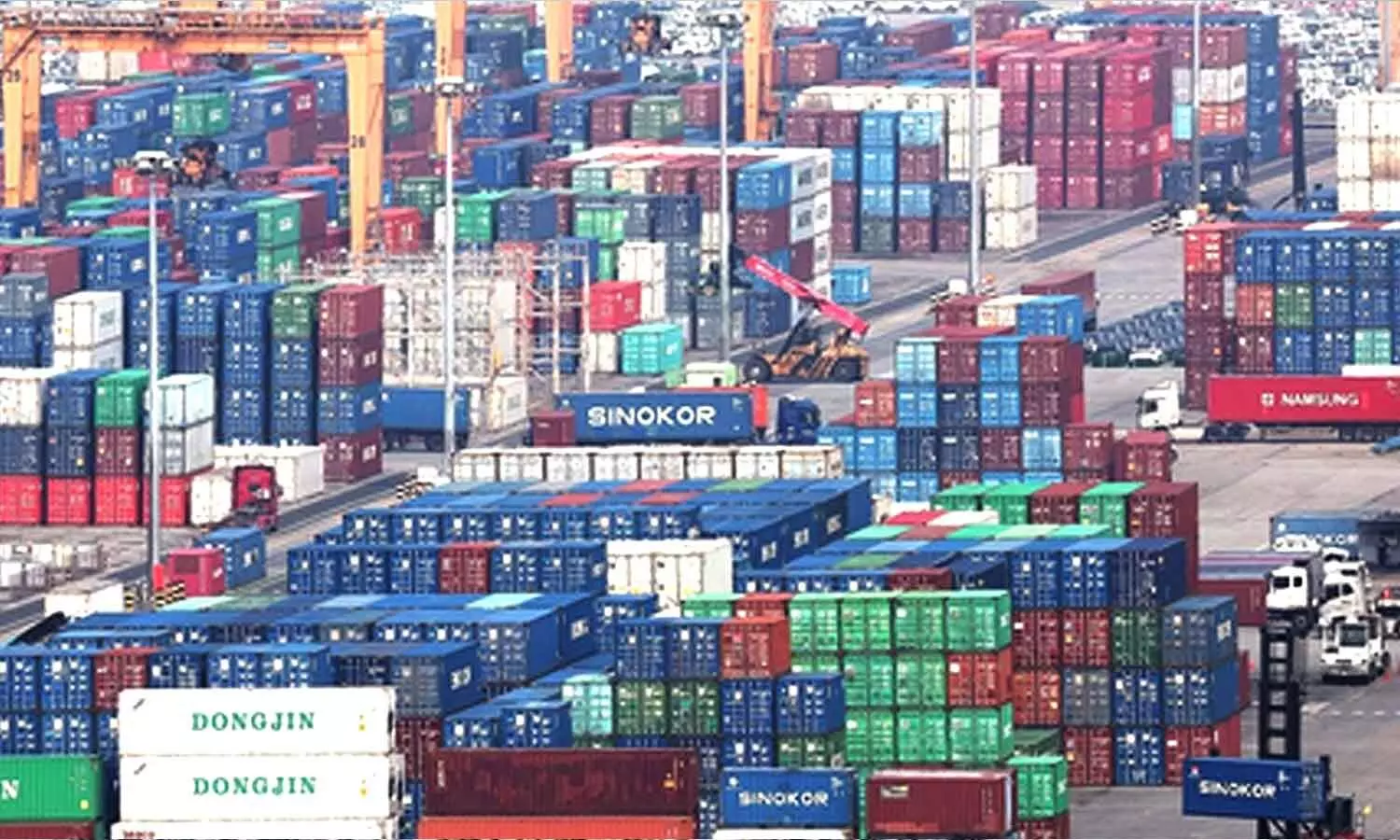
South Korea's Q2 current account surplus ranks 2nd on robust chip exports
Seoul: South Korea posted the second-largest current account surplus among major economies in the second quarter, surpassing the combined surpluses of Germany and Japan, central bank data showed on Sunday.
The country's current account surplus reached US$116.63 billion in the April-June period, trailing only China's $193.72 billion, according to International Monetary Fund (IMF) data available on the Bank of Korea's Economic Statistics System.
Germany ranked third with a surplus of $52.28 billion, followed by Japan with $50.62 billion. Their combined surplus of $102.9 billion was $13.73 billion less than South Korea’s, reports Yonhap news agency.
It marked the first time South Korea's surplus exceeded the combined figures for Germany and Japan since comparable data for all three countries became available in the first quarter of 1996.
South Korea's surplus more than quadrupled from $28.39 billion a year earlier, far outpacing increases of 11.9 percent in Germany and 5 percent in Japan.
The sharp increase was largely driven by surging semiconductor exports amid rising chip prices and robust global demand.
According to the Ministry of Data and Statistics, South Korea's semiconductor exports soared 181.6 percent on-year to $113.89 billion in the second quarter.
Meanwhile, the number of temporary and daily workers in South Korea fell to its lowest third-quarter level in 31 years amid a prolonged construction slump, government data showed on Sunday.
The combined figure dropped by 95,000 from a year earlier to 5.73 million in the July-September period, the lowest third-quarter level since 1995, according to an analysis of microdata from the Ministry of Data and Statistics.
Of the total, the number of daily workers fell by 38,000 to a record third-quarter low of 833,000, largely due to weak employment in the construction sector.
Daily construction workers declined by 28,000 to 381,000, accounting for 74.6 percent of the overall drop. Those in their 50s saw the sharpest decline, down 21,000.
The number of temporary workers, whose contracts last at least one month but less than a year, fell by 57,000 to 4.89 million in the three-month period.
By industry, the accommodation and food services sector recorded the largest decline in temporary workers, down 30,000, followed by construction, and information and communications, which shed 22,000 each.
Govt to hold a meeting on drought situation with opposition and farmers: Minister
PM Modi to visit Odisha today, inaugurate RBI data centre in Khordha
Cyclone update: Depression to approach AP today, rains for five days
Narrow mindsets conspiring to plunge country into instability, chaos for the sake of power: CM Adityanath
Five-day fishing ban from today as Tamil Nadu braces for heavy rain
PM Modi to visit UP, Odisha today; to attend IAF aerial display at Namo Ghat in Varanasi


