Bharat’s AI turn

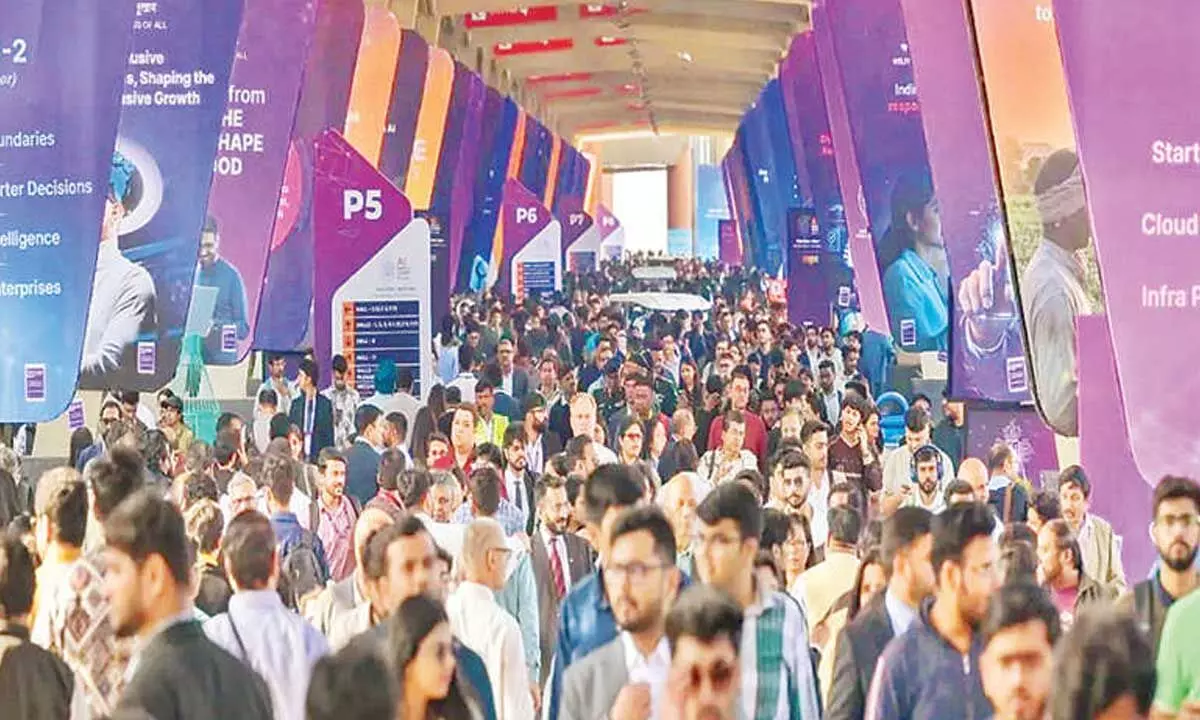
At the recent Global AI Summit hosted by Bharat, the spotlight fell on chips, compute power and large language models. Yet one of the most consequential debates unfolded in a less obvious arena is art, culture and intellectual property.
As artificial intelligence reshapes creative production and distribution, policymakers are confronting a new frontier: how to protect artists, secure ownership, and position the country as a leader in ethical creative technology.
The media and entertainment sector alone crossed ₹2.3 lakh crore in 2023, growing steadily on the back of digital platforms. Globally, the art market is valued at over $60 billion annually, with online transactions accounting for nearly a fifth of sales.
As art migrates to digital formats, immersive spaces and blockchain-backed marketplaces, the intersection of AI and culture is becoming economically strategic.
The 2026 Summit signalled that Bharat intends to shape the ecosystem rather than just transformation.
Copyright in the Age of Generative AI
The country’s primary legal framework governing artistic works is the Copyright Act 1957, strengthened through amendments in 2012 that reinforced royalty protections for authors and creators.
However, the law was drafted in an era before generative AI systems could replicate artistic styles, compose music or produce visual art at scale.
Today, AI models are trained on vast datasets scraped from the internet which are often without explicit consent from creators.
For the folk and tribal artists, whose motifs circulate widely online, this raises pressing concerns. Warli patterns, Madhubani designs and Kalamkari motifs can be absorbed into global AI systems, reproduced in derivative works and monetised without attribution.
The proposed Digital India Act, expected to replace the IT Act, 2000, is seen as an opportunity to introduce clearer norms on AI accountability, platform transparency and data usage. MeitY’s advisories on responsible AI deployment have also emphasised traceability and due diligence.
Policy experts argue that three reforms are urgent:
•Mandatory disclosure of AI training datasets.
•Legal clarity on copyright status of AI-generated outputs.
•Subsidised AI-based copyright monitoring tools for artists and communities.
Artificial intelligence can, paradoxically, become a shield. Digital fingerprinting systems embed invisible signatures into artworks, enabling detection even if images are altered or cropped.
Machine learning tools scan online marketplaces for unauthorised copies and alert creators. For artisans with limited access to legal recourse, such systems can transform enforcement.
Blockchain and the Reinvention of Provenance
If copyright secures authorship, provenance determines value. Historically, provenance has depended on paper trails and expert verification—systems prone to opacity.
Blockchain offers a transparent alternative. By recording transactions in tamper-proof digital ledgers, blockchain creates immutable ownership histories. Digital artworks tokenised as Non-fungible token (NFT) carry embedded metadata: creator identity, timestamp and resale conditions.
Smart contracts can automatically enforce resale royalties, ensuring that artists benefit from secondary market transactions—a right rarely realised in traditional art markets.
International auction houses such as Christie’s and Sotheby’s have integrated blockchain-backed provenance systems to enhance buyer confidence. For artists from Bharat seeking global collectors, transparent digital registries could stabilize pricing and reduce forgery disputes.
A National Digital Art Registry built on blockchain architecture which is linked to verified digital identities has emerged as a policy idea gaining traction. Such a system would formalise ownership records and integrate seamlessly with export promotion frameworks.
AI Authentication and Data-Driven Valuation
Forgery and misattribution have long plagued art markets. Works attributed to masters such as Raja Ravi Varma have periodically been subject to authenticity controversies.
AI tools now analyse brushstroke geometry, pigment composition and stylistic evolution patterns to detect anomalies. While not replacing art historians, these systems augment institutional credibility.
Valuation is also becoming data-driven. AI models analyse auction histories, exhibition frequency, collector demand patterns and institutional acquisitions.
Contemporary artists such as Subodh Gupta operate in a global marketplace where transparent pricing data influences reputation and long-term value.
For policymakers, investment in national digital art archives and AI research collaborations between technology institutes and museums can build domestic capacity in authentication science.
Cultural Data Sovereignty
Perhaps the most sensitive debate at the Summit revolved around cultural data sovereignty. AI systems trained on Bharatiya artistic traditions without consent risk turning heritage into extractive data.
The Ministry of Culture has already initiated digitisation drives under programmes such as the National Mission on Cultural Mapping. However, digitisation without licensing safeguards could expose community-owned art forms to global exploitation.
Experts propose:
•Community licensing frameworks for traditional art forms.
•Attribution mandates in AI-generated derivatives.
•Recognition of collective intellectual property rights.
Metaverse and Immersive Economies
Art is also moving beyond static images into immersive digital environments often described as the Metaverse. Virtual galleries, AI-responsive installations and 3D heritage reconstructions are expanding both audience reach and revenue models.
Online art sales globally have approached $11 billion in recent years, reflecting the growing significance of digital transactions. For Bharat, large-scale digitisation of heritage sites and museum collections could generate licensing revenues and expand soft power.
Virtual reconstructions of historical spaces, AI-guided museum tours and interactive classical performance archives represent both cultural preservation and economic opportunity.
Aligning with Digital Vision
Bharat’s broader digital public infrastructure through Digital India, India Stack and Startup India provides foundational support for art-tech innovation.
With over 65 per cent of the population below 35 years of age, the demographic profile aligns naturally with digital creative industries.
The AI Summit underscored that art-tech is not niche. It intersects with export policy, skilling missions, tourism and digital governance. Integrating creative entrepreneurship into national skilling programmes can enable rural and urban artists alike to access global markets.
Road Ahead
The AI moment is also a cultural moment. To lead responsibly, policymakers must:
1. Update copyright law to address AI authorship and derivative use.
2. Establish a blockchain-based National Art Registry.
3. Mandate dataset transparency in generative AI systems.
4. Safeguard community intellectual property rights.
5. Invest in AI-art research and skilling initiatives.
The 2026 Summit marked a conceptual shift. Technology policy can no longer be divorced from cultural policy (yet to be prepared). In the age of algorithms, governance must ensure that innovation amplifies imagination rather than erodes it.
(The writer is a Creative Economy Expert)