Nayakapatana’s palm-leaf legacy

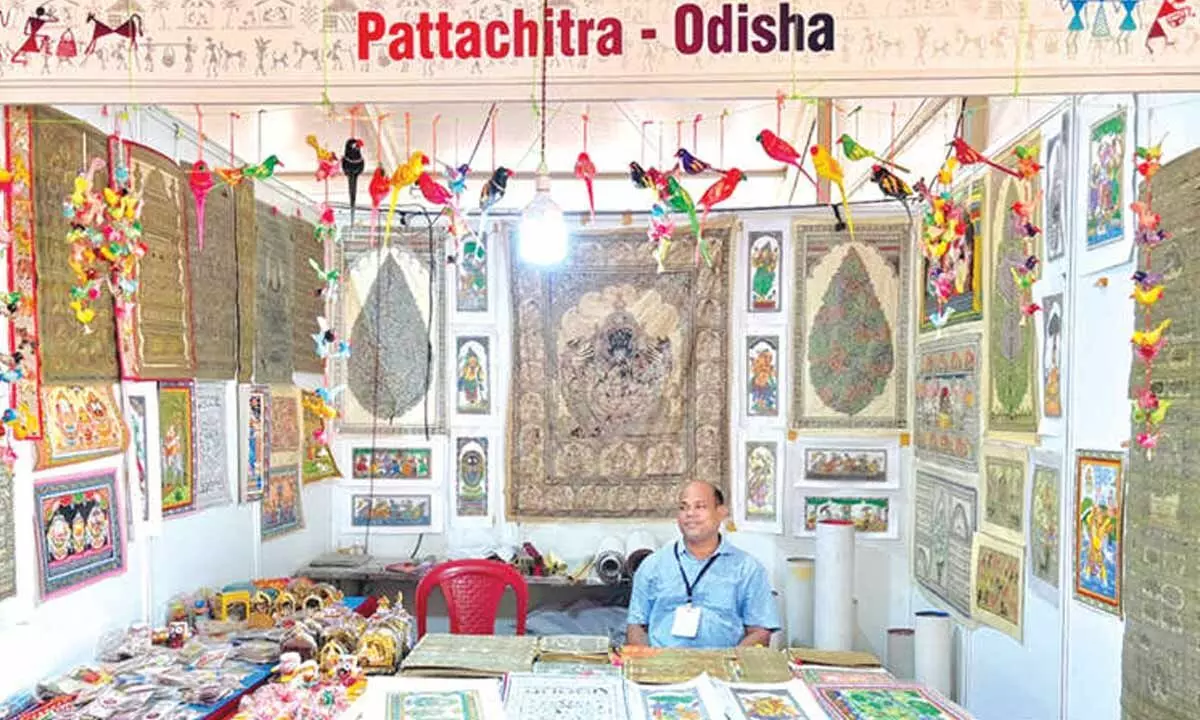
Not far from the pilgrim town of Puri lies Nayakapatana, a lesser-known crafts village that quietly sustains one of Odisha’s most intricate art traditions. Overshadowed by the celebrated heritage village of Raghurajpur, Nayakapatana remains intimate and unassuming—yet almost every household here practises the ancient art of Pattachitra, particularly its more demanding palm-leaf variant, Tala Pattachitra.
It is here that Pramod Kumar Maharana was born into a hereditary lineage of artists. “Earlier, survival was difficult,” he reflects thoughtfully. “Today, through workshops, teaching children and selling my work, I can earn ₹15,000 to ₹20,000 a month. It gives dignity to our tradition.”
A Village Where Every Home is an Atelier
In a village of roughly 600 people, nearly half are practising artists. Pramod Kumar’s own extended family counts 120 members—every one connected in some way to the craft. “In our homes, even the women are trained in this art,” he says with quiet pride. “My brothers and I have all received state awards. Now our children are learning too, even as they pursue formal education. They know that one day they must carry this forward.” He himself began training at 13; today, at 45, his practice remains both devotion and profession.
Tala Pattachitra: Etched on Time
Pattachitra—literally “cloth painting” (patta meaning cloth, chitra meaning picture)—is among Odisha’s most revered art forms, closely linked to the rituals of Lord Jagannath. While the cloth-based tradition flourished in temple towns, the palm-leaf form evolved as a parallel narrative art, used historically to inscribe sacred texts, genealogies and mythological tales.
Palm-leaf manuscripts predate the widespread use of paper in India. Even today, Maharana explains, palm leaves remain woven into the cultural fabric of Odisha. “Our janampatris are still written on palm leaves. The first wedding invitation is inscribed on tala patra and offered at the feet of Lord Jagannath. Even death intimations in our community are sent this way. This art is not separate from life—it is part of it.” The preparation of tala patra is meticulous. Mature palm leaves are sun-dried for two to three months, then soaked and treated with turmeric, which lends both a warm tint and natural antibacterial protection. The leaves are stitched together to form a textured surface. Unlike the vividly coloured cloth Pattachitra—where vegetable and mineral dyes create striking reds, yellows and indigos—Tala Pattachitra is predominantly monochrome. Its drama lies in precision.
The artist first sketches lightly, then engraves with a sharp stylus. Direction matters: the incision must move steadily from top to bottom. A reverse stroke results in uneven lines. Once etched, a mixture of lampblack or natural pigment is rubbed into the grooves and wiped clean, allowing the dark lines to glow against the pale surface.
The themes range from episodes of the Ramayana and Mahabharata to local folklore and stylised depictions of deities. The detailing is astonishing—floral borders, rhythmic lines, and miniature figures unfolding across panels like visual poetry. During the workshop, as I attempt a simple lotus motif, I realise the deceptive complexity of the craft. Drawing is forgiving; engraving is not. Under Pramod Kumar’s guidance, my hesitant lines are filled with black pigment and gently wiped. A delicate lotus emerges—my humble initiation into an art that has endured for centuries.
“We must preserve this ancient heritage,” Maharana says in conclusion, his voice steady with conviction. “It existed even before paper. If we do not practise and teach it, it will fade. But as long as our families continue, Tala Pattachitra will live.”
In Nayakapatana, it certainly does—quietly etched, line by patient line, onto the memory of time.