Shades of Orange: When a colour becomes a collective canvas
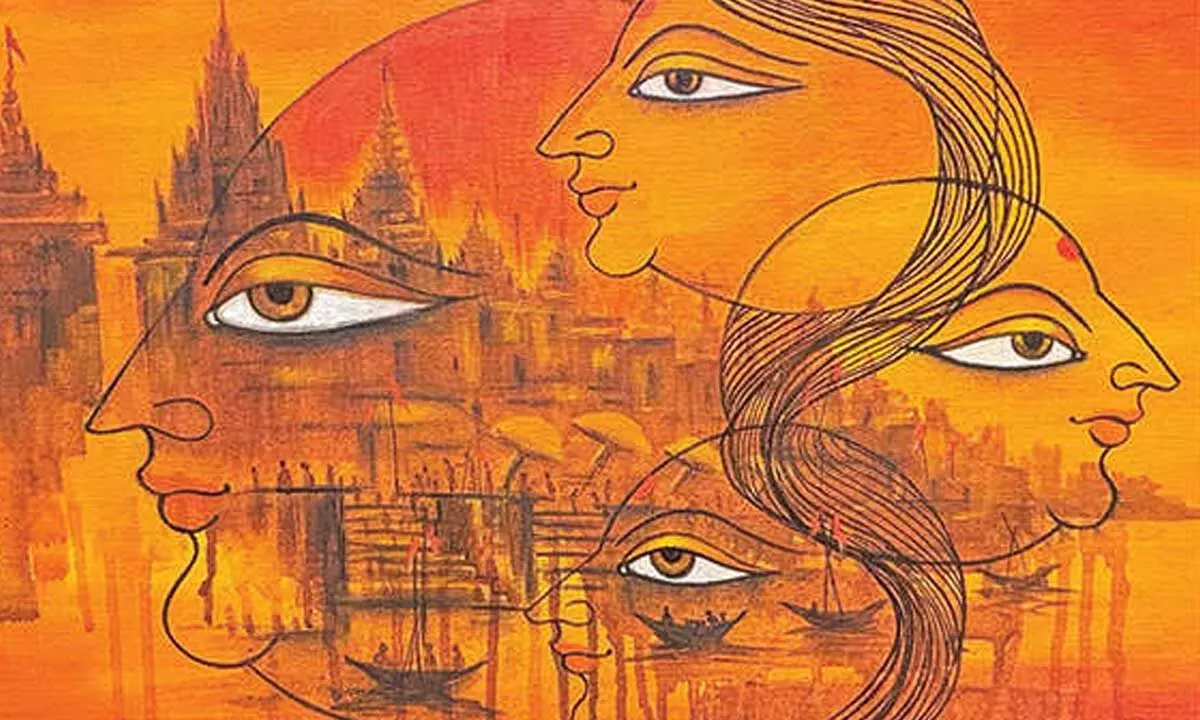
Recently, the serene halls of the State Gallery of Art, Madhapur, Hyderabad were transformed into a vibrant field of creative energy as Parichay Arts Foundation hosted an acrylic art camp for artists from the twin cities. Aptly titled “Shades of Orange,” the camp explored a single hue as a universe of emotions, meanings, and lived experiences.
Founded by artist-curator Jaywant Naidu, Parichay Arts Foundation has consistently worked to create platforms where artists can engage in dialogue through art. Speaking about the concept, Naidu said, “This art camp is all about the quest to be inspired by the orange colour, which is predominant in many masterpieces of well-known painters like Akbar Padamsee, S H Raza and Kishen Khanna.” His vision was not merely to celebrate a colour, but to investigate how a shared palette could still yield deeply personal expressions.
As brushes moved across canvases, orange revealed its many lives — spiritual, emotional, social, and intensely personal.
For Bharati Kar, orange is a synthesis of forces. “Orange is a vibrant warm color that blends the energy of red with the cheerfulness of yellow. To me, it symbolises enthusiasm, divinity, creativity and vitality.” Her work radiated a quiet optimism, echoing this balance between power and joy.
Sukalyan Dutta viewed the colour as an agent of change. “For me, orange is a vibrant, energetic color that symbolizes creativity and transformation.” His canvas suggested movement and metamorphosis, as if form itself were in transition.
In contrast, Sushil Patil brought a contemplative depth to the hue. “Orange is the warmth of a setting sun, grounding yet overwhelming. It’s a fiery reminder of responsibilities tied to our deepest dreams.” His interpretation connected colour with contemporary anxieties, where hope and burden co-exist.
For some artists, the statement was concise yet powerful. Alupula Pocham simply declared, “Orange stands for creativity,” allowing the visual language of his painting to speak beyond words.
Anjiya Naik expanded the emotional spectrum. “For me, orange color represents energy, warmth, spirituality and the rhythm of life. With different shades of orange, I explore emotions, nature and inner consciousness.” Her canvas moved fluidly between abstraction and introspection.
Madhu Kuruva offered one of the most strikingly personal readings. “Orange is the colour of hunger — it carries everyday struggles of my life as an artist.” Here, orange became not decorative, but existential, charged with lived reality.
Nagaraj Goud celebrated its youthful vibrancy. “The shades of orange express youthfulness and charm, bringing freshness to life. They evoke romance, creativity and the spirit of new creation.” His work pulsed with optimism and renewal.
For Maredu Ramu, orange traced a poetic arc of love. “Orange color is about purity of love from sunrise to sunset.” His canvas followed the cycle of the day, mirroring emotional constancy.
Kotha Revanth returned to the duality of the colour. “Orange lives between comfort and intensity — a steady glow that anchors us while asking us to grow.” His work reflected ambition tempered by realism.
Kishore Jeripothula emphasized its social energy. “Orange colour encourages conversation and social interaction. It is a color that demands attention without the ‘stop’ signal of red.” His composition echoed this communicative vibrancy.
Labhya Lingaraju bridged spirituality and society. “Spiritually, orange is the pursuit of the highest state of consciousness, and in general, I believe it is a color for socializing.” Her interpretation unified inner and outer worlds.
What made Shades of Orange compelling was not the uniformity of colour, but the diversity of thought. A single hue became a prism through which artists reflected personal histories, cultural memory, social realities, and spiritual aspirations. By the end of the day, the gallery walls bore testimony to a remarkable truth: when artists share a colour, they do not share a vision — they multiply it. In ‘Shades of Orange,’ Parichay Arts Foundation demonstrated how one colour can become many stories, each brushstroke adding a new voice to a collective canvas.