Where forest is the shrine

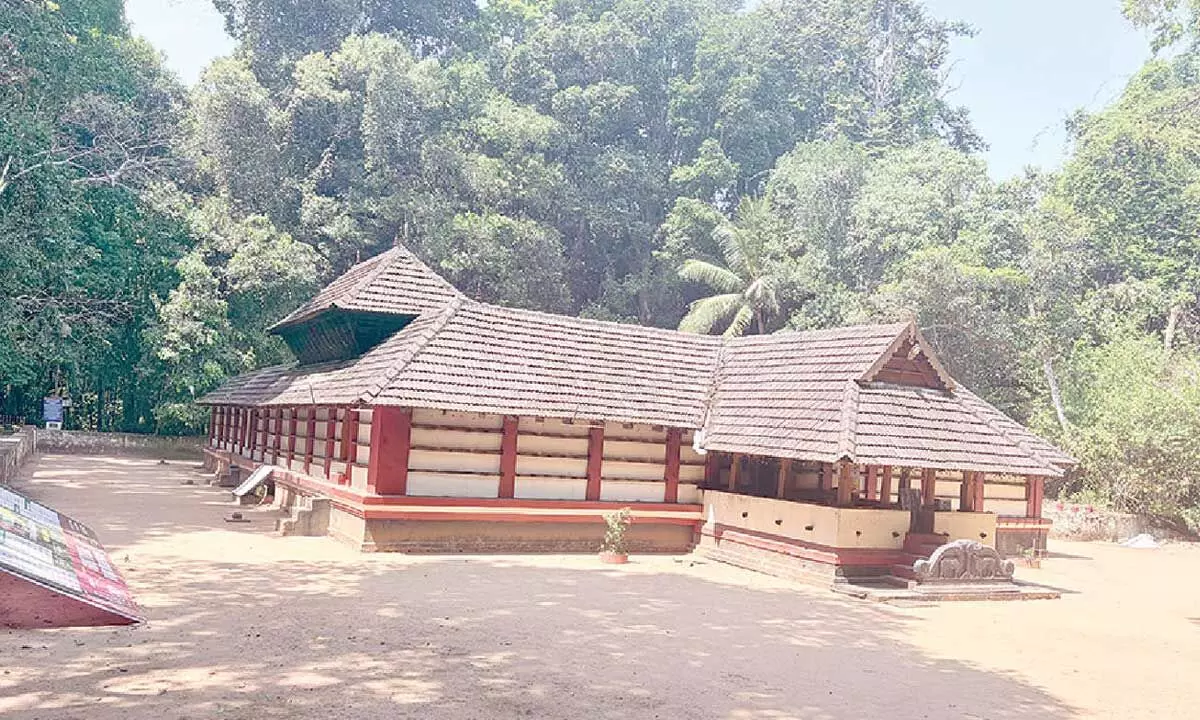
On the outskirts of Perumbavoor, the sacred grove of Iringole Kavu Bhagavathy Temple stands as a rare sanctuary where faith protects the forest rather than exploits it. Revered as one of Kerala’s ancient kavus, this living shrine to Goddess Durga embodies a timeless ecological ethic, reminding us that preservation is not merely policy, but sacred responsibility
On the outskirts of Perumbavoor in Kerala, beyond the hum of highways and expanding townships, stands a forest that has resisted becoming real estate. There is a serious challenge for the grove with encroachments and preservation is the responsibility of every individual. Why is it sacred and why should it be preserved? The Iringole Kavu Bhagavathy Temple represents a rare continuity in contemporary Bharat as a place where devotion does not conquer nature, but consciously submits to it.
Sacred groves, known locally as kavus, are an ancient feature of Kerala’s cultural landscape. For centuries, these forest patches were preserved as abodes of deities, protected not by legislation but by reverence. Iringole is among the most prominent of these living traditions. Here, the forest is more than a picturesque backdrop to worship. It is the shrine itself.
The walk into Iringole is a gradual transition from the everyday to the elemental. Light filters through thick canopy. The air grows cooler, scented with damp earth and leaves. Roots twist across narrow pathways. The temple structures appear modest, almost reluctant to dominate the landscape. One senses entry into a space governed by different rules, ecological as much as spiritual.
Those rules are explicit and uncompromising. Devotees are not permitted to bring flowers purchased from outside. No packaged offerings enter the premises. Perfumes and artificial fragrances are disallowed. Nothing extraneous disturbs the grove’s balance. Even more telling is the prohibition against removal: not a fallen twig, not a leaf, not a fragment of bark may be taken away. The forest belongs to the Goddess; its integrity must remain undisturbed.
In an age when pilgrimage centres struggle under plastic waste and commercial overreach, Iringole’s discipline appears both austere and visionary. It is conservation embedded in custom. By restricting external inputs and forbidding extraction, the temple ensures the grove sustains itself without erosion.
The simplicity extends to the prasadam. Devotees receive naturally produced jaggery, traditionally prepared. There are no elaborate sweets or ornate packaging. The offering is earthy and unrefined, reflecting agricultural rhythms rather than market aesthetics. Holding the jaggery after walking through the grove feels less like receiving a token and more like participating in a cycle — land to community, community to deity, deity back to devotee. The temple is a forest shrine dedicated to Goddess Durga, situated about 2.5 kilometres from Perumbavoor in Kunnathunad Taluk of Ernakulam district. It is revered as one of the 108 Durga temples in Kerala believed to have been consecrated by Lord Parasurama. The presiding deity is worshipped as an incarnation of Yaga-Nidra — Yoga-Nidra or Maya — the cosmic feminine energy.
The Goddess manifests in three forms across the day: Saraswati in the morning, symbolising knowledge; Vana Durga at noon, embodying the power of the forest; and Bhadrakali at night, representing righteous fury and the destruction of evil. These shifting forms mirror not only theological imagination but the changing moods of the forest itself.
The temple preist narrated the significance of the temple linking Iringole to Lord Krishna. When Kansa sought to kill the infant placed in Krishna’s cradle, the divine Yoga-Nidra, she rose from his grasp as a radiant force and remained in the sky as “Irrinnole.” Over time, the region came to be known as Iringole. Tradition holds that the gods and goddesses encircled this divine energy in the form of trees and plants, and the sacred forest took shape around it.
Equally significant is the temple’s reliance on forest resources for ritual. Leaves, bark and flowers are sourced from within the grove, not gathered indiscriminately but with care. Janjati (Tribal) communities living in and around the forest possess traditional ecological knowledge that guides this extraction. Consider the use of bark from the Inja tree to clean temple sculptures. Bark removal, if careless, can damage the tree. The Janjati (tribal) practitioners know precisely how much to take and from where, allowing regeneration. The act is measured, not commercial; restrained, not extractive.
In this relationship between shrine and settlement lies a quiet model of sustainability. Faith protects the forest. The forest sustains ritual. Ritual sustains community. Community preserves knowledge. The cycle predates modern environmental vocabulary yet aligns seamlessly with its principles.
Historically, the kavu was owned and managed by 28 families, later primarily by the Naganchery Mana along with Pattasheri and Orozhiam families. Today, it is administered by the Travancore Devaswom Board, even as its sacred grove tradition continues.
Annual festivals reinforce this integration. The ceremonial invitation of the Goddess is conducted with materials drawn from the grove, accompanied by chants that resonate softly through the trees. There is celebration, but not spectacle. The forest absorbs sound rather than amplifies it. Ritual feels less like imposition upon nature and more like awakening within it.
Sacred groves across Bharat have diminished over decades under development pressures. Those that survive do so because communities invest them with meaning. Iringole endures through observance of its codes and not nostalgia. For visitors accustomed to grand temples and commercial corridors, the experience can be quietly transformative. Devotion here is measured not by abundance but by adherence. In a country grappling with environmental fragility, Iringole offers a lesson: policies are essential, but they gain strength when supported by cultural conviction. When protection becomes a sacred duty, compliance ceases to feel imposed.
In the filtered light of this grove, where even a fallen twig is not ours to claim, the message is simple and enduring: reverence can be regulation enough.
(The writer is a Creative Economy Expert)