Blending beats with atmosphere: From clubs to concert halls
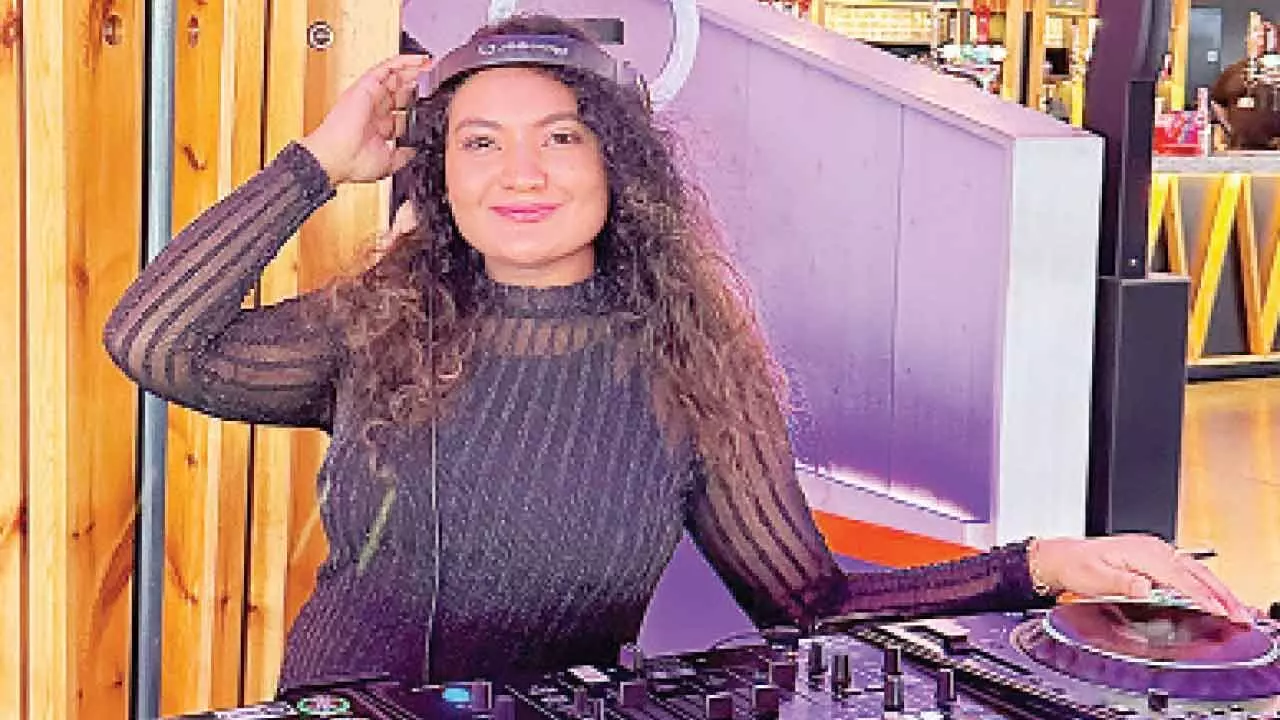
DJCurl’s transition from club DJ to immersive sound designer marks a deliberate shift toward emotional nuance and spatial depth. Her work departs from traditional beat-driven formats, opting instead for layered soundscapes built around live instrumentation and ambient textures. This evolution isn’t just stylistic — it’s a philosophical repositioning. DJCurl treats sound as an emotional architecture, shaping performances that blur the lines between music, memory, and environment. In a niche scene often constrained by genre or expectation, she pushes against the edges, crafting a sonic language that feels both intimate and expansive
From the pulse of underground dance floors to the stillness of elegant lounges, DJCurl is redefining what it means to design sound. Once known for her electrifying presence as a club DJ, she has quietly evolved into an architect of immersive ambient experiences, seamlessly blending electronic textures with live acoustic instrumentation. Her journey is not just about shifting genres; it is about reimagining the role of sound in space, emotion, and performance.
At the core of this transformation is a deep desire to explore emotional nuance through music. While her early work thrived on volume, rhythm, and crowd response, DJCurl began gravitating toward a slower, more intentional sound. She traded high BPMs for breath, distortion for depth. What emerged was a refined artistic identity rooted in electronic sensibilities, yet tuned to the delicate phrasing of live instruments.
One of the most defining collaborations in this phase of her career is with saxophonist Michael, an artist she encountered during a shared performance lineup. That meeting sparked a partnership that now forms the backbone of her recent work. Their synergy lies in contrast: Michael’s expressive melodic lines matched with DJCurl’s layered atmospheric backdrops. It is not fusion for novelty’s sake, it is a carefully calibrated conversation between two worlds.
Together, they have brought a hybrid sound to unexpected places. At the Holland and Barrett launch on Oxford Street, one of London’s busiest commercial districts, DJCurl built a sonic buffer between the chaos outside and the wellness-themed calm within. Her soundscape featured reverb heavy chords, filtered ambient samples, and pulse textures that subtly followed Michael’s phrasing. The result was a surprisingly serene moment in the middle of city noise, a performance that aligned not just with the event, but with the brand’s core values.
By contrast, their Hilton Heathrow performance required something entirely different. This was not a street facing activation, but a VVIP gathering that called for elegance, discretion, and emotional warmth. DJCurl responded with restraint, stripping back the layers to create space. Her design became less about being heard and more about being felt. Guests described the music not as background, but as “the evening in sound form” — a testament to her ability to shape atmosphere without ever demanding attention.
What distinguishes DJCurl in this space is her rare ability to treat music not just as performance or production, but as spatial design. She builds her soundscapes like environments, reactive to people, architecture, and intention. As she puts it, “There is design in how I shape sound to a space, but there is also performance in how I respond live. And of course, there is art, because behind every piece is a story.”
Technically, her approach is meticulous. Drawing from her roots in electronic music, she leans heavily on ambient layering, sidechaining to live dynamics, and filtered field recordings. Nature sounds, urban textures, and subconscious rhythmic cues are all carefully woven to serve the environment. Her mantra: if the sound feels like air in the room, it is working.
Balancing electronic elements with acoustic instruments is a delicate act. She often avoids melody in favor of texture, allowing live performers to lead while she sets emotional tone from the background. It is this quiet confidence, this understanding of when not to play, that sets her work apart. As a woman navigating the niche world of ambient sound design and live acoustic fusion, DJCurl has had to break through the usual assumptions. “There is often an expectation that the technical side of sound, especially design, is male territory,” she has noted. But with every collaboration and performance, she is steadily dismantling that narrative. Her work speaks for itself, and more importantly, it invites others to listen in a new way.
Context plays a central role in her process. Retail spaces, hotel lounges, and private gatherings each demand different sound languages. “I spend time understanding the space, the people, the purpose,” she says. “It is like tailoring a suit. The same fabric takes on a new form depending on the cut.” This sensitivity to setting allows her to shape music that feels deeply personal to each environment.
Looking ahead, DJCurl is continuing to expand the boundaries of her sound practice. She is currently developing collaborations with instrumentalists in violin, flute, and Indian classical music, as well as exploring projects that combine ambient composition with live movement and dance.
What began as a search for deeper emotional terrain has become a genre in itself, part ambient, part electronic, part design. DJCurl is not just moving between scenes. She is stitching them together, crafting a new category of performance where sound is no longer confined to the stage, but flows into the atmosphere. In this brave new space, DJCurl is not just performing. She is composing architecture in sound. And she is only just getting started.