MUSICAL HOMAGE TO LORD RAMA

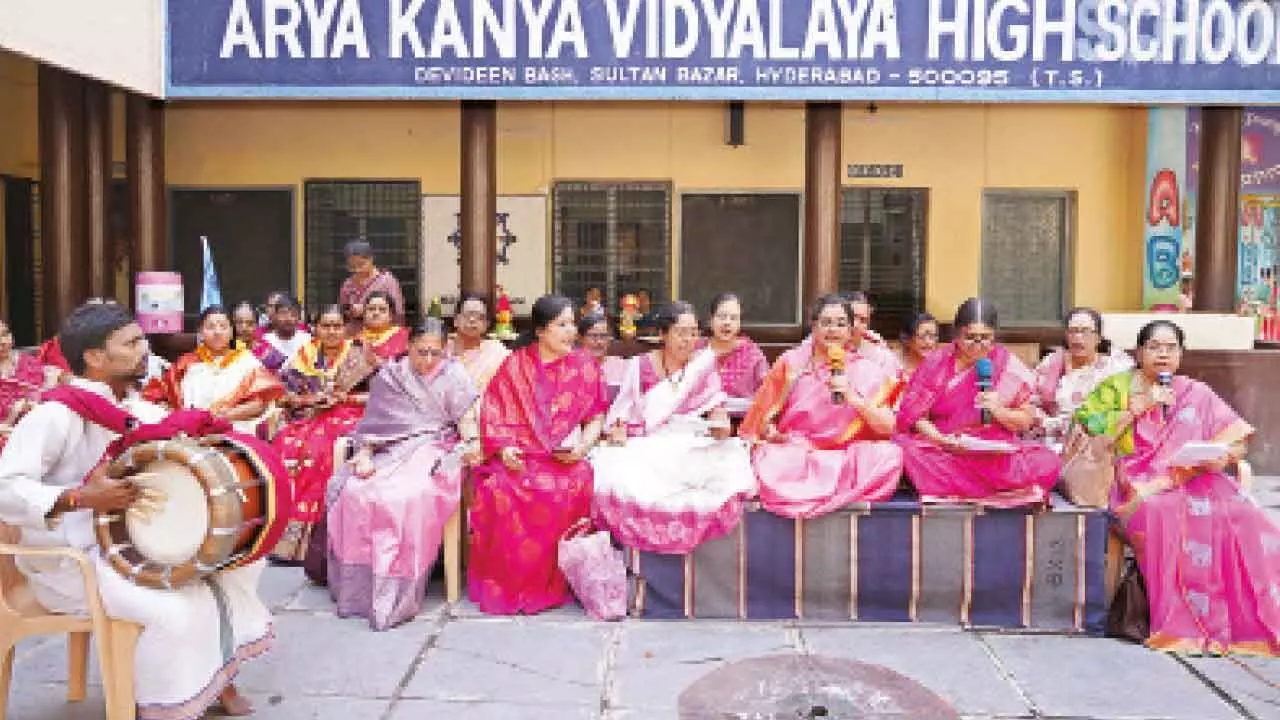
Carnatic musicians performed a variety of compositions on Lord Rama by vaggeyakaras from different centuries
This programme was all about taking music to the people. On a delightfully warm, winter morning, at Aryakanya High School, Hyderabad, a classical-music programme featuring compositions on Lord Rama by different vaggeyakaras (musicians who compose both the words or lyric and also set it to music) from across several centuries was presented to the audience. The concert was melodious and educative too as it was interspersed with commentary on the background and context of each composition. Interestingly, for percussion accompaniment, there was a thavil artiste instead of the customary mridangam player.
From music connoisseurs and fellow performing musicians to curious members of the public and schoolchildren, a fairly large crowd attended the concert. In the second half, there was another cultural programme, namely a lively Bathukamma song and dance in which many women participated with enthusiasm.
The lead performer of the classical-music concert was Carnatic musician and vocalist Dr Y. Ramaprabha, Founder, Sammohana School for Vocal Music. Accompanying her was her colleague, Neyveli Gnanambal Ramanathan. Also performing along with them were vocalists Sesikala, Jayaprada, Anantha Lakshmi, Suwarna, Sarada Adhikarla, T. Kamalakumari, Lakshmi Kurnala, Ramasudha, Sasikala Kidombi, and M. Padmapriya. For percussive support, they were accompanied on the thavil by S. Seshadri.
The programme was held by Sri Sathya Sai Seva Samithi, Koti, Hyderabad, as part of the larger, nationwide Ratha Yatra titled Sri Sathya Sai Prema Pravahini, an event organised by the Sri Sathya Sai Seva Organisations (SSSSO), founded by spiritual leader and philanthropist Sathya Sai Baba.
But why music one may ask as did a few curious audience members? This is because promotion of classical music has always been an integral part of the activities of the SSSSO, though undoubtedly, the focus has been charitable missions like providing free medical-aid to millions of patients so far through two world-class super-speciality hospitals, general hospitals, and additionally regular medical camps across India and in over 100 countries; subsidised, high-quality education to lakhs of students so far; and clean drinking water benefitting millions. In fact, icons and countless legends of Indian music including Bharat Ratnas, Padma Vibhushan and Padma Bhushan awardees like Pandit Ravi Shankar, MS Subbulakshmi, Pandit Jasraj, Mandolin Srinivas, etc., have performed before the spiritual guru Sathya Sai Baba, considering it a privilege to do so.
This morning concert featured multiple compositions all dedicated to Lord Rama. In fact, this God and stories from the Ramayana have been a favourite with many south-Indian classical music composers through the centuries as also performances by classical dancers from Bharatanatyam, Kuchipudi, Kathakali and so on.
The concert commenced with Namostute Raghunayaka (Naatta ragam, Adi thalam) composed by Tumu Narasimha Dasu. This was preceded by an invocatory shlokam. The rendition of the keerthana was melodious and the group of singers were in good synchronisation with each other in this composition and the items that followed. Then came Appa Ramappa (Arabhi ragam, Adi thalam) composed by Rakamcherla Venkatadasu, who has an interesting Chilkur Balaji temple connection. How can there be a concert in the city which does not showcase vaggeyakara Tallapaka Annamacharya, the Padakavitapitamaha credited with a staggering 32,000 keerthanas? So, his composition followed, the well-known Ramachandruditadu Raghuveerudu (Jujavanti ragam, Adi thalam thrisra gathi).
Among Bhadrachala Ramadasu’s best-known compositions is Takkuvemi Manaku, Ramundokkadundu Varaku (Sowrashtra ragam, Adi thalam) in which he says as long as one has God (Rama) on one’s side, one need not fear anyone or anything or feel any sense of inadequacy. The composition’s various charanams describe the 10 avatars of Lord Vishnu which is why it is also a popular choice with some Kuchipudi dance performances. This was followed by a brisk rendition of another Bhadrachala Ramadasu composition Kodanda Rama, Kodanda Rama (Saranga ragam, thrisra gathi) in which the audience was invited to join in. S. Seshadri provided competent and energetic support on the thavil in this concert.
The audience clearly enjoyed the programme, joining in the singing towards the end while eager schoolchildren too nodded their heads to the music. The reaction of the audience was summed by P Visweswara Sastry, the Koti Samiti Convenor and event-organiser who said: “Everyone enjoyed the shower of melody and devotion that was presented this morning through music and dance.”
The dance happened very soon as the concert was followed by a lively Bathukamma celebration led by Dasa Vani, leader of the Skill Development Centre which imparts vocational skills to underprivileged women. The Bathukamma Panduga is a unique heritage of Telangana and one of India’s most colourful floral festivals. Here, colourful, seasonal flowers, often with herbal properties are arranged in temple gopuram shape and placed in the centre. Around this, women dance and sing thematic songs as happened with much energy and joy in the event. The programme concluded with the customary Mangala Harathi and distribution of sweets.