A thorough checklist helps perform tasks without hiccups

The need to ensure that the requisite level of preparedness precedes any important task. The job is broken down into small sequential steps that have to be followed meticulously. The confidence and assurance that result from making a checklist has been complete and comprehensive. It helps in achieving the objectives. Some examples of such an exercise are the procedures followed by pilots of aircraft, before taking off and landing, and the steps followed by surgeons before an operation and prior to its completion
Running through a checklist is nothing new today for professionals such as a pilot about to start a flight or a surgeon beginning an operation. Historically, however, few institutions have valued the importance of established protocols and standard operating procedures so much as the armed forces.
A story probably apocryphal, concerning the legendary first Indian Chief of Army Staff and also the first Field Marshal, General K M Cariappa, and his deputy and sixth chief of army staff, General K S Thimayya, illustrates this point in a rather lighter vein.
General Thimayya had an appointment with his Chief for a drink at 7 pm on a given day. That the two were cousins obviously had no bearing on the formality attached to the occasion and the rigour of protocol. Thimayya spent a whole week – assiduously polishing the brass, shining the shoes and ironing the uniform. The distance to the Chief’s house was measured, as was the travel time.
On the appointed day, Thimmayya arrived, as planned, a few minutes in advance at the entrance to the Chief’s house. He waited till the time was right, drove in, stepped out of the car and executed a perfect salute, and said, “Good evening, Sir!”
General Cariappa’s response was, “Timmy, where is your cap?”
Apparently, so absorbed he was that in the thoroughness of the preparation, General Thimayya had forgotten to sport the most important item of his uniform-the cap!
Ever since then rose the need to ensure that the requisite level of preparedness precedes any important task. The job is broken down into small sequential steps that have to be followed meticulously. The confidence and assurance that result from making a checklist has been complete and comprehensive. It helps in achieving the objectives.
Some examples of such an exercise are the procedures followed by pilots of aircraft, before taking off and landing, and the steps followed by surgeons before an operation and prior to its completion.
After selection to the IAS, I was asked by the Union Public Service Commission (UPSC) to undergo a medical examination – normally a mere formality. I had no known ailment (except perhaps hypochondria!) and did not anticipate any problem. My brother-in-law Sitaram Yechury, (who at that time was serving in the Union Ministry of Health), accompanied me. His presence was not objected to (as it should have been!) as he carried with him the health ministry credentials.
After the usual run of tests, I had to undergo an ophthalmic examination, a part of which was recognition of different colours. I was shown a book whose pages had pictures of objects with outlines in spots of different colours. The pictures would appear sharply, if one was able to distinguish the dots of different colours. I simply could not make them out. I was told later that this might have partly been on account of nervousness caused by the occasion, particularly after I had been alerted to the possibility of my having a condition. No matter how hard I tried, the pictures swam in a blur in front of my eyes. Sensing my difficulty, the technician proceeded to conduct another test with a machine that flashed blue and green lights alternately. Once again, the blue colour looked green to me and vice-versa.
My nervousness grew as the possibility of not being selected dawned on me for the first time. What would my father think! It was he who was none too happy with my performance at the viva voce. Was his dream, to see me as a civil servant, set to be dashed to the ground merely on account of some silly defect in my vision? And he had just recently suffered a heart attack. Many events of the past flashed across my mind as I continued to make mistakes in chromatic cognition.
My brother-in-law promptly got into the act. He began to cross examine the technician with a barrage of questions. What method was being used, he asked, was it entirely objective? If not, how could the technician tell when I was making a mistake? Did it matter at all that I could not make out colours when, after all, I was not going to be a railway guard or a traffic constable?! The first seeds of doubt were successfully sown in the mind of the technician. By that time I too had settled down a bit and, when some of the tests were repeated, I was able to fare somewhat better.
“See? What did I tell you?” exclaimed Yechury and argued that my own shakiness, a faulty methodology or a defective protocol in the examination, or a combination of these factors may have led to an unnecessary doubt being created about my vision.
Partly uncertain by now about the initial opinion he had formed and partly because of the hurry in which he was on account of the large number of candidates still to be examined, the technician decided that it was not really worth pursuing the matter. I was declared fit and walked out mopping sweat off my brow.
But for my brother-in-law’s timely (perhaps somewhat unwarranted!) intervention, it is possible that I could have been disqualified on grounds of defective colour vision.
Clearly, the technician had, no doubt, clearly laid out a checklist of tests prescribed for his duty. But, then, though it was sound and normally adequate for the task to be performed, it could not withstand the piercing cross examination, which it was subjected to by Yechury!
As a matter of fact, I should have become aware of the defect several years back. I recall how, as an undergraduate student in Hindu College, Delhi, I was performing a titration experiment in chemistry. When one fluid was added to another, drop by drop, the idea was to stop when the mixture turned pink. I continued to add the drops until Dr Mehra, our chemistry lecturer, rushed down from the dais of the laboratory, on which he was sitting, shouting, “Mohan, please stop. It has gone from pink to purple, and now is about to turn black!”
Truth to tell, for many years after the UPSC test, whenever I was driving a car, I needed someone sitting next to me in the front seat, to alert me when the green was changing to red and red to green, so that I knew I would know whether to stop or start!
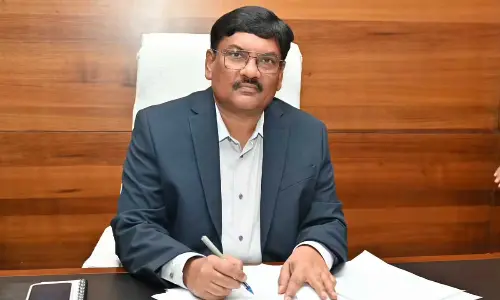
(The writer was formerly Chief Secretary, Government of Andhra Pradesh)