Constituent Assembly and the British Influence

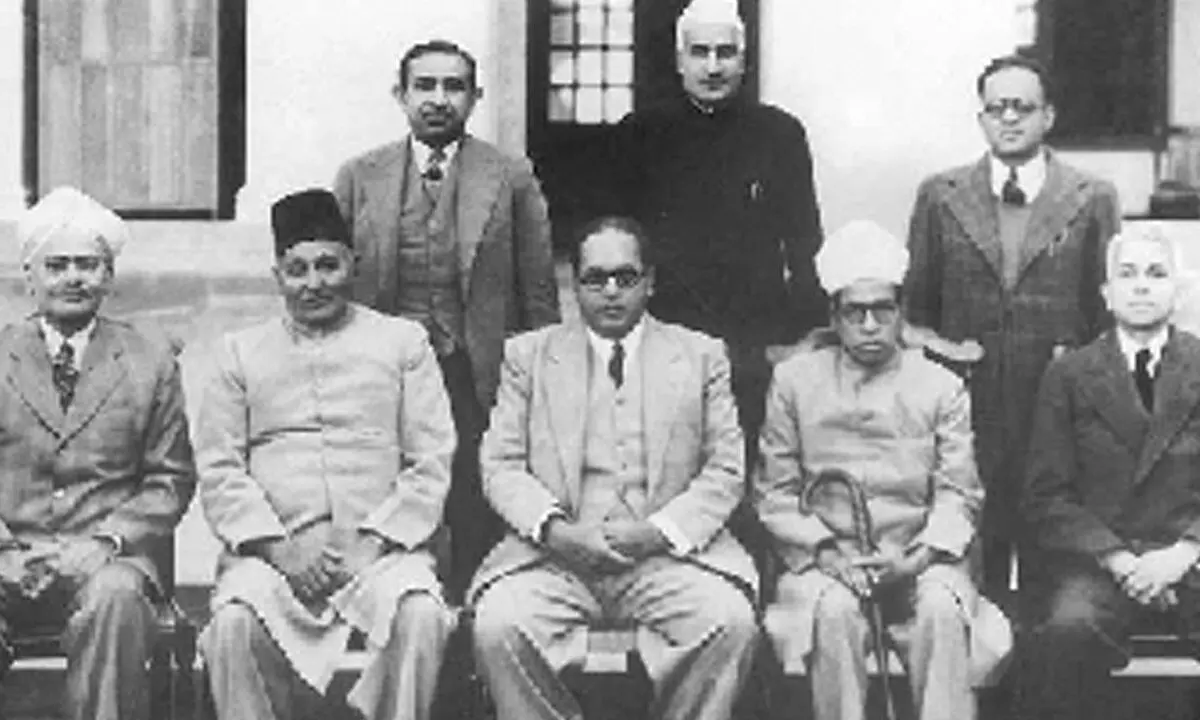
As the Vice-President of the Viceroy’s Executive Council (equivalent to the position of a Prime Minister) from September 1946, Jawaharlal Nehru played a pivotal role in steering the Constitution’s formation. On December 13, 1946, while moving the aims and objects resolution, Nehru acknowledged the British influence on the process: “The British Government has a hand in [the Constituent Assembly’s] birth. They have attached certain conditions. We accepted the State Paper … and we shall endeavour to work within its limits.”
Though this statement highlights the constraints under which the Assembly operated, it conceals the “understanding” between the Congress led by him and the British.
Rau’s appointment as Constitutional Adviser, likely influenced by his Cambridge education and connection with Nehru, facilitated the creation of a draft that aligned with British preferences to frame the Constitution that maintained continuity with colonial frameworks and thereby perpetuated British legacy. Nehru’s role as a political intermediary was crucial in balancing Indian aspirations with British demands, raising questions about whether his actions were driven by pragmatism or a desire to secure political power for himself, especially given his appointment as the Vice-president before independence.
Pseudo-secularism and
minority appeasement:
Nehru’s vision of secularism, shared by Patel and others, prioritizes religious minorities like Muslims and Christians, often to the disadvantage of the Hindu majority, and is reflected in Articles 25–30 of the Constitution. These provisions grant minorities rights to establish and manage educational institutions, preserve their cultural practices, and expand their religious demography, while similar protections are denied to Hindus. Damodar Swarup Seth’s 1948 critique in the Constituent Assembly argued that recognizing religious minorities as distinct entities undermined the very idea of secularism and national unity, potentially sowing the seeds of another partition. This Nehruvian framework of minority appeasement, continued by both pseudo-secular and pseudo-Hindutva parties instead of equal treatment for all, has sparked resentment about its impact on India’s social cohesion.
Emergence of the Ambedkar-centric narrative:
The narrative attributing the Indian Constitution to Dr B R Ambedkar emerged from a confluence of historical, social, political, and Christian missionary factors. To deflect criticism of the Constituent Assembly’s unrepresentative nature and protect Nehru’s minority-centric secularism, Congress leaders, including Nehru, allowed the factoidal narrative of a “Dalit-architected Constitution” to take shape. This framing served to shield the Constitution from scrutiny and silence critics by invoking Ambedkar’s identity as a Dalit leader and symbol of social justice.
Ambedkar’s visibility in Assembly debates, coupled with his role as Minister for Law and Justice, made him a natural focal point for this narrative. The Ambedkarite movement, which gained momentum after his 1956 conversion to Buddhism, further promoted this narrative to inspire Dalit pride and empowerment. The emotional resonance of a Dalit shaping India’s democratic framework amplified his symbolic importance, often at the expense of recognising Rau’s technical contributions or Nehru’s political leadership.
The mischievous misnaming of the “Committee to Scrutinize Draft Constitution” as the “Drafting Committee” contributed to the misconception that Ambedkar authored the Constitution. Rau, a bureaucrat without a political constituency, and Nehru, already a towering figure in Indian politics, received less public recognition, allowing the Ambedkar-centric narrative to dominate. Political strategies aimed at wooing Scheduled Castes (SCs) and Scheduled Tribes (STs) further reinforced this narrative through statues of Ambedkar holding the Constitution, roads, colonies, public buildings, spaces, and educational institutions named after him, and media portrayals, such as the 2000 biopic Dr. Babasaheb Ambedkar, which cemented his image as the Constitution’s sole architect and drafter. The narrative’s alignment with Dalit empowerment goals further entrenched its dominance.
Judicial reinforcement
of the narrative:
The Indian judiciary has played a significant role in perpetuating the Ambedkar-centric narrative. Statues of Ambedkar holding the Constitution, installed in the Supreme Court (1980) and some High Courts, symbolize his perceived role as the Constitution’s architect. The 2025 Gwalior Bench of Madhya Pradesh High Court controversy, where lawyers clashed over an Ambedkar statue, underscores the narrative’s emotional and political weight. A registrar’s order on April 21, 2025, justified the statue by citing Supreme Court precedent and Ambedkar’s role as the “maker,” despite historical evidence to the contrary.
Judicial pronouncements, such as Indra Sawhney v. Union of India (1992) and Ashoka Kumar Thakur v. Union of India (2008), frequently invoke Ambedkar’s vision. Constitution Day speeches by Chief Justices often describe him as the “architect,” reflecting cultural reverence rather than historical accuracy. Judicial training, focusing on case law rather than historical scholarship, and the inaccessibility of primary sources, like Rau’s papers or Ambedkar’s 1953 Rajya Sabha speech, perpetuate reliance on secondary narratives. The judiciary has reinforced a socio-political context making Ambedkar’s legacy sacrosanct, particularly among SCs and STs. Questioning his role risks accusations of casteism, discouraging judges and scholars from challenging the narrative. Political promotion by Ambedkarite groups and government initiatives, such as Ambedkar Jayanti, amplifies this perception, as seen in the Gwalior controversy, where opposition to the statue was perceived as disrespect.
Christian missionaries
and Article 25:
Christian missionaries have leveraged Ambedkar’s prominence to promote conversions among SCs and STs, mistakenly attributing Article 25’s right to “propagate” religion to him. This provision was crafted by the Committee on Fundamental Rights, headed by Sardar Patel. Ambedkar’s brief engagement with Christianity in the 1930s aligned with the missionaries’ social reform agenda, but his 1956 conversion to Buddhism explicitly rejected Christianity’s foreign ties. Nevertheless, missionaries continued to highlight his constitutional role to appeal to Dalits, reinforcing the Ambedkar-centric narrative for their own purposes.
Restoring truth vis-à-vis
Ambedkar-centric narrative:
India’s national motto, Satyameva Jayate—truth alone triumphs—etched at the base of the national emblem, demands unwavering commitment to historical accuracy. Yet, the pervasive narrative that B.R. Ambedkar was the sole architect of the Indian Constitution betrays this principle, perpetuating a myth that overshadows the collaborative efforts of B.N. Rau, Jawaharlal Nehru, and the 299 members of the Constituent Assembly.
To honour the Upanishadic ideal and align public and judicial understanding with historical reality, a concerted effort to restore balance is imperative. Legal curricula must be reformed to emphasise the Constitution’s collective genesis, correcting the misleading term “Drafting Committee” and highlighting Rau’s foundational draft and Nehru’s pivotal role in shaping its framework under British oversight.
Primary sources, including the Constituent Assembly Debates, Rau’s papers, Nehru’s Aims and Objects Resolution, and Ambedkar’s 1953 Rajya Sabha speech—where he rejected sole authorship as a “hack”—should be integrated into educational programs to foster a nuanced perspective. Archival accessibility must be prioritized to empower scholars, students, and the public with evidence-based insights.
The judiciary, too, must uphold truth by avoiding rhetorical claims of Ambedkar as the sole architect, acknowledging the collaborative process in judgments and speeches. By embracing Satyameva Jayate, India can dismantle this false narrative, honouring all contributors to its constitutional legacy and reaffirming its commitment to truth over myth.
(The writer is a retired IPS officer and former Director of CBI. Views are personal)