From Mahatma to Ram: A move in tune with changing times

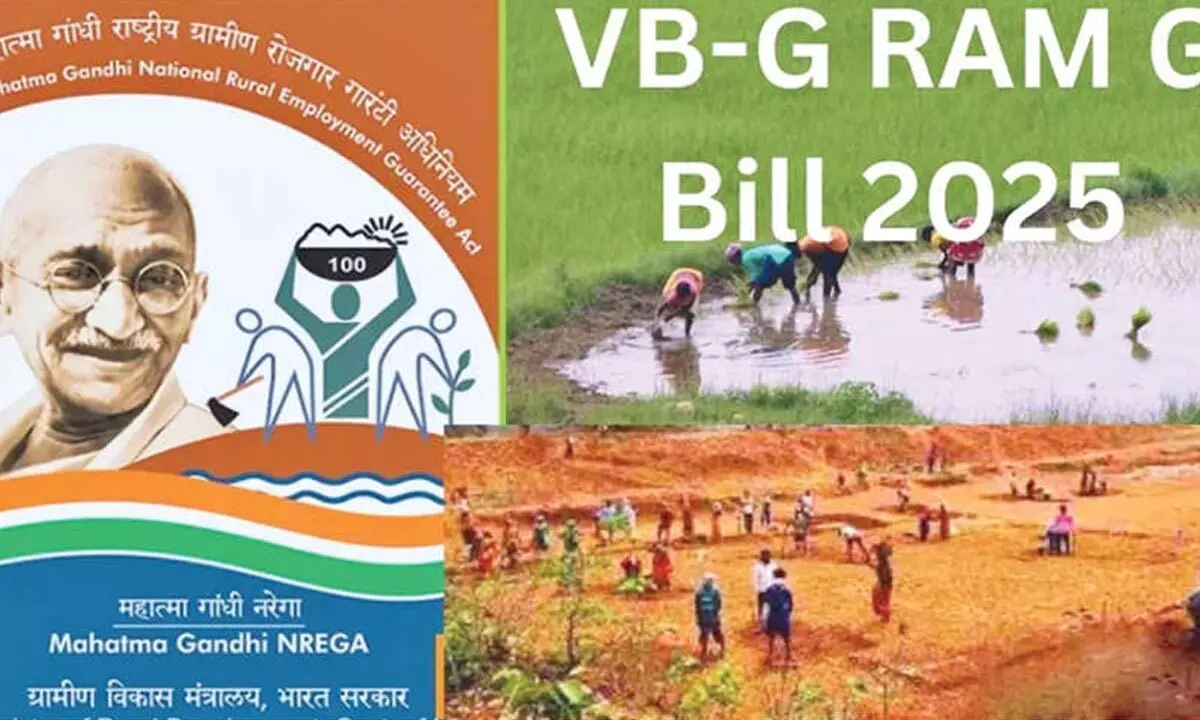
MahatmaGandhi National Rural Employment Guarantee Act of 2005 was in implementation for the last 20 years. As a flagship Indian rural employment programme it has been one of the world’s largest public works programme with a total expenditure of around 11.75 lakh crore in the last 20 years of its existence creating 4872 crore person days.
It has played a significant role in holding up the wage rate in rural areas, preventing migration to urban areas and in creation of durable assets in the rural areas. After the NDA government came to power in 2014-15 recognising its importance they not only continued with the scheme but also enhanced the allocations under the scheme between 2014-15 till date resulting in expenditure of Rs 7 to 8 lakh crore creating approximately 3209 crores person days.In fact 65 per cent of expenditure and employment generation under the scheme has occured in the last one decade of NDA rule. It is now proposed to replace the above scheme with a new scheme named as VB-G RAM G.
Any scheme which is under implementation for over two decades needs a review to bring it in tune with changing times and changing circumstances. The new Act proposes to do the same. The new Act which has been passed by the Parliament increases the work days per annum from 100 to 125 days while bringing in a holiday for the scheme for above two months at the time of the peak agriculture operations.
This way it tries to reconcile the interests of agriculture labour with that of the farmers. It also separately recognises special category job-seekers and has a Special Grameena Rozgar Guarantee Card for them as specified id schedule – II. While the earlier scheme was 90per cent funded Central Government the present scheme envisages 60 per cent funding by Government of India and the rest by the State Government.
In all industrialised countries as the economy progressed, there was a shift of labour from agricultural sector to the manufacturing and service sector. This is the right way of ensuring income of the labour is enhanced by creating employment opportunities in the manufacturing and tertiary sector. But in India it happened but not yet at the desired level. In 1947 in India 70-75 per cent of the workforce was dependent on agriculture. By 2025-26 this has come down to 45 per cent but still it is substantially high compared to developed countries where it ranges from 1 per cent to 5 per cent. More so, when agriculture as a percentage of GDP is coming down sharply.
In 1947 share of agriculture in GDP was around 54 per cent and has come down sharply to 18 per cent by 2025. Hence with lesser share in GDP agriculture still employs proportionately more labour force .The long term solution for this problem is facilitating transfer of labour from agriculture to manufacturing and tertiary sector to improve their income.
A program like MGNREGA or the new RAM G can only be a cushion, facilitating this transition. This cannot happen unless large scale skill upgradation is done to make labour employable in the manufacturing and tertiary sector. There is a need for taking up large scale skill upgradation program to achieve this objective. Government of India has to concentrate on large scale demand driven skilling programs for the rural agriculture labour and this should be a major mission-mode programme to be taken up in addition to employment generation through RAM G programme. This is the only way for better prosperity .
An attempt is made in the new Act to reconcile the interests of agricultural labour and farmers which is welcome. This is a long standing grievance from the farming class attributing labour shortages during peak agricultural seasons like harvesting and sowing . However where harvesting is now taken over by machines this need not be an issue. instead of blanket fixed holiday of 60 days for the programme It would be better to leave this to local Gram Panchayats to implement with flexibility depending upon the local cropping pattern and other valid reasons restricting it to not more than 60 days .
MGNREGA used to be a 90 per cent funded by Centre and to the extent was not constrained by fiscal problems of the states in the implementation That is one of the reasons for its success in the last two decades. Now it has been converted as a centrally sponsored scheme 60:40 ratio between Government of India and State Governments. There are possibilities of the scheme getting struck in certain States where the matching grant could not be provided by the concerned States. This problem is already being experienced with reference to a number of Centrally sponsored schemes and this may be no different from them.
The normal procedure in centrally- sponsored schemes is that if the state government does not provide the matching contribution the next instalment is withheld. If the same system is followed here it can result in the program getting derailed. Number of state governments are facing financial problems. Scheme can get derailed in number of states due to non provision of State share. Political backlash will come to Centre as this is a major scheme till now fully funded by Centre. Hence Centre has to devise a way of implementing the scheme to the extent allocated to the states even when states share is not coming forward.
MGNREA has been a very successful programme and has played an important part in stabilizing rural wage rate and to an extent preventing migration from rural areas to urban areas in the last two decades .with an allocation of 86000 crore it was the biggest rural welfare programmes during 2024-25 followed by rural drinking water mission .If central government maintains same allocation and states are able to match their contribution under the new Act it can have an even bigger impact .
But most of the States have serious fiscal problems with funds already commited to freebie schemes. Hence most of them may have problems in providing matching share. States withgreater fiscal space may benefit more out of this new funding norms . That can result in uneven pattern of implementation of the programme.
(The writer is former Chief Secretary, Government of Andhra Pradesh)